• The move to the new server is done. There are some software and database maintenance updates in process. This has us passing the hat around to help out. We appreciate any donations. Seriously, even a dollar helps. The payment page may be found here - https://www.audiokarma.org/support.html

Random loud pop sound on left channel Pioneer A-9

allanmatters

Active Member
Hello to all fellow audiokarma folks.

Yes it's another pop discussion. I know there's dozens of these issues here in this forum as well as others . Read through all still looking . System is a pioneer A-9

I decided to test the system . So for now its kept open for days . I sit with the system for at least 3-4 hours trying to find the issue . . I have wiggled twisted all PCB boards to get the source of the random pop sound .

Before that let me tell you that the system has been repaired in the year 2014 . The left side output transistors have been changed as well as many others on the equalizer board by a technician. It was was working fine until the end of 2017 . It started with random loud pop sound s which could occur at any time . And can definitely give you a fright. (It's really annoying) I even shared a link to a video I shot of it .

So the pops can come at any time . Sometimes when you ON the system after about 10 seconds . It's will pop a couple of time s and then maybe every 45mins or every 2 hours . Sometimes it never pops too . I checked the power amp board . Wiggled wires transistors resistors there. All solder joints are fine clean stiff. I still have to check the equalizer board (The board which has all audio inputs.) I even tested it with the speaker A and B buttons in the off position . Though no sound ,you can see the left VU meter jump. Which means it's still popping. So I guess the speaker relays are fine too

I have checked the bass control and treble control board . all fine . I still need to understand how to get access to the balance tone board .. I did keep the system exposed for about 3 and a half years . When I say exposed . I mean no cloth to cover it . No wooden cabinet etc. So eventually allot of dust has got into it . Since it was kept down stairs at the ground floor there's more chances of dust going into it .. I checked all switches and bass treble knobs power switch and balance knob as well . All those are fine (no pop sounds on adjusting them). It's seems purely random sometimes at any unexpected time . On big speakers the pop sound is so loud I feel like smacking it cause it's gives u a real fright .

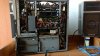
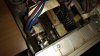
Now its on test mode with small speakers connected so I don't get bugged with the loudness of the pop sound . Here are some photos
Do note that in the video it may look like adjusting the volume leads to the pop. But that is not the case .In fact I just switched on my system as i am writing this ,it popped after 1 min being in the on position. And it's popped on every 2 mins . And now it will probably pop later after 30 mins or any random time .
So this pop is clearly a random one . What should I look at next ?
 

Attachments
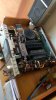
  • IMG_20180328_165330782.jpg
    IMG_20180328_165330782.jpg
    51.3 KB · Views: 15
  • IMG_20180328_125100155.jpg
    IMG_20180328_125100155.jpg
    79.9 KB · Views: 16
  • IMG_20180328_125024107.jpg
    IMG_20180328_125024107.jpg
    102.7 KB · Views: 16
Last edited:
Register to hide this ad
I have a feeling it's the ceramic resistors on the power amp board near the output transistors. They are sort of white rectangular cement block . There's seems to be 2 of them on the left channel PCB but they seem split sort of ( like a pair connected together and another pair connected together). I guess the technician has put equivalents cause they don't look similar in shape to the OEM on the right channel PCB.

The original ones on the right PCB is not in pairs . It's just one and one .

I even tested the system on idle mode and the pop comes after a good 10 mins . .

It's hard to explain what type of ceramic resistors the tech used . It's like one pair connected together between them is a wire from the inside of the resistor which is bridged to the next one sort of sticking to each other (that s how one pair is ) . Similarly the other pair . Their bodies are also touching the PCB . I thought ceramic ones should be away from the PCB .

I managed to get the value . Rank 3W 0E47 5% . That s the equivalent he used .

Can't seem to find that or a closer match in the user manual parts list

Also on idle mode the left channel heat sink is a little warm .just little . The right is cool like cool .
 
need to do a little more research...the A9 is a amp only version of the sx9 and these are meaty machines with some seriously packed in guts.

just because the resistors look different does not mean they cannot be used.

you could have something on the input path going noisy. first check the dc offset at the speaker terminals (no volume, no signal) and if you have the ability, check the dc power supply voltages, there are I think 5 you need to look at, my own sx9 has been on its side for years while I make excuses to delay fixing the power supply because my voltages were not rock solid. if the PO had outputs replaced, something went bang inside and not everything might be fixed.

and if you are REALLY froggy, see if you can set the idle current, but due to the packing, its something you dont wanna slip a probe on
 
random pops are often a transistor gone bad and can be found with freeze spray and gentle heat . most likely around the input differential area .
 
True true it is a meaty one indeed @quaddriver . I will look into the following you have told me, carefully of course. The pops now even come immediately on cold start . And eventually after a few mins again .

@petehall347 when you say differential areas you mean the output transistors on the power amp board right ?
 
the differential inputs are 5 legged transistors on the amp board. (2SA798) the service manual is on hifi-e and mebbe here( have not looked yet)

get it and read it over carefully because any and all replacement of parts, well, 'some disassembly required'
 
Thanks I was just reading the manual . I did come across those 5 legged transistors. Just trying to differentiate on preamp board . Don't know where it is . Still reading . It's more easier to locate the pre amp board on the a-7 . This one however the a-9 is a bit complex
 
Alright got it . It's on the equalizer board . I am however going to remove the equalizer board though and look at it thoroughly for any sign s of lose solder

The differential input transistors I found in the equalizer board are s2291 and 2259 pairs
 
you are right, and FWIW, the manual scan here is better than the one on hifi-e.

there are a lot of candidates for the pop, this is way more complex than the sx9 amp. it does it equally on any input such that you can rule out in the phono section and defeat tone to rule that out as well?
 
I don't have a TT so can't really check through that input if that's what your saying . Oh that wonderful . A cleaner copy here on audiokarma ? I've been reading through the manual I got for hifi engine for quite sometime now . Thanks for letting me know about the one here too .

There is something I'd like to bring up though . The bass and treble control have their own independent board . As well at the balance control board and record source selector . These two boards are side by side . It's is a mystery only these two boards are dirty AND OILY . The whole board with the things attached to it . There seems to be no signs of leakage from any capacitors .

The other boards in the amp are dirty too like black dirty cause I didn't keep it covered I guess for 3 years . But these two independent boards which I described are dirty and greasy . I wonder why so greasy . Makes it look impossible to clean
 
Last edited:
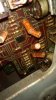
Here are some pics . If u look closely u can see the shiny greasy stuff along with usual dust . It's sort of dry and greasy or oily should I say
 

Attachments

  • IMG_20180329_214505257.jpg
    IMG_20180329_214505257.jpg
    64.5 KB · Views: 27
  • IMG_20180329_214513535.jpg
    IMG_20180329_214513535.jpg
    68.3 KB · Views: 26
  • IMG_20180329_214529487.jpg
    IMG_20180329_214529487.jpg
    55.4 KB · Views: 26
I have tried using the " line straight option " . When that button is switched on the bass treble and balance can't be used as it becomes direct sound . Still the pop comes even with the line straight option on
 
ok, if the phono selection is not made, and its straight line, then it rules out a ton of stuff.

I have never worked this topology before so I might study the SCM.

there are many op amps used as dc servos in there to keep offset down, and its a 2 step bias setting, Im still curious if you have zero or close to it offset and if the bias is stable.

the paired inputs and mirrors are likely subable with discreet units, but the dual FETs...you might need to ask MTF if they are the problem
 
The thing is I know my memory is good . Cause when I purchased this unit from the owner back in 2013 I did open it as soon as I came home to check on the insides . I liked it . It was clean almost every where . When it had stopped working on the left channel (as output transistors blew cause of fluctuating current ) I gave it to a tech to fix plus I had then purchased a stabilizer just Incase the current fluctuate s again . This was back in 2014 . I was not home back then so I couldn't open and inspect the set. I was outstationed in a different country for a new contract .

I am back home now for the past 6 months .
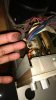
Now I have noticed on the left side front inside where the bass treble balance control board's are it's dirty AS WELL AS OILY . The entire PCB there only is Oily like something accidentally split on it . I even took a pic of it . It reminds me of the dirty black greasy stuff in automobiles as i used to get my hand s often dirty when fixing something near my cars engine . It smells like oil . I am curious to know what happened there not that it's gonna give me satisfaction finding the person who did it . I feel it happened at the technician s shop. Something accidentally fell on those boards. Even the ground space under those boards is Oily oily black dirt mixed . All the capacitor s and diodes and switches and knobs there are covered with it . Do you think that could have seeped in ? And causing this issue ?
 

Attachments

  • IMG_20180330_222811462.jpg
    IMG_20180330_222811462.jpg
    36.3 KB · Views: 12
So there are 3 boards . First board for the bass treble control . Another for the balance and record out selector . And the 3rd PCB which has all the loudness buttons mono line straight etc . I can manage taking it out and cleaning . I did some cleaning on the tips of the capacitor s but I think disconnecting then and cleaning the boards will be more effective . I made a video based in this too . I had early suspected this was the cause of the loud pop . The bass control tone in the PCB .this is manually causing the pop and it's not as loud as the pop when it occurs on its own . When the pop occurs randomly with no physical touching on the system , it's wY loud . Like the vu meter on the left goes all the way up . So all that oil may habe seeped in the tone control s and switches over the past 3 years along with dust .

Not sure if that's the cause. I don't mind dismantling and desoldering those boards so I can clean them good . What do y'all think ? Worth the effort ?
 
Last edited:
Never mind. I think I found it . SPEAKER RELAY. I was browsing through different forums trying to find out what else could cause a static pop . So I came across this thread on a forum here
http://forums.stevehoffman.tv/threads/help-noise-problem-on-vintage-pioneer-receiver.124853/

So I switched the speaker set A off and connected my speakers to the speaker set B at the back of the amplifier. I switched off the speaker A and only running the speaker set B .
The entire day I tested the system. I ran the unit for 2 hours and then kept it off for two hours to cool . I kept repeating the process . Not a single static pop compared to all the other days . I also cooled the system by moving it to a cooler room with the air-conditioner ON for about 1 to 2 hours . Then shifted it back into the warm room and powered up the amp . Since I don't have a freeze spray to suspect if it is a thermal heating issue on some faulty transistors.

I hope this is the issue (the relay of the speaker A) I never thought of switching the speakers to set B . It may be too early to conclude this because over night the system will cool down more ( a good 9 hours uninterrupted OFF mode )and morning results can tell me if that was the cause or not . Usually I get fresh pops in the morning

I also read allot about how speaker relays get bad over time . That is when the volume is cranked up and you suddenly switch off the system while the volume is at moderate level or higher . This happens to me most of the time as we have power cuts here which come in for 10mins at anytime maybe and then resume back to normal . My home battery is big but not stable enough to keep the pioneer A-9 ON even with a stabilizer connected to it or without the stabilizer.. It struggles to stay on even on idle mode with the battery power .

So based on this I feel convinced my speakers relay for A is gone bad due to he amount of times the system has shut down due to no electricity suddenly because of a power cut and also while the volume is at 30% or 40% or even 70% .Based on this I feel convinced that it was one of the reasons of the pop sound .

It maybe too early but I will test this for weeks and the make a final conclusion.
 
Last edited:
Back
Top Bottom