Hi Brice, they sound great,I let them burn in about a week, and I’ve been rolling tubes to find the sound I like. I’ve tried tungsols, and gold lions for the power tubes, GEs, RCA,Sylvanias for the rectifiers, and Sylvania, ge, raetheon, rcas on the small tubes. So far I like the Tungsol 6550s, Sylvania 5y4gas , and some old Sylvanias 12av7, and 6ab4.. I’ve been listening to Fisher L200a’s, and I’m thinking I’m just more accustomed to the sound of the EL34. The only other KT88 amp I have is a Citation 2, but I have not listened to it for years. Either way the Fairchilds sound awesome!Outstanding.
How do you find the sound?


You are using an out of date browser. It may not display this or other websites correctly.
You should upgrade or use an alternative browser.
You should upgrade or use an alternative browser.
Rare Beauty: Fairchild's 275 Amplifier
- Thread starter dcgillespie
- Start date

radioactive
tube gear fanatic
What cap?Hey guys, can anyone tell me who the manufacturer of this cap is, tried IC, Mallory, and 1 or 2others with yellow jackets, but no real match. Any help appreciated Thanks
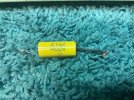

Looks like something is printed under the yellow wrap. Have you removed it to see?


yes they are . I love 6550 and KT-88 p/p amps never heard a set like yours. happy music time for fact.I have no idea why the pics won't enlarge, I've never had that happen before. But I'm re-posting them here again in the same order as before to see if that works. I apologize for the hassle:
Below: Yeah, let the drooling begin!
View attachment 1822147
Below: I was going to tell the client that they were both junk, but I think I need to come up with a better story....... (black mark above the right rectifier tube of right unit is from some previous Duct Tape affair, but comes off easily enough)
View attachment 1822149
Below: The undersides are a different story.....
View attachment 1822150
And:
View attachment 1822153
Below: But look a little closer at those new bias caps that were installed! Whoops........
View attachment 1822156
And yet again..... (The ends you can't see are twisted together and grounded)
View attachment 1822158
Below: I know. Tacky, tacky, tacky. But it did ultimately allow this unit to be rousted out of its slumber, and develop 60 watts RMS at 1 kHz from a 122 vac line, with the power transformer voltage tap set on 125 vac, using 6550C tubes. Bias and Balance controls were set to Fairchild specs. Amazing that those wax Good-All caps weren't leaking, as it biased and balanced easily -- although it wasn't really on long enough to find out if they were going to.......
View attachment 1822160
Edit: The text for each pic has now been brought down as well so you can have an idea of what the pic is showing.

Amplified Parts sells those as generic polyester film caps. I have no idea who makes them. They've been around for ages in that weird, no source marking form.oops..
Whether the Fairchild draws from other designs, or other designs draw from the Fairchild, who knows -- but the prize for having a cathodyne phase inverter directly drive a pair of UL connected 6550 output tubes would seem to go to Fairchild. Dynaco had already been driving EL34s that way in their MK II model, but 6550 tubes require notably more drive voltage, and at lower impedance levels. I know of no other design doing this right out of the gate with the 6550 when it was first made available. And, like the Dynaco design, the inverter is direct coupled from the previous stage, but that stage being the other half of the 12AV7 dual triode eliminates all the problems of plate voltage inconsistency, and has far less potential for heater/cathode hum than Dynaco's pentode/triode arrangement has. The 12AV7 tube was designed as an RF tube however (as was the 6AB4 used in the input stage), so these tubes can be prone to noise in general, but at least with the 12AV7 being a Medium Mu tube, any noise it generates is not nearly so objectionable compared to that which a High Mu 12AT7 tube can produce -- which was also primarily designed as an RF tube as well. The 12AV7 wasn't actively used very long, being rather quickly moved to the "not recommended for new design" status. It's a pretty darn capable tube however, basically being a 6BK7B with a 12.6 volt heater option. This latter tube lasted all throughout the tube years however, so if the 12AV7 tube ever becomes an endangered species, the 6BK7B could be used with little more than changing the heater wiring to the socket -- and, it's plentiful and inexpensive.
As designs go, I always tend to favor those using triodes in the small signal stages -- with the EF86 being the near lone exception. It's not so much a sonic thing than it is that with triodes, circuit operation is just more consistent from tube to tube, so the 275s were already appealing to me based on that reason alone. I also generally prefer audio intended tubes for audio applications if only to eliminate the issue of finding quiet tubes, which I had to deal with regarding the 6AB4 (1/2 of a 12AT7 RF tube) in this project. I finally had to purchase a small lot of them to find two quiet, matched tubes for these amplifiers, and then return the unused tubes. A 6C4 and 6CG7 would deliver the same performance capability in this design, are consistently quiet tubes, and would address the sensitivity issue to boot.
Looking back at this thread in my fascination with things Fairchild, the schematic comparison between the 260/260R (1614/6CA7) and the 275 (6550) reveals that the two amplifiers are damned near identical, down to the size of the cans covering the transformers, the 275 having replaced the 260R sometime in 1956. The power transformer was obviously tweaked a bit to get the lower secondary voltages reported on the schematic (400VAC in the 260 vs. 365VAC in the 275), but I have a sneaking suspicion that the OPT was the same dual C core unit in both amplifiers, especially considering your earlier note that the OPT plate load value seems rather more suited to the EL34/6CA7 than the 6550. The famous late 1956 article from Todd mentions that the EL34 Fairchild 255 also uses a (smaller) dual C core OPT, along with mentioning several other amps that use similar iron, and there really wouldn't have been much reason to mention the earlier 260 using the same OPT after the 275 supplanted it.
The 260R uses the 6AB4 in the input stage, but has a 12AU7 in place of the 12AV7 used in the 275. Considering that the 6C4 was a well-established tube at the time the 260 was designed, I wonder why they chose to go with the 6AB4 in that position?

More gain. The 6AB4 is one half of a 12AT7, both of which were also well established tubes when the 260 was designed as well, but has significantly more gain than the 12AU7/6C4.
Dave
Dave
Is that really necessary, though, with the 275's high sensitivity and the availability of other twin triodes that could be paired with the 6C4 to get equal performance? Based on your experiences finding reliable 6AB4s, they seem to be a bit on the flaky side. Fisher used a 12AT7 as the input tube and phase splitter in several of their monoblocks, so Fairchild certainly wasn't the only hi-fi company chasing high gain in their input stages. It seems like they were, to a degree, creating as many problems as they were solving. The high gain and sensitivity required the addition of a level control in a great many 1950s monoblocks, adding complexity and another spot to introduce noise of one form or another.More gain. The 6AB4 is one half of a 12AT7, both of which were also well established tubes when the 260 was designed as well, but has significantly more gain than the 12AU7/6C4.
Dave
For anyone interested, I just put some pieces together of information I originally found six years ago or so, regarding the construction of the Fairchild 275 output transformers.
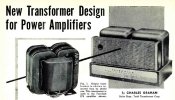
Todd Transformer kindly left us a clue in that photo of the unpotted transformer: AA-15.
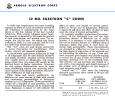
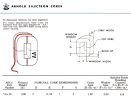
What I didn't realize for several years is that when I first started researching transformer winding and construction, I'd run across a web page with an eclectic assortment of rare catalogs and other data, including price sheets and catalogs from Arnold Engineering Company. AA-15 was one of their standard 12 mil Silectron C-cores.
Now if I can get Todd Systems, the seeming successor to Todd Magnetics, to tell me if they still have any winding data from 70 years ago, duplicating the 275 OPT (and possibly tweaking it with primary resistance and UL taps more ideally suited to the 6550/KT88 tube) should be within reach.
Todd Transformer kindly left us a clue in that photo of the unpotted transformer: AA-15.
What I didn't realize for several years is that when I first started researching transformer winding and construction, I'd run across a web page with an eclectic assortment of rare catalogs and other data, including price sheets and catalogs from Arnold Engineering Company. AA-15 was one of their standard 12 mil Silectron C-cores.
Now if I can get Todd Systems, the seeming successor to Todd Magnetics, to tell me if they still have any winding data from 70 years ago, duplicating the 275 OPT (and possibly tweaking it with primary resistance and UL taps more ideally suited to the 6550/KT88 tube) should be within reach.

s-petersen
Scott
I uploaded some of that to the AK database I think, possibly 5 or 6 years ago, there were several pages to that, I think.