• The move to the new server is done. There are some software and database maintenance updates in process. This has us passing the hat around to help out. We appreciate any donations. Seriously, even a dollar helps. The payment page may be found here - https://www.audiokarma.org/support.html

Re-purpose TV antenna?

mikejennings

Active Member
I have a rather large yagi TV [vhf/uhf] TV antenna mounted on the house. Since they went to digital over the air broadcasting I have 86'd the TV as I am out of range for the "local" stations.

I get decent FM reception even with just inside dipole. I was wondering if the TV antenna would work for FM reception. I understand that the band is slightly different, but not all that far off [VHF]

Thanks

Mike
 
Register to hide this ad
jhtstone is exactly correct. To see where your local transmitters are located, visit fmfool.com. You can get a "radar" map showing the directions from your address. In a few rare cases you might want an antenna tuned to a particular frequency but the TV antenna will almost certainly meet your needs.
 
Odd that you apparently had decent analog TV reception, then with DTV no go. Opposite here. I receive all digital TV channels stable and crystal clear including the low power stations that used to be nearly unwatchable with noise and multipath distortion.

Some older TV antennas came with two break-off elements to tune the bandwidth of the TV antenna's low VHF section normally tuned to 54-88 mHz TV band, to extend up to 108 mHz. Others will work too just not as optimized for FM band.
 
Not so odd the OP lost reception of the DTV signals. Without looking at his tvfool.com report my guess is that there is a good chance that all the local signals moved to UHF. I may be wrong - just going on an educated guess.
 
DFW only has two stations that remained on VHF, and those are the ones most people have problems receiving, since most antennas touted as "digital" are UHF only, or UHF and very weak or 0 gain on VHF. I get the VHF fine. Always have. Back in analog days UHF was almost impossible at my location because of multipath. I thought DTV wouldn't work here because most were moving to UHF and I could not get decent UHF. Turned out, no problem with digital. So dependent on line of sight, surrounding buildings, distance, hard to predict exactly what will result. I know people who live closer to the transmitters than I do but they are in an RF hole down too low and OTA just won't work.
 
Thanks folks.... I'm about 80 miles from the TV broadcast towers in Seattle and a little challenged by topography. When they went digital it all went away... no cable available where I live and not at all interested in satellite.

I do listen to a lot of FM so this should work out for me.

Mike
 
Yes, it will work very good, especially if you can rotate it at need. FM radio is sandwiched in between channels 6 and 7. You can pick up stations quite a distance away.

Here's a link I found about frequencies.....

AM and FM Radio Frequencies

http://hyperphysics.phy-astr.gsu.edu/hbase/audio/radio.html

The FM broadcast band is right above TV channel six.

TV antennae, in general have elements that are tuned for the VHF low band, channels two through 6, then starting again for channels 7 through 13, the the UHF channels.

The elements on the low band VHF portion of the antenna are going to be too long for the best performance in the FM broadcast band and the elements for the high band VHF portion of the antenna are going to be way to short.

And the element to element spacing that determines antenna gain and reception pattern in not going to be correct.

The typical TV antenna does not have continuous coverage from 88 MHz, the end of the VHF low band channels (channel 6) to the beginning of the VHF high band channels (channel 7) at 175 MHz.

In fact it was not a desirable feature for the most part because of interference to TV channel 6 from FM broadcast band stations.

That is not to say that a TV antenna will not receive FM broadcast band signals, but as previously mentioned, it will not be optimum.

If one wants the best reception and is going to the trouble of installing an outside antenna, a purpose built FM broadcast band antenna is the way to go.

Better performance, small, lighter, and less wind resistance means and easier and simpler installation.

If one already has a TV installed, sure give it a try.

Just as an example of the difference in length of the elements, the full length of the shortest element for the VHF low band will be about 60 inches.

The length for the middle of the FM broadcast band is about 54 inches, and about 50 inches for a station at 105.1 MHz.

This is a fair amount of difference in length at these frequencies.

Again, if one already has a TV antenna installed, give it try, any metal up in the air will receive a signal.
 
Some companies took existing FM antennas and sold them as HD antennas as one market died and the other picked up. My Wineguard HD-6000 used to be called the FM-6000. Just be aware some TV antennas actually filtered out FM frequencies via a FM trap that can be disabled.
 
Exactly.

Many manufacturers jumped on the Digital band wagon.

Some changed model numbers.

HD to represent an antenna that would work with hybrid digital transmissions.

Of course the antenna does not care whether the RF transmission is strictly analog or a combination (HD, hybrid digital and analog).

And not all FM broadcast band traps in TV antennae were switchable and the same with RF pre-amplifiers and RF line amplifiers.
 
Good luck.

I'm sure it'll work to some extent but just keep in mind that the FM band is just a tiny portion of that spectrum and the elements devoted specifically to that range are not very numerous.

That is assuming that the FM band wasn't specifically designed out of that antenna.
 
If it is a VHF/UHF Log Periodic type antenna it should work, as they are wide frequency coverage, and continuously cover from 60Mhz to 900Mhz. All the smaller and larger elements which does not fit into the FM frequency work as part of the antenna contributing to massive forward gains.

http://en.wikipedia.org/wiki/Log-periodic_antenna

http://glendash.com/Dash_of_EMC/Log_Periodic/Log_Periodic.htm

http://www.ebay.co.uk/itm/MOONRAKER...d=100005&prg=1048&rk=2&rkt=2&sd=300516895069&

I am well aware of log-periodic antennae, having designed and built numerous versions.

Log-periodic antennae do not offer the same performance to size ratio.

And not all TV antennae are log-periodic.

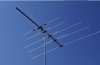
See picture below.

Note that there are two sets of elements on the boom. The longer set is for TV VHF low band and the adjacent shorter elements are for TV VHF high band.

This type of antenna, Yagi-Uda will not have continuous frequency coverage between the low VHF TV band and the high VHF TV band.

This a TV antenna that has coverage for low band VHF TV and high band VHF TV without continuous frequency coverage in between (and UHF, but those elements are not part of this discussion due to the frequency range of UHF TV channels).

For a given physical size, a properly designed Yagi-Uda style antenna will have better performance. With a log-periodic antenna, performance is traded for bandwidth.

"The log periodic antenna works the way one intuitively would expect. Its “active region,” –the part of the antenna which is actually radiating or receiving radiation efficiently -- shifts with frequency."

That is, not all of the elements are active or working for a given frequency.

So for a given frequency of operation, there are relatively fewer active elements, than a purpose designed Yagi-Uda style antenna.

It is true that some TV antennae may by LPAs. But even then, their performance to size ratio for a given frequency will not be as good as a purpose built Yagi-Uda antenna.

In general LPA antennae are not know for massive gain at a given frequency when compared to a Yagi-Uda style antenna.

When it comes to deep fringe reception, it is not unusual to use cut channel antennae due to the better performance.

To be clear, the point of my post is, that if a person is considering installing an antenna for FM broadcast band use and has an unused TV antenna, chances are that a purpose built FM broadcast band antenna will give better results, even if by chance the TV antenna is an LPA (log-periodic array) antenna with continuous frequency coverage.

Remember, there is no substitute for full size frequency specific antennae.

As I have posted many times, with antennae, it is location and application and since the majority of people in the USA live in moderate to strong locations for RF field strength for the frequencies that they want to receive (TV or FM), the actual performance of the antenna chosen may not be an issue.

But for those in less than moderate RF field strength locations, in may in fact be a consideration.

But that does not change the basic physics of antenna design.

Purpose designed and built, frequency specific antennae will give the best performance.

 

Attachments

  • TV ANTENNA WINEGARD YAGI.JPG
    TV ANTENNA WINEGARD YAGI.JPG
    33.2 KB · Views: 19
Thanks folks.... I'm about 80 miles from the TV broadcast towers in Seattle and a little challenged by topography. When they went digital it all went away... no cable available where I live and not at all interested in satellite.

I do listen to a lot of FM so this should work out for me.

Mike

TV signals are also sold through Telephone wires along with ADSL
Not merely Coax cablings.
You have No such provider?
 
I live in the San Juan Islands in WA state... only choice for TV up here is satellite. No cable / and we are outside of the coverage area for digital over air from Seattle....

I don't miss it and don't want it really... my original question had to do with whether there is a use I can put that big yagi that I bought when they went digital to see if I could at least pull in PBS or it's just headed to the recycle yard.

I could probably add it to my telephone/DSL bundle but I'm not really interested...besides CenturyTel, who his the only landline provider here just had the undersea cable that serves the islands break last month which brought down all communications in the county [including 911 which was exciting for those of us in uniform] for a week. Cell phone coverage is also very spotty up here. Not interested in paying them any more than is necessary for a landline and DSL.

MJ
 
Last edited:
TV signals are also sold through Telephone wires along with ADSL
Not merely Coax cablings.
You have No such provider?
You talking about U-Verse? They can't even force-feed that through the phone lines to my home, and I am less than a mile from the local SBC central office.
 
Mike,

Have we established that it is indeed a Yagi-Uda antenna that you have?
Post a pic of it, maybe able to determine the type.
I have a large (8') deep fringe LPA (no idea of the mfg) with a booster and rotor on top of the 40' tower. I get decent FM reception near 100 miles away (mono). A rotor is important unless all your sources come from one direction.
 
Reporting back on the "experiment".....

With the 12' yagi pointing at the Seattle stations I now have a rock solid stereo lock on them! Almost no discernable noise on King FM [classic] or KUOW [NPR]

It is not on a rotator but I do have a smaller 6' mounted above it pointing NNE towards the Canadian towers and a flip of the antenna switch brings those in as well.

I am pleased with the results and at least for now not adding to the metals junk [recycling] pile.

Thanks for the info and advice!

Mike J
 
12' & 6' yagi's mounted where?
Right on, simple/effective setup, sounds to do the job, spot on.
Enjoy your tunes, FM rocks.
It cost me $150 for a new rotor/controller and the local tv guy $100 to climb the tower and change it, so you are big $'s ahead of me ;-)
Well at least I got great tunes and reverse eng the new CM rotor controller, rid of the old noisy mechanical rotor controller (remember them?). Figured out how they both work, if anyone cares to know :-)
I want to eventually have my radio control the rotor, simple i/f really, just need to write some code to do it, a timer/counter, relay, phase shift ecap. etc

Cheers
Rick
 
Mine are mounted about 25' and 30' feet of the ground on an aluminum 2' thick walled pipe mounted to my deck railing and guyed.

Steep pitched metal roof precluded me from even considering climbing up there to mount any thing on the peak,.... christ, chimney cleaning is enough of an adventure.

The ground slopes away from my deck for about 100 yards before dropping 150' into Lopez Sound [Puget Sound]. So lucky location and orientation to the signals.

MJ
 
Back
Top Bottom