• Please note that Audiokarma will be offline briefly for updates early on Monday morning, September 28th.

Realistic 2100 2nd repair attempt

Audi0

Super Member
I Tried once and failed trying to repair the 2100. Decided I'm going to take another stab at it.

My first hurdle is. I know rail voltage is close to 60 vdc. Both amp cards can be pulled out with ease. Can I power the amp boards out of the amp with an external power supply that's 48vdc but 10a without causing an explosion. It's the high amps that concerns me. The one board has a 1v short. I figure if I trace it back using artificial 48v power I can trace where I went wrong.
 
Register to hide this ad
I would suggest that you use a dim bulb tester, rather than removing boards and external supplies. Dim Bulb tester (Incandescent bulb in series) will limit the current usually to a point preventing damage from shorted components. You can see which amp board is causing the problem, and then troubleshoot it
 
It's the realistic 2100 D. The issue is it's just at 1v so the protection relay very borderline wants to trip. The 1 v short is on the bias or idle side. Or may not be a short just something wired wrong. Plus I got no room to trace the issue with the amp cards in the amp.

It passes the dim bulb test as in the bulb won't light up. So Im assuming its safe to do so.

The other side it's a 12v issue causing the amp not to click over. This may not pass the dim bulb test.

I'm going by memory here from months ago.
 
Memory sometimes fails and frankly not to offend..
The other side it's a 12v issue causing the amp not to click over. This may not pass the dim bulb test.
I'm going by memory here from months ago.

Maybe try a 75w bulb and check out the unit again? reexamine the pcbs etc?
bink :D
 
Ready to listen to some advice as I'm lost.
Yeah its 1v that is in the dc offset circuit on the one board and the other has 12v short. Which is a clue. Have some idea how to repair gear and some basic test gear. All diodes / zenors and capacitors (except a hand full) were replaced. Every resistor was went through and the bad ones were replaced. Both boards were mirror images in repairs.

The sad thing it's been sitting for so long I've borrowed parts a pieces from it to fix other pieces of kit.

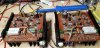
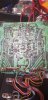
20190225_191605.jpg
 
Last edited:
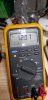
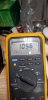
On the out pins these are the exact numbers I'm getting. My memory was pretty good.
I tried a lot of different thing but can't figure it out.

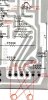
20190225_201327.jpg
20190225_201304.jpg
 
after all the parts replacements, possible you have a small solder bridge somewhere.. got a good magnifier glass? reexamine your work. in addition sometimes solder pads and traces can be broken if you have lifted any.
 
Last edited:
I've corrected someone else work. As it was fubar when I got it. I corrected the lifted trace work with patch pieces the best I could.

Spent and hour and half with an ohm meter.
Checked transistors in circuit /diodes. Not it as both boards match each other readings.

Check continuity on traces. Everything that's connected to trace. Then went point to point on said trace and moved onto the next. Still not it wtf.

I'm stumped I think the only solution is powering the boards and tracing where it is going wrong.

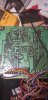
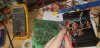
20190226_134558.jpg 20190226_134552.jpg
 
Ok so that 12v number is definitely going throughout the board. Its dropped down to 9v.

I rigged something up to figure it out. Hmmm and getting that number at some of the output transistors.

20190226_171807.jpg 20190226_171728.jpg
 
Screenshot_20190226-173901_Drive.jpg

Ok according to this pulled from the 2100 manual not the d manual something is f*cked. I get rail voltage where is should be but the other numbers are 9v instead of the .8mv. Same goes for the other side. Any ideas on how to nail it down.
 
Hmmm.. Testing ? Am I correct thinking you provided supply voltage to B+ and B- (pins 12&15) to the amp boards and you have tested all noted voltages (pg's. 40 and 41) and all are correct or within meter error?
--------------
--------------
I spent a good hour % 1/2 searching for other posts reflecting rebuilding the amp boards and unfortunately none were related or just incomplete as to final results or sm errors. i.e. posters just dropped their threads not reporting back.
 
Screenshot_20190227-131527_Drive.jpg

So I tested them all. Nothing reads within spec. Only ones that line up are rail voltages and the tr 514 40mv on leg. Everything else is that 12 v number. Any ideas?

And yes I dragged the board out of the amp powering it the same way if it were in there.
 
View attachment 1433311

Ok according to this pulled from the 2100 manual not the d manual something is f*cked. I get rail voltage where is should be but the other numbers are 9v instead of the .8mv. Same goes for the other side. Any ideas on how to nail it down.

The correct manual is out there... would think it might be a better resource.

Just google it... at HIFIengine and another site.
 
The power amp stage is basically the same. Plus the non d manual has those voltage numbers. There is for sure differences with the circuitry like with the protection circuit.

Not quite sure where I went wrong still.
 
Ok I'm onto something I think. The readout on Thermal comp transistor has 3 positives no ground. Which would be the ground for this transistor? By ground I'm looking for a negative number.
 
Last edited:
Nope not the issue but I corrected the heatsink short issue. Still 3 positive voltages there.

It's the emittor with npn transistors that go to ground right?
 
Last edited:
Sorry, can't read your voltage measurements.
The bias transistor (TR506?) should have a collector voltage of about +1.4Vdc and the emitter at -1.4Vdc
What voltages are you seeing on TR506 c,e
 
Can't remember the exact number but

On b/c/e 10/10/10 all dc postive

Checking pinouts.

Checked with multimeter for shorted transistor. It reads the same as the other board but it's in circuit and coming up with a high number.

Going to wire up the other board to see if I get the same sort of number there. If so then i know I did something wrong and mirror imaged it.
 
Last edited:
Back
Top Bottom