• The move to the new server is done. There are some software and database maintenance updates in process. This has us passing the hat around to help out. We appreciate any donations. Seriously, even a dollar helps. The payment page may be found here - https://www.audiokarma.org/support.html

Realistic APM 200...

Moondust

Member
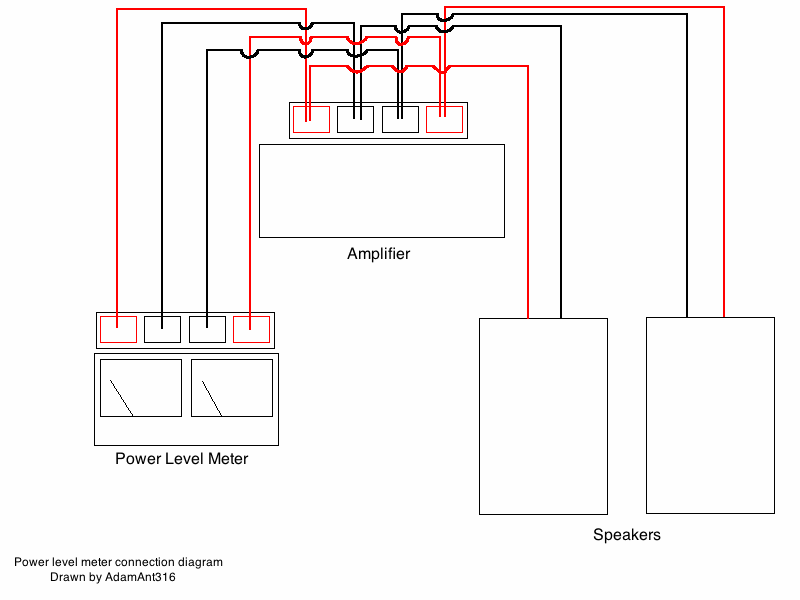
Ok I recently bought 2 of these vu power meters. Can post pics later. They only have speaker inputs on back, no outputs. So from my reciever i could run speaker A to speakers, and run speaker B to the power meters. But what if i am running A and B both to speakers? Do i just splice speaker wires on A and put meter in middle?

I went to download manual from hyfiengine, and it said i must sign up...Well when i try to sign up, the site says invalid email, any idea why? I tried a yahoo one and a gmail one...There are other manual sites, but none of them have this unit...Thanks
 
Register to hide this ad
Seems to me you could run both the A (or B) speakers and the meter off the same terminals. In other words, two wires off speaker A (o rB) right/left and two wires off speaker B right left, 4 wires total of the A terminals.
Run them in parallel, a short run to the meter (if you want the meter close to rest of the system) and a longer run to the speaker.
Won't be any extra load on the receiver since the meter presents no load.
 
You are saying one set(A) speakers through the one power meter box...and another set(B) speakers through other meter box?

So basically one meter box will always be on...But in order for other box to be on, I would have to switch other speakers on too...
 
Just go with the diagram. That will work fine.


Why do you even need two meters?
Each meter has left and right channels.
That will tell you (kind of, approximately, they are not all that accurate) the power output of your receiver.
Use the second meter on a different system or keep it as a spare.
 
Last edited:
Yeah i might use one on 2nd system. Thought it might be cool to use both on one system though. Either way thanks for help and replies...
 
Keep in mind that most amplifier "power" meters don't actually measure power. They measure *voltage*, assume a load impedance, and display a guess. Since the vast majority of amps are voltage sources, the meters will read "power" output even with no speakers connected.

Like any voltmeter, the APM should be connected across (in parallel with) what you are measuring, not in line (in series with) it. You need to know how your particular amp/receiver handles "A+B" selection if you want to make even a reasonable guess as to how to set or interpret the meters. Some amps put the A + B speakers in parallel for maximum power, some put them in series to ensure an easy load for the amp. That alone will make at least a factor of four difference in the total load.

But even that pales in comparison to the factor of ten difference in impedance that many speakers exhibit over the full audio range. There's also power compression, where high power levels cause the voice coils to heat up and increase resistance. So while meters can be informative, they're not going to be terribly accurate most of the time.
 
Found this
That's a graphic I created, as your screenshot shows. Here's a better view of it:
apmdiagram.gif

That setup has worked for me with the APM-100, 200 and 300. Some folks have reported issues with this setup, and having better luck with the setup shown in the user manual. Not quite sure why. :dunno: And as far as putting meters with meters, I've thus far limited myself to using one APM with an audio setup at a time, though it hasn't prevented me from using them with amps that already feature meters:
mainstereo.jpg

mcmainstereo.jpg
 
Back
Top Bottom