• The move to the new server is done. There are some software and database maintenance updates in process. This has us passing the hat around to help out. We appreciate any donations. Seriously, even a dollar helps. The payment page may be found here - https://www.audiokarma.org/support.html

Recap standard?

Moth R. Superior

Active Member
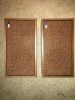
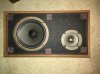
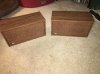
Yesterday I scored a pair of absolutely flawless Fisher XP44b's, in pretty much brand new condition. I was super impressed with the sound that these "Little Giants" brought to the table, I'm still beside myself.
What I was wondering: should I assume just because of their age ('71-'73) that a recap in necessary? Is it pretty much standard practice to recap a speaker of this vintage? I'm completely taken back by how good they sound already, but am I to think this can be improved?
This would be my first attempt at a recap job, and they do seem like a decent place to get started.
Everything else with this pair is to say the least, impressive, condition wise. Rubber surrounds perfectly intact, as are the grill cloths, badges, vinyl veneer.
Would appreciate your wisdom. Thanks!
 

Attachments

  • XP44b7.jpg
    XP44b7.jpg
    109.8 KB · Views: 53
  • XP44b2.jpg
    XP44b2.jpg
    87.8 KB · Views: 52
  • XP44b6.jpg
    XP44b6.jpg
    122.5 KB · Views: 59
  • XP44b8.jpg
    XP44b8.jpg
    92.2 KB · Views: 55
Register to hide this ad
Man, if you like the way they sound don't do anything to them.A lot of folks here will recap anything of that vintage just as an insurance measure,not always necessary in my opinion.If I score some old speakers that need refoaming and cabinet work I'll go head and recap since I have it all apart anyway. On the other hand I've recapped speakers that old with no noticeable improvement.
 
"It Depends"

I got a pair of XP66b (I think?) at a GW and passed them on with no work other than fixing a busted grille. Likewise I've only refoamed a few pairs of speakers and actually checked the capacitor values and they were still close to nominal.

However recapping my Rectilinears and KLHs made a noticeable improvement in treble response...
 
FYI: if you didn't know the grilles are nailed on and the frames are a heavy cardboard material so be careful pulling them.
 
Capacitors age, their values drift and resistance (ESR) increase. I'll be willing to bet you there are electrolytic capacitors in there and they began to drift when Ronald Reagan was in office. Keeping original capacitors in a crossover network because it'll retain that Vintage Sound is a logical fallacy. If you are interested in staying as close to their original sound as possible, recap the crossovers with the same type of capacitors. Electrolytic with electrolytic. I've got a handful of speakers that use old, paper dome tweeters. I've tried them with both new poly caps and new electrolytic capacitors. The electrolytics simply roll off the highs, less of a sparkle. Those old dears need all the help they can get and all have poly caps on them today.

Remember, you can always keep the original capacitors (if they aren't glued into place). This way if you or the new owner ever get an itch, they can be put back. I did that for a few years and found myself swimming in a small sea of old, out of spec capacitors. I tossed them all last year, still don't miss 'em.

Biggles
 
FYI: if you didn't know the grilles are nailed on and the frames are a heavy cardboard material so be careful pulling them.
Correct, N8Nagel. They were "nailed" in place by those really long staples (I forget what they're called), but with some very careful prying with a putty knife, and the help of a needle-nose, I was able to remove them without any damage. I'll be adding velcro to make the grills removable.
 
The only potential problem with 'if you like it don't change it' is that if the caps HAVE drifted a lot, there is signal going to the wrong drivers. This can put stress on mids or tweeters especially - if there is too much lower frequency content going to them.

I agree with replacing electrolytics in any case, and if you really want to know if they are in spec, find a multimeter with a cap function and check them. Of course that won't tell you ESR, which is why a lot of people just replace them. To me it's like buying an old car out of a barn and driving on the original tires. Yep, they're original. Whoopee. blumpblumpblumpblumpPOW!

Usually what you'll hear afterwards is more of the top end. If your ears or the tweeters don't go up that high anyway, it may not make that much difference.
 
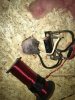
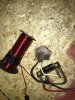
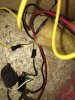
Alright, well I pulled the woofers to get a look and here's some pics of what I found.
CE 50657-3, 4uf 25 v, and a spool of copper wire.
Again, pardon my ignorance, I am a novice to this arena, but would like to learn.
XP44b-XO1.jpg XP44b-XO2.jpg XP44b-XO3.jpg
 
The spool is an inductor. Those rarely go bad and you can check it with an ohmmeter, it should have low DC resistance as in an ohm or less. That 4uF cap looks like one of those (expletive deleted) Temple caps that Wharfedale, KLH, and Rectilinear used and replacing it with a new proper one should make a definite improvement in treble response. I'm guessing the thing between the two is the backside of a potentiometer or L-pad?
 
The spool is an inductor. Those rarely go bad and you can check it with an ohmmeter, it should have low DC resistance as in an ohm or less. That 4uF cap looks like one of those (expletive deleted) Temple caps that Wharfedale, KLH, and Rectilinear used and replacing it with a new proper one should make a definite improvement in treble response. I'm guessing the thing between the two is the backside of a potentiometer or L-pad?

If you mean that black blob of goo, it's covering what leads out to the screws that connect to the speaker wire.
 
Ah makes sense. so x-over is very simple and the only piece likely needing replacement is that 4uF capacitor.

Most likely the inductor is in series with the woofer and the capacitor is in series with the tweeter... yes?
 
Ah makes sense. so x-over is very simple and the only piece likely needing replacement is that 4uF capacitor.

Most likely the inductor is in series with the woofer and the capacitor is in series with the tweeter... yes?
Correct. Seems simple enough. Gonna practice up on my soldering skills, and then a parts run.
As this is my first dance at this procedure, any recommendations as far as brands, etc.?
 
I would use a poly film and foil or metallized poly film cap. If you have a local parts place, they will probably not have 'audio' caps but they will have a film cap that will do the job. Tell em it's for a crossover network. I would use a higher voltage rating - 50 or 100V is not too high.

Ideally an audio rated cap like the Dayton metallized polyprop from Parts Express or Mundorf from Madisound would be great. The Daytons are used by a lot of AKers. $1.75 but the shipping will kill ya.:p

http://www.parts-express.com/dayton-audio-dmpc-40-40uf-250v-polypropylene-capacitor--027-421
 
I changed out the original electrolytics in my pair of Yahama NS10T's.
Called Madisound and they were extremely helpful and it was not too difficult to change them out.
I think it was an improvement I can hear. I'm happy with the mod.

Now I have to do the same thing with my new-to-me Yahama NS-690's.
Again Madisound helped me get just the right caps without overspending.
 
Back
Top Bottom