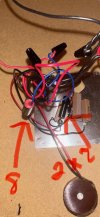
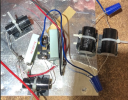
I was redoing two pairs of KLH 6s recently, and largely out of curiosity - both pairs sounded nice, especially after redoping - I recapped them, too. I did one pair at a time so I could compare the (only to discover I don't have an amp right now with speaker A and B, so I was kind of hobbled in making meaningful comparisons).
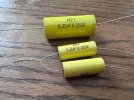
The first pair were newer, I believe, based on what I assume are serial numbers (the ceramic magnet structures are square, if that helps). I measure the caps (all the black with red end Temples) that I removed: the 8 microfarad caps were 8.52 and 8.43 - not too bad - and the replacement Dayton was 7.8. The old 2 microfarad caps were 2.7 and 2.66, 2.59, and 2.82, and the Daytons were 1.99 and 1.98.
The other pair, a friend's, bought in 1972 had circular ceramic magnet structures. The old 8 microfarad caps were 10.28 and 8.76 - not so good - and the 2 mcrofarads were 5.26, 5.33, and 2.61 and 2.78 - the first pair being very far out of spec. The Daytons were almost exactly the same values as the ones put into the previous pair.
Once recapped, the speakers were a bit brighter, as you would expect with film caps replacing electrolytics. It seemed, comparing the first recapped pair with the unmolested pair, that with the new caps, the decrease setting sounded similar to the normal setting with the old caps.
I'm not sure if I'm sure the change was worth the effort and cost - brightness isn't inherently more accurate sounding or more pleasing to me.
I will admit that I was surprised by how far off the caps in one the second pair speakers were, and also that I hadn't noticed anything amiss. Perhaps I should be embarrassed that I didn't identify the issue when listening, but: 1.) I was listening with the high frequency switch on normal, so the grossly out of spec pair were not even in the circuit, and 2.) I've lost a lot of confidence in my golden ear pretentions over the decades, both because my hearing has gotten somewhat worse, but more so because I've realized that no stereo sounds consistently like the real thing at all, so I'm increasingly willing to listen past the equipment, and enjoy the music. I hadn't listened long enough or in an optimised system - perhaps I might have picked up on the difference in the speakers.
I'm not entirely sure why I am posting this, but I'd be interested in how many caps that are replaced are significantly out of spec - I've encountered a fair number before (and usually in KLH speakers where the tweeter appears to be dead, but its a dead cap. But my measurements suggest that even know-to-be-failure-prone caps often are quite close to intended value.