• The move to the new server is done. There are some software and database maintenance updates in process. This has us passing the hat around to help out. We appreciate any donations. Seriously, even a dollar helps. The payment page may be found here - https://www.audiokarma.org/support.html

Recommendations for Integrated or Separates for Devore Gibbon 8

R. Mallow

New Member
Hi all,

I recently purchased some Devore Gibbon 8's locally, which I am loving; they're by far the best speakers I've ever owned. Yes, I know--rookie level, to some. But I've been thrilled. However, I feel that my current electronics are not a perfect match for them, which are:
preamp: rowland research coherence one (series 1)
amp: hafler dh200


My sense is that the high frequencies aren't quite "sparkly" enough, if I am using the term correctly. I'm not super up on audiophile terms, so y'know...give me a little leeway here. I am guessing this might be what people would call "too warm" but I think for me, based on all the info I can gather, what's going on is the high frequencies are maybe a touch too attenuated--I noticed the same thing on other speakers when I compared an advent model 300 with 90s rotel gear, the latter of which was definitely rolled off at the top and bottom by comparison to the former.

I know the typical recommendations for devore: leben, shindo, line magnetic, etc.--these are all above my pay grade for the time being, and I'm having trouble getting a grip on their overall sound signature. My sense is that they are probably pretty flat through the bass and mids, with a slightly rolled off treble--this based on my sense of how the rowland matches with the gibbons. But again, it's hard to say.

I would greatly appreciate:
--suggestions for an integrated or separates for great performance/bang for buck that matches well to the devore gibbon 8s.
--a description of leben, shindo, or line magnetic in terms of sound signature so that I can do further research

Required Specifications:
--15 wpc minimum
--built in phono section
--budget will be maximum $1000 (i'd like to downsize as I consider this to be a temporizing measure, will eventually upgrade when budget allows, but that may be a year).

Priorities:
--above all: instruments sound natural, like they are instruments
--sense of depth (instruments arranged front to back in a logical manner)
--realistic image size (no 50-foot giant guitar players please)

I know this is a tall order. On my budget, one can't expect perfection. I'm willing to sacrifice the best performance in any one area for a more even ability across the board.

Thanks all!
--R. Mallow (Jim)

PS: As some already know, I can be a little slow in responding at times. I apologize for that. I will try my best to reply to everyone, and in a timely manner. I'm very grateful for anyone who is willing to offer their valuable time and experience; I hope by adding this postscript I minimize any offense taken.
 
Register to hide this ad
Addendum:

I'd love to have a fairly decent grip on bass (nothing too flabby or muddy), which I know is difficult with low wattage, but just overall something towards that end of the spectrum.

Have looked at rogue audio (cronus and sphinx seem like decent bets?) and primaluna (prologue seems to be in budget). Would welcome thoughts about those, too.
 
I've no experience with the Gibbons. I've heard, I believe the 93 or 96 at show. Axpona audio shows. Lovely speakers.
I've little experience with modern amps. My Sphinx V1 has power to drive my 4 ohm rated Maggie 1.7i @ 86db spl.
My Cronus Magnum V1 is, to my ears a little more smooth in treble, than Sphinx. I don't find its 4 ohm power rating, published. Not sure if its power increases at 4 ohms. My Cronus was special ordered without phono pre, for more versatility, by previous owner. I use NOS Mullard pair in Sphinx and a single Mullard in Cronus.
I like either amp for my jazz and vocals. Also feed to ADS L880 @ 89 db, or Ohm C2 @ 88 db speakers. I sometimes add a Schiit Loki equalizer on a line input, to either amp.
I enjoy both amps. But can't give you a sound comparison to other modern amps.
Guess I wouldn't call these low wattage amps. You should know the Cronus puts out some heat if in small room/summertime.
 
Last edited:
Your speakers are not ‘rookie level’ by any means. Your preamp is no slouch either.
Tell us what you are using for program material.
And with your budget there is no reason to sacrifice anything.
 
I've no experience with the Gibbons. I've heard, I believe the 93 or 96 at show. Axpona audio shows. Lovely speakers.
I've little experience with modern amps. My Sphinx V1 has power to drive my 4 ohm rated Maggie 1.7i @ 86db spl.
My Cronus Magnum V1 is, to my ears a little more smooth in treble, than Sphinx. I don't find its 4 ohm power rating, published. Not sure if its power increases at 4 ohms. My Cronus was special ordered without phono pre, for more versatility, by previous owner. I use NOS Mullard pair in Sphinx and a single in Cronus.
I like either amp for my jazz and vocals. Also feed to ADS L880 @ 89 db, or Ohm C2 @ 88 db speakers. I sometimes add a Schiit Loki equalizer on a line input, to either amp.
I enjoy both amps. But can't give you a sound comparison to other modern amps.
Guess I wouldn't call these low wattage amps. You should know the Cronus puts out some heat if in small room/summertime.

Old Guy8, thanks for your input. I am thinking that the heat won't be too big of an issue--it's looking like I may be moving out to the Monterey peninsula or the PNW (have been applying for work with some good leads). When you say smooth in the treble, are you referring to a bit more attenuation? Sorry, I know it's a question of the less-well-heeled, but I'm pretty bad with terminology. If that's what you mean, is that due to the Mullard tubes? I'm thinking, then, the EQ would be to tip up the treble a bit?

My understanding is that ADS are "warm," though I've not heard them and am somewhat unclear on whether that means that the treble is less pronounced or if it's full-bodied or what have you. I've seen pretty variable comments on the gibbons, but my sense is that most have said the treble is slightly tipped up. I think that would stand to reason if they're voiced with tubes, but I'm VERY far from a tube maven. I think in regards to sensitivity, though, they're about the same as the ADS--difficult to get info, but it appears published 90 dB and more accurate would be 88 dB..


Your speakers are not ‘rookie level’ by any means. Your preamp is no slouch either.
Tell us what you are using for program material.
And with your budget there is no reason to sacrifice anything.

Thanks, DOBIEGUY--and you're absolutely right about program material, serious oversight on my part! Short answer: I listen to a bit of everything, which is also a fairly unhelpful answer. I have found in the last couple of years I am listening to more and more small-scale jazz groups and classical, but have a deep love for psychedelic rock, pop, and prog from around 1965-1975. More so lately, I'm into great engineering than taste related to a particular genre. The only things I don't really go for are metal (except sometimes black sabbath and a couple others) and billboard 40 type stuff (think bieber, radio friendly country music and hip hop, etc.). For the purpose of illustration, here are a few of my favorite records:
--Unicorn by Tyrannosaurus Rex
--Atom Heart Mother by Pink Floyd
--The Papas and the Mamas by the Mamas and the Papas
--Ptah the El Daoud by Alice Coltrane
--Rachmaninoff's Concerto No. 3 as performed by Horowitz and the New York Philharmonic with Eugene Ormany Conducting
--Unhalfbrickling by Fairport Convention
--Baroqueswing Vol. II by Charl Du Plessis Trio
--Revolver by the Beatles (or any post-Rubber Soul Beatles record, really, and solo stuff except most of Ringo's work)
--Baroque Violin Favorites performed by Bin Huang and Hyun-Sun Kim
--Now by Kim Jung Mi
--Blossom Dearie's eponymous album (1957)
--Odyssey and Oracle by the Zombies
--Mug Museum by Cate Le Bon
--Small World by Gabor Szabo
--If You Listen by Francoise Hardy
--Friday's Child by Lee Hazelwood

Phew! Probably got a longer response than you wanted, there.
 
I've thought of my ADS as warm, until an audio shop manager told me he thought the brand was slightly bright. I don't know what to call them, after that. He has an audiophiles ear. I'm not up on audio terms and don't want to lead you astray.

My Rogue amps are in two separate systems in same 400 sq. ft, 7' high bright room. Only area rugs and few pillows to soften accoustics. When I've added an equalizer or had tweeter switches available on ADS or Ohm speakers, generally tune down treble a little. Or boost bass slightly. I have added a resister replacing the tweeter jumper on my Maggies to reduce treble. Just how I like it.

I think My Rogue amps are neutral sounding. Mullard tubes may soften them slightly. But neither is syrupy. I think the Cronus is a little more velvety or refined than the Sphinx. Not surprising, given higher price and massive transformers. I'm guessing the pre tubes in the Sphinx were to soften the class D power sections rough edges. Not audiophile terms. Hope I'm not adding confusion.
 
Last edited:
I should have asked what gear you are using. CD,PC,TT, streaming.....
Oh man! I can be a bit stupid, sorry for that. For digital, I'm just connected to my television and stream or play from a hard drive. It's not an ideal option, but I typically listen critically with vinyl. My set up on that end is a Sanyo TP825D turntable with either a shure m91ed or Audio Technica AT211EP cartridge, matching stock stylus for each. To my mind, the Shure sort of reinforces what I've thought about high frequency stuff, I think, since the AT cartridge to a minor extent ameliorates the problem. Still, I prefer the sort of body (bloom, maybe?) that the Shure imparts vs. the AT, which seems balanced but somehow thin. The digital stuff also sounds better than with previous setups, through which it used to sound pretty bright. I've been somewhat reluctant to get a new cartridge or DAC until I have the rest of the set up optimized, but maybe I'm going about this wrong.

Also, I'm using really crap speaker cables and interconnects right now, which could potentially be changed out to tailor the sound a bit--though I've also been reluctant on that front since I view those as the sort of final tweaks in terms of component switching, and my amp is definitely not up to snuff compared with my preamp and speakers.


I've thought of my ADS as warm, until an audio shop manager told me he thought the brand was slightly bright. I don't know what to call them, after that. He has an audiophiles ear. I'm not up on audio terms and don't want to lead you astray.

My Rogue amps are in two separate systems in same 400 sq. ft, 7' high bright room. Only area rugs and few pillows to soften accoustics. When I've added an equalizer or had tweeter switches available on ADS or Ohm speakers, generally tune down treble a little. Or boost bass slightly. I have added a resister replacing the tweeter jumper on my Maggies to reduce treble. Just how I like it.

I think My Rogue amps are neutral sounding. Mullard tubes may soften them slightly. But neither is syrupy. I think the Cronus is a little more velvety or refined than the Sphinx. Not surprising, given higher price and massive transformers. I'm guessing the pre tubes in the Sphinx were to soften the class D power sections rough edges. Not audiophile terms. Hope I'm not adding confusion.

Thanks for the detailed explanation. It seems like sometimes people mean warm like there's a high frequency cut off (like the tweeter is rated only to a certain Hz for flat playback or reproduction), which I guess to me seems to fit better into "highs are not extended." On the other hand, my impression is that some people use "warm" to mean that the treble is attenuated or the upper-mids and mids are more pronounced or full bodied. Maybe that's the reason for the difference between the manager's description/assessment and yours? It's always so hard to say. And of course, as sqlsavior mentioned, one man's sparkle is another's tizz.

And no need to apologize for muddying the waters! As the saying goes, "the more you know, the less you know." I think more information is always a good thing. Besides which, I think you did an admirable job describing.

If you don't mind my asking, how old or if it's more comfortable, what age group/generation are you from? I do speech-language pathology (which entails some fairly involved voice and aural rehabilitation stuff) and work closely with audiology, so I'm always interested in the data (or soft data in this case) side of things. Of course, that'd still be me making some serious logical leaps and absolutely doesn't account for preference, but I find it helpful. Most people prefer neutral frequency response, some have noted (can't provide a ref here, though). As a data point for those who might be interested, I'm 30 and my hearing is pretty standard until 18kHz after which point I have a statistically significant mild-moderate loss.

Are you sure you don't simply have a "sweet top end" that you are not used to yet?

One man's sparkle is another man's tizz.

sqlsavior--I can't be certain, but I suspect it's more related to attenuation. I've had the speakers for nearly a couple of months now and have been working from home quite a bit, so music's been on a lot (probably 6 hours a day pretty easily). Nevertheless, it's absolutely possible given that my expertise is much lower than many folks here, and because it's hard to say exactly how long it would take to adjust to the change. The rest of my gear I've had for a fair bit longer and am comfortable with their signature across a few speakers (though of much lesser quality, and with admitted problems--e.g., KLH 17's with a sub, AR 5's, my buddy's Von Schweikert vr3's to a lesser extent) and with another amp (pioneer ref m90, which didn't change the issue much, I thought). Anecdotally, another piece of evidence: when I was researching the rowland research pre, many posts allude to it being a bit "too warm" compared with the series 2 gear or other preamps made by jeff rowland in the early-mid 90s.

Again, though, I'm far from an expert, so it's totally possible. If the problem is related to sweetness, is there a way I might be able to tweak my system for a reasonable price to decrease/increase that aspect and listen for the change?

Thanks again, everybody. My favorite thing about AK is how willing members are to share knowledge; it really brings another layer of enjoyment to the hobby (or addiction haha). I hope one day I have enough knowledge to be more helpful on these forums!
 
Hey all,

I wanted to say thank you again for your replies. A follow up for anyone who might see this thread in future in reference to the devores, and/or is, like me, relatively wet behind the ears in the hi-end sound game:

The OCD urge to futz struck because I thought there just had to be something going on, system-wise. I think this may have been a systems optimization issue to a greater extent than component matching. So, the lesson here is even if you think you've got it dialed in, keep working at it.

What solved the issue (and of course also opened new ideas/ a big can of worms) is adjusting my input signal significantly lower on the digital end, which resulted in a serious--and i mean SERIOUS--upgrade in sound quality. The overall sound is feeling much more balanced now across the frequency spectrum (even if it's not), drums have more snap, strings have more pluck, everything is better textured, and the highs don't feel so constrained--this lattermost point probably accounts for a good deal of what I was hearing before. I stand by my critique of slightly attenuated highs, but it no longer matters all that much. I'm willing to bet that further attention to speaker positioning could also improve the sound, but it's sort of not worth the effort right now being as my living situation is changing in around 2 weeks.

The issue now is that this signal attenuation won't be possible with my phono stage (except perhaps a lower output cartridge), which leads me to the new can of worms:

I'm starting to think a passive preamp (or no preamp at all) would actually better suit my needs. I'm now considering dumping my preamp and amp, investing in a relatively high power push-pull tube amp and either a passive pre or a switch box and standalone phono stage (depending on whether I can get adequate volume control without a pre). Well, the quest continues...as always. Current thinking is to save up a few more shekels and buy a music reference rm9 mk I and an okay phono stage (since my cartridge is nothing crazy).

In any case, I'm so much happier with my current situation. Last night I ended up listening to music until 3 am without realizing it--always a good litmus test of overall satisfaction. Another lesson learned.
 
Reviewers on the whole like the speaker, but with a few reservations. It can't play big and sounds congested when asked to produce louder levels. That to be expected considering the size of the woofer being asked to produce midrange frequencies. too. The HF dispersion is very poor and the speakers need to be critically aimed to get the sparkle you are after. For a small speaker it does a nice job. But unless you are in a space with no room for more capable speakers I would be looking for speakers not electronics. There is nothing wrong with your Hafler, its a very listenable smooth amplifier. I suppose you could look for a Krell, Threshold or Ayre which have a little more zip, but they were always a little to irritating for me with most speakers using resonant metal diaphragms in tweeters and mids. Before jumping off the deep end I would go to a live un amplified concert or recital and listen carefully. Your speakers maybe more ideal than you think. What. we hear at live concerts that are amplified usually doesn't represent the true sound of the instruments or vocals. Have you had your hearing checked lately?
 
It sounds like you have turned the corner sound wise. Congrats,and enjoy! By the way,what is the size of your listening room,and how do you have your speakers set up?
 
Reviewers on the whole like the speaker, but with a few reservations. It can't play big and sounds congested when asked to produce louder levels. That to be expected considering the size of the woofer being asked to produce midrange frequencies. too. The HF dispersion is very poor and the speakers need to be critically aimed to get the sparkle you are after. For a small speaker it does a nice job. But unless you are in a space with no room for more capable speakers I would be looking for speakers not electronics. There is nothing wrong with your Hafler, its a very listenable smooth amplifier. I suppose you could look for a Krell, Threshold or Ayre which have a little more zip, but they were always a little to irritating for me with most speakers using resonant metal diaphragms in tweeters and mids. Before jumping off the deep end I would go to a live un amplified concert or recital and listen carefully. Your speakers maybe more ideal than you think. What. we hear at live concerts that are amplified usually doesn't represent the true sound of the instruments or vocals. Have you had your hearing checked lately?

twiiii--thank you for your thoughtful reply. i do think the speakers are likely ideal, at least at my current price point. i am currently in a large-ish 1br (found a crazy price on my place in SLC a couple years back) so i've got (estimating here) maybe 12' x 17'--so, small to medium room. My current listening position is about 10' back from the center point of the speakers, which are approximately 4 feet from the side walls and approximately 9 feet apart. They are toed in towards the listening position and tilted back using the spikes to address the dispersion issue you mentioned--I agree that they are tend towards head-in-a-vice issues.

I certainly think the positioning is sub-optimal, but at this stage it's not worth messing with because in 2 weeks I'll be moving. I've had job offers in a couple of cities in California; I'm hoping for an offer at this hospital in Los Angeles, however. Regardless, any of these locations are going to have me in a pretty small apartment (think 10' by 10', possibly in a larger room if its a studio but i'd be listening near field in that case), likely with neighbors. So, considering the likely small room size and because I would rarely if ever listen at high volume (a "cranking it" moment for me currently is 80 dB SPL average, typically with low-mid 90s peaks), I think the gibbons' tendency to sound congested when pushed won't be an issue. It's worth noting that with the digital signal at full strength or when spinning vinyl, I never broke 20 watts--assuming the meter from a pioneer reference m90 was accurate; mind you, the full digital signal was largely responsible the less desirable sound quality described in my initial post. With the digital signal decreased to approximately half (for loudest volume necessary), I was able to set the volume pot around 12-12:30, which seems to have produced the best quality. I have not yet measured how many watts are being consumed given these settings.

While I agree that the hafler is a very solid amp, I think that given the circumstances, an active preamp is simply unnecessary as the preamp currently seems to do best when neither attenuating or amplifying the signal to a great extent given the conventional wisdom is your system is only as good as the weakest component. In other words, I would think the hafler would represent a choke point by comparison with eliminating the preamp and investing instead in a very good amp.

Additionally, the gibbon 8's are also said to be very tube friendly, and I believe the various iterations of the gibbon series have been voiced with audio note and leben--though take this statement with a grain of salt, as it's subject to my recollection of others' statements in other AK posts and on various forums. By contrast, others have noted that the gibbons sound best with 50 wpc of solid state amplification. So, taken together, my sense is that a music reference rm9, rm200, or (least desirable?) rm10 run without a preamp would be an excellent way to insert some level of tube-like sound, have a bit more oomph due to the high wattage of the rm9 and 200, and to keep a relatively neutral sonic profile. My sense is this might produce slightly tipped up highs, if other reviews of the gibbons are to be believed, but this might match well with the shure m91ed cartridge i've got in place currently, and a dac with slightly attenuated highs would also be inexpensive.

Now, to the questions of live music and of hearing.

To the former point, I have not recently (last 6 months) had the opportunity to see a live concert or recital (in a concert hall setting), but I do fairly regularly hear small scale jazz (trios, quartets) live, as well close friends who play violin, and in a couple of psychedelic rock and post rock bands--these last two being, i think, the least useful except for additional info reference regarding drums. I feel that my sense for how instruments ought to sound is reasonably good, though I'm sure I've not got as good of ears of others here. I can say, at least, that I notice obvious issues with the rowland research pre, most notably that horns and violins lose a lot of texture in re: that biting quality and roisin, respectively. The tone is definitely not so neutral either (kind of golden, if you'll forgive all these wishy washy terms I'm throwing around), but that aspect is euphonious to me. I will, however, firmly stand by my finely tuned ears related to vocals. Making fine distinctions in this domain are, after all, my professional area of interest (speech-language pathology).

To the latter point, the last time my hearing was checked was about 8 months ago. Since I work closely with audiology, I have access to PTA and OAE testing basically whenever, which is pretty handy. At last check: mild-moderate sloping hearing loss above 18kHz (i.e., probably not noise-induced in terms of its audiometric configuration). 8 months is more than enough time to have additional deterioration, but my sense is that's unlikely given my age (30). Granted a sloping high-frequency loss does sound quite like early presbycusis, it seems to me that sort of deterioration would be unusual in absence of some neurodegenerative condition--but that's the purview of audiology and thus largely outside my training (read: don't quote me on that). Of course, I also haven't had ABR testing, and god only knows what untoward effects all that acid and pot in my salad days may have done, auditory brainstem and cortex wise (kidding about the damage, not about being a former burnout).

WHEW! Long reply again. Obviously something I am prone to. Hopefully I was thorough in answering. Given all that, do you still advise sticking with the current set up? Or am I potentially thinking soundly?

Thanks again!
 
It sounds like you have turned the corner sound wise. Congrats,and enjoy! By the way,what is the size of your listening room,and how do you have your speakers set up?
TEA FOR ONE--thank you! and apologies, forgot to quote you in the previous post. see paragraph one for room and positioning details--these are approximations, i'm pretty beat and don't want to get the tape measure out haha.
 
It sounds like you have turned the corner sound wise. Congrats,and enjoy! By the way,what is the size of your listening room,and how do you have your speakers set up?
A few more details:

The speakers are positioned with the drivers approximately 24" off the wall, and my listening position is very close to the back wall (within a foot, which i know is too close to the wall, but it's worth sacrificing some level of sonics for extra space for the dog to romp and play). At present the ideal listening spot is probably 3 feet in front of where I sit, so if I'm doing more critical listening, i relocate a chair.

The big issue is the room configuration due, i think, to reflection points vs. openings--the kitchen opens up about 4 feet from the right speaker and is only partially reflected by the wall, which i've attempted to address by using decor to match side reflection distance. The bedroom (which i close off shutting the door) and alcove that leads to the bathroom are on the listening position side of the room (back wall a foot speaker-right of the listening position for the alcove, bedroom is another 5-ish feet speaker-right of that).

So, whereas I might be able to shift the sweet spot backwards by side-to-side movement and playing with toe in, I had opted to leave it as "good enough" for the time being and at least have a good deal of the treble energy reflecting at distances from the drivers. The corner to speaker-left of my listening position traps/accumulates a lot of bass, but again not worth dealing with given the upcoming move.
 
I have had great and reliable performance from my Yamaha A-S500 amplifier, replaced by the A-S501. This is an integrated amp and has a popular following. Mine did need to be broken in as it was a bit too bright at first, but the excellent tone controls helped me during the aging process.
 
I think that keeping the Devores close to the front wall,you sacrifice some imaging,and probably a boost in bass. However life is full of compromises! Sometimes being close to the target is good enough. Enjoy!!!
 
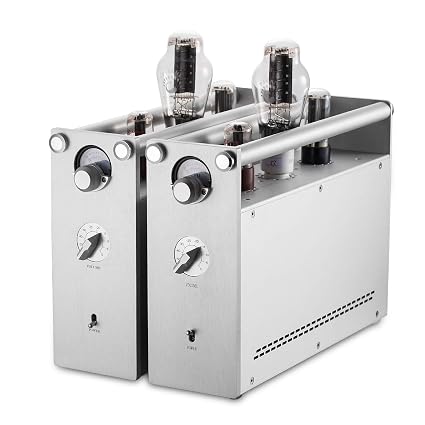
Best amp for the tube friendly Devores would be a 300B SET. You won't have to upgrade as it doesn't get better than a single ended triode amp if you value resolution. Plenty of power for 90 db speakers and you can buy these Nobsound mono blocks on Amazon for $1169 or on ebay for $869 shipped. One AK owner here has a pair and gives them the highest praise.

613aTkjuJKL._SX425_.jpg
 
Last edited:
I have had great and reliable performance from my Yamaha A-S500 amplifier, replaced by the A-S501. This is an integrated amp and has a popular following. Mine did need to be broken in as it was a bit too bright at first, but the excellent tone controls helped me during the aging process.

Thank you for the recommendation--I am probably looking to spend a bit more and sort of "max out" in terms of my budget--so, downsize, but not by a big margin. Although it's a stop gap type amp, I think, it would likely be a year or two long stop.


I think that keeping the Devores close to the front wall,you sacrifice some imaging,and probably a boost in bass. However life is full of compromises! Sometimes being close to the target is good enough. Enjoy!!!

You are very likely right regarding imaging, though they are front ported so I think they're not terribly compromised. In any case, you're right it's a trade off--I think I prefer the bass boost, but we'll see what it's like in the next apartment--then it's full steam ahead again for the ol' neurosis.


Best amp for the tube friendly Devores would be a 300B SET. You won't have to upgrade as it doesn't get better than a single ended triode amp if you value resolution. Plenty of power for 90 db speakers and you can buy these Nobsound mono blocks on Amazon for $1169 or on ebay for $869 shipped. One AK owner here has a pair and gives them the highest praise.

613aTkjuJKL._SX425_.jpg

Those are very interesting--I'm reading sort of mixed reviews on them, but I have a suspicion they're probably harshly judged since their seems to be a bit of 300B eliteism online (this being, like...my opinion, man). I have definitely wanted to try a 300B amp because they do seem pretty magical, BUT I do wonder if they'd have sufficient oomph. I believe the gibbon 8s are only 88dB efficient--the super 8s and upwards have 90, 90.5, 91 dB sensitivity. Since I don't listen that loud (typically 65 dB to 75 dB average SPL with 80 and peaks, respectively, at absolute highest), I imagine they'd be reasonably safe from clipping, but I can't figure as to whether they'd end up sort of sloppy/flabby. As a point of reference, some claim that the Leben cs300xs at (i think) 15 wpc is more musical than the cs600, but the majority seem to favor the 600's grip. Those nobsound monoblocks would only play like 3 dB quieter than the leben, but maybe it pushes that grip even further down.

Interestingly, there's a line magnetic 216ia up for sale on another site right now for $1000, which if I had sold off my preamp already I wold be sorely tempted by. There's also a Kenwood kw220 up for grabs at a pawn shop near me for $185 right now (though I have no idea what kind of shape it's in); definitely an interesting option for that price, though I imagine not nearly as nice sounding.
 
A system is only as good as it's weakest link ..you have an excellent preamp and speakers and an Okay, kind of amp..
I would be looking at a truly good cartridge and turntable .. major improvement .. you need better source material ..
Higher quality speaker cables and interconnects .. (make the most of what you've got)
Improved digital sources ..
And lastly an improved amp ..
You can't reproduce detail that isn't there because of a limited cartridge and turntable ..and the rest of the system is very capable..
 
Back
Top Bottom