• The move to the new server is done. There are some software and database maintenance updates in process. This has us passing the hat around to help out. We appreciate any donations. Seriously, even a dollar helps. The payment page may be found here - https://www.audiokarma.org/support.html

Reconditioning Hardened Cloth Speaker Surrounds

grey_beard

Active Member
I recently was given a pair of Sansui sp-2000's. Upon hooking them up to several different solid state amplifiers I came to the conclusion that they lacked bass almost entirely. The only way to coax anything approximating proper bass response was to turn on loudness and increase the bass on the amplifier to 75% - even that produced less than desirable results.

After removing the wooden speaker covers I found that the 12" woofers were almost impossible to move when pushing on them. I've never encountered a speaker like that so the hunt was on.

Much searching led me to some threads here that mentioned that the sealant used on these cloth surrounds during the vintage of these speakers could become overly hard over time which I believe is what has happened to this pair. I have no information on the history of these speakers as they were a throw-in on a purchase from CL so I can't speak to how these particular speaker surrounds became stiff or when it may have first been noticed.

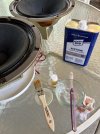
Following instructions found on this thread, http://audiokarma.org/forums/index.php?threads/sansui-cloth-surround-restoration.565910/ I removed the old surround sealant and replaced it with new sealant purchased from Vintage-AR on the auction site.

I chose to use acetone to remove the old sealant which seemed to work quite well and immediately allowed the previously frozen woofers to move.

Now to wait for the new sealant to dry and report back with the A/B results measured against the non-treated speaker.
 
Register to hide this ad
Now to wait for the new sealant to dry and report back with the A/B results measured against the non-treated speaker.

That "sealant" doesn't dry. It's supposed to stay sticky for its entire life.

Thanks for reporting your results from renewing the surround treatments.

GeeDeeEmm
 
Oh boy @grey_beard, looking forward to your comments after further testing. Just as @gdmoore28 stated, the sealant applied does not really dry, but it may take a couple of hours for the Toluene to evaporate completely. Keep us posted. :thumbsup:
 
Dang, well aint that something. Congrats on your efforts and ive got a sneaking suspicion all will be well.

Biggles
 
If is it not the same as the original doping material, you will change the physical parameters of the drivers and that will change the crossover point for that driver.

This is like putting foam surrounds on speakers that use rubber ones.

I totally agree, but in the case of the old Sansui woofers a brittle surround will not allow for proper movement and therefore degraded bass. If an original one was tested long ago and the parameters were known someone could experiment and try to obtain results similar to the original, but that is not the case here. In this situation I believe that I would suffer the consequences and do the same thing in order to try and make the surround more flexible to obtain increased bass output. Worst case is to buy a couple of generic woofers from PE to replace the originals since they are already not functioning properly. Just my opinion of course.
 
I had SP1200's, that also had the hardening surrounds, didn't want to flex. I didn't have the courage to mess with the cloth. Sold mine. They sure had some beauty cabinets. But even with like new surrounds, the cabinets don't have optimum volume for optimum performance of 10" woofer, IMHO.
Enjoy.
 
Last edited:
If is it not the same as the original doping material, you will change the physical parameters of the drivers and that will change the crossover point for that driver.

This is like putting foam surrounds on speakers that use rubber ones.

Absolutely correct. The reason for using the Vintage-AR sealant is because it is supposed to be similar to what was used during the period these speakers were produced on cloth surrounds. Though we can't go back in time to compare the sound, this pair is shot and without serious intervention will soon be relegated to plant-stand status. So, here goes nothing.

I had SP1200's, that also had the hardening surrounds, didn't want to flex. I didn't have the courage to mess with the cloth. Sold mine. They sure had some beauty cabinets. But even with like new surrounds, the cabinets don't have optimum volume for 10" woofer.
Enjoy.

The cabinets and especially the wooden covers are just gorgeous, unfortunately these particular speakers put out minimal response below 45hz. The speaker will barely move when pushing on it but loosened up noticeably immediately after removing the old sealant, confirming the finding of others that it is the sealant becoming stiff which restricts the woofer's movement.

Now for my findings:
After stripping the old sealant and applying the new Vintage-AR sealant the bass response is noticeably improved. I applied a test tone and now get a good response down to 30hz. The response is greatly improved at higher frequencies as well. I've read some complaints on this board of people stating these speakers are boomy on the low-end. The ones I have are not, and even after the removal and application of fresh sealant, they remain subdued in the lower register.

The most surprising difference is in the overall clarity of sound produced from the newly treated speaker. The untreated one sounds muffled in comparison which I believe has to do again with the hardened surround on the woofer. I will find out tomorrow if the treatment improves the sound of the second speaker and report back.

So far, so good! A great big thank you to doctorolds for his thorough documentation which gave me the courage to try this.

@drbiggles, did you ever give this a try? Last I saw it looked like you were going to order some sealant. It looks like I will have plenty left over for you to give it a go if you are still interested after all these years.
 
Last edited:
Here are a few observations and notes from the cleanup of the cloth surrounds:

-I used acetone to soften the existing sealant. This seemed to work quite well. I would recommend acetone to anyone considering this project.
-I used a moderately stiff bristled paint brush to apply the acetone and gently scrub the cloth surround in order to remove the sealant. This seemed effective enough though a toothbrush may have been a better choice.
-It took several passes around the woofer before I felt I had removed as much of the original sealant as possible. I used an old white tshirt to clean off the old sealant every minute or so, after application of acetone and gentle scrubbing. The sealant came off in an orange/red color.
-As the cloth surround gets cleaner, the threads of the fabric become more and more prevalent. The sealant was applied more liberally in some places and where it remained it felt somewhat smooth after applying acetone and gummy as the acetone was removed but old sealant remained.
-It was very rewarding to feel the speaker begin to move more and more freely with each pass.
-I inspected the back of the surround in an effort to see if any sealant was perhaps making it's way through to the back of the fabric. If it was, it seemed an inconsequential amount plus with the speaker mounted in the basket it would have been prohibitive to try and remove any that was present.
-The surround forms a U shape around the cone. There is definitely sealant on the full U so I had to work to clean not just the bottom of the channel, but both sides as well.
-When applying the new sealant, I was careful to apply as thin a layer as possible - just enough the shine as the cleaned cloth is dull.
-At this point I have only applied one layer. I am not sure if there is any purpose to add another layer of sealant to these speakers. Quite frankly, the bass response is still subdued compared to other speakers I have.
-I used a signal generator app on my phone designed for testing subwoofer response to get an idea of what the speakers were outputting before and after as it allows me to walk down the scale in 5hz increments.

All-in-all, it was a simple project and will hopefully make these speakers more enjoyable. They certainly are fine looking.
 
Way to go @grey_beard. I'm glad to see that someone else decided to give this process a try. I hope that you are satisfied with the amount of bass you actually recovered by doing it.

If only someone that had a great memory had a pair when new and applied the sealant to the same type of speakers now in order to judge or determine how well it works would be awesome, then we would have a better idea. Of course the t/s parameters for an original driver compared to one that has been altered with this process would be the answer. This is not likely to happen, but it is possible.

Thanks for sharing and documenting your experience with us and if you keep them for a while let us know if they retain there bass performance. :beerchug:
 
Last edited:
Hey Grey Beard,

Youre awesome. Thank you for your time in the project and putting it down here. My 2 pairs of 3500's are long since gone, the 1500's too. Although, the latter didn't suffer a stiff surround like the larger ones did. If i run across another pair, ill try your method out.

Biggles
 
Final report.

These speakers are very enjoyable.

Here's a rundown of what I did to them.

1. Recap the crossover. Don't shoot, but I used electrolytics. I know... I could have gone with Daytons, but I didn't know better at the time. I also, didn't use any "bypass caps". Still super happy with the sound.
2. This was the time to replace the tiny little speaker terminals with some that can actually fit a 14 gauge speaker wire or a banana clip. If you've never recapped one of these crossovers, several caps are soldered to the positive terminal so it was easy enough to replace both positive and negative while in there.
3. And the purpose of this thread, reconditioning the cloth surrounds. This clearly made the majority of the difference in sound as I did A/B test with one surround done and the other not. This a super easy part of reworking these speakers. You don't have to open the back. You do however need to order the new sealant from the auction site. The bass response is vastly improved.

Bottom-line, I could be quite happy running these speakers as primaries. I currently have them setup in my office running off a Marantz 2226b. They sound full and clear. No complains. Now to put the wood grills back on and enjoy hearing and looking at them for awhile before passing them on.

P.S. I have enough of the sealant left for at least one more set of 12" inch woofers. Message me if you are interested and I'll gladly send it over to you.
 
Thanks for sharing your experience and documenting your procedures. I'm glad that you're happy with the end results. Hopefully others will begin to try this process to obtain bass response that is closer to what was originally intended. :rockon:

PM incoming on sealant.
 
Wow gray beard, good notes here. I have a pair of 2500s I might do this to. Thanks to doctorolds for referring me to this thread. Did you happen to get any pics of your speakers after cleaning with acetone? I just ordered some of that sealant to do my KLH 17s, I’ll have some leftover to do my 2500s when it comes time.
 
Just picked up a pair of SP2000s, beautiful condition cabinets, and drivers, and original boxes. Tone controls had to be seriously cleaned and that got mids and tweets working properly, absolutely wonderful tones in those registers. Bass a bit thin. Came here hoping the find that the leftover AR goo I got a while back will work any sure sounds good. The acetone will be done outside. Excellent description, Grey_Beard, thanks. I'll try to post some photos.
 
I just came into a pair of Sansui SP-200 that are in very good, un-screwed-with condition. The caps were closer than they had any right to be but after measuring I replaced them with new electrolytics like they came with originally. Cleaned up the switches with DeOxit and Q-Tips. I noticed that the woofs were kind of stiff feeling but just put them back together and listened for a few hours. I didn't think they really sounded deficient on the bottom end, not "modern" by any means, but reasonable. In my reading on the InterWebs I saw that there were at least a few parties that warned against trying to loosen them up. I thought this made some sense with the GIGANTIC port and relatively large volume of space in the cab. These are NOT Acoustic Suspension speakers. Don't you think it's possible that the compliance on these might be stiff for reasons other than age? I realize that this was kind of a zombie thread ...
 
Back
Top Bottom