• The move to the new server is done. There are some software and database maintenance updates in process. This has us passing the hat around to help out. We appreciate any donations. Seriously, even a dollar helps. The payment page may be found here - https://www.audiokarma.org/support.html

Record Cleaning Question

If you want the best record cleaning results you need to break out your wallet, and roll up your sleeves. There is sufficient labor involved.

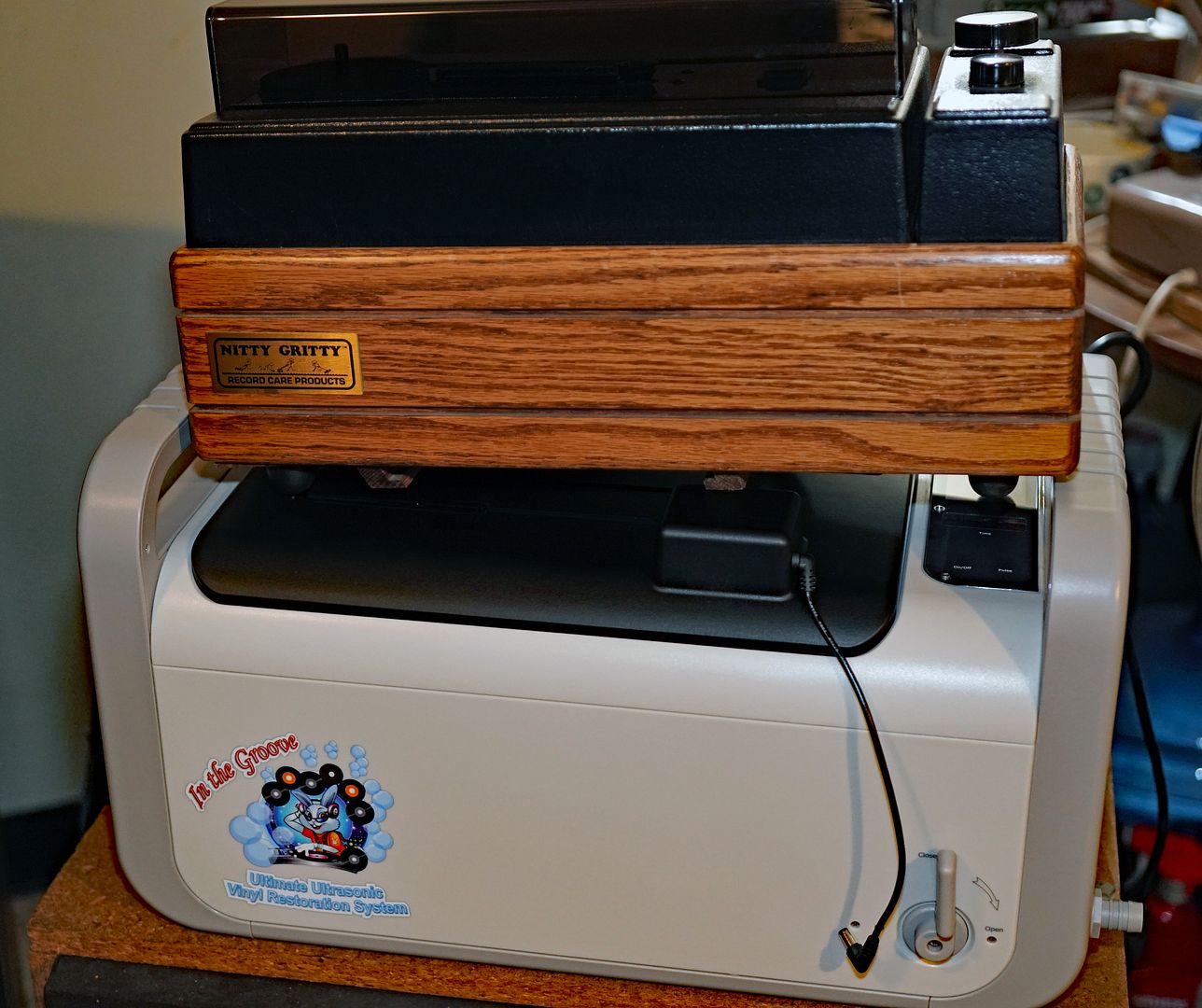
The Kirmuss Record Restoration system. 3 records at a time, 40ml ISO in the tank. Application of suffocate few minutes. Some albums take multiple rounds. I've seen some outstanding results with used records.


View attachment 3830980View attachment 3830981
Edited to make my post sound nicer:
The Kirmuss is nothing but an ISonic at a much higher price.
 
Edited to make my post sound nicer:
The Kirmuss is nothing but an ISonic at a much higher price.
This is just my 2¢ of 2¢. So take it with a grain of salt. ;)

I've owned my Kirmuss since 2018, zero problems. Which is not what I could say about the Nitty Gritty 2.5 that the Kirmuss replaced. Even though the Nitty Gritty was not an ultrasonic bath, it was always breaking down or leaking. The Kirmuss has prolly cleaned more records in the last 8 years than the NG did in 20 years. The NG was just not reliable. I ended up just using the NG's vacuum to dry LPs, which I hand-washed.

I'm guessing maybe 400 LPs or more have been cleaned by the Kirmuss.

I did get the Kirmuss from a guy who bought two and sold one new-in-box for $500 (2018 prices). The only accessories I bought are a couple of sets of spare felt wipes.

91e35f7f-9a98-40b9-a1d6-330b9c42d45f.jpg
 

That looks like a deal.

Here is my take on record cleaning:

- Wet cleaning of all varieties (cloth and kitchen sink, Spin Clean, Ultrasonic) don't really get the guck out unless you vacuum the dirty liquid out after cleaning.

- Using a vacuum cleaner at full suction on a turntable or lazy Susan is problematic because it is difficult to get a system where the record is clamped down to the spindle and doesn't just stick to the vacuum cleaner

- I use a crevice tool covered with a soft clean microfiber cloth to vacuum, but I simply hold the record and vacuum - this takes a bit of practice (the record can fall rather easily and you end up getting your pant leg wet), but I would like a better system. I have a junk AT 120 turntable that I would like to use as a platform to vacuum dry, but I haven't yet figured out an easy way to clamp the record down. I suppose my next move should be to get a small wet/dry small shop vac that has adjustable vacuum pressure, so I can use a minimum amount of - but then will this get as much crud out as my full power vacuum?
 
I feel grateful to have come along at a time when one can buy an ultrasonic cleaner for under $100. Got my Vevor for $95 plus tax with free shipping. So just over $100 all in. If the thing does what it's supposed to do, it was a no-brainer even though I'm still so new to turntables (if we don't count the first 30 years of my life). One of my very early memories is of going to my grandmother's house and hearing her play "I've Gotta Be Me" by Sammy Davis on her stereo console. We're talking 1966. That became my favorite song at age 3. Not kiddie songs, though I enjoyed them too.

It was clearly displaced when I was 12 or so by Simon and Garfunkle's "Flowers Never Bend" and other mellow stuff like that. A few years later, I was deep into Emerson, Lake and Palmer, early Genesis (the Peter Gabriel version) and Pink Floyd. After college, my tastes broadened out. Discovered public radio and opened to all kinds of stuff. Just about melted when I heard Suzanne Vega singing "Knight Moves". Both by the music and the lyrics.

Do you love any, do you love none?
Do you love many, can you love one?
Do you love me?
Do you love any, do you love none?
Do you love twenty, can you love one?
Do you love me?

Heavy philosophy for a young adult wrestling with relationship challenges for the first time.
 
I'll start by running them for a half hour.
Whoa there bronco! 30 mins is a long, long time in an ultra sonic bath.
I would say cutting that down by ⅔ is more than enough time. More than 10 mins will not yield any greater benefits and, given that you're going to be using (very clean) tap water, the longer it runs the more likely it is to cause damage.
 
Whoa there bronco! 30 mins is a long, long time in an ultra sonic bath.
I would say cutting that down by ⅔ is more than enough time. More than 10 mins will not yield any greater benefits and, given that you're going to be using (very clean) tap water, the longer it runs the more likely it is to cause damage.
Well, I'll be experimenting with records I don't care about.
 
@Parallax982, I do so admire your enthusiasm! Let us know how it goes, and should you seek answers to most if not all of the questions you've already asked, they are more than likely waiting for you in the sticky thread that is quite long, hence few these days like to go there.

That said, you might heed the cautions by @Lou G and @chaz (above) that exposure longer than 10-15 minutes does not give better results (verified by scientific method, observing groove cleanliness with a microscope.....again, see @Lou G post). Further, as already mentioned, longer exposure can increase risk of damage. Since you're "adequately motivated" :) you might run the following test for yourself to see exactly what the cavitation process does by taking a piece of aluminum foil and suspending it in the tank while the transducers are active. After a few minutes, (in my experience, at least 3 and sometimes up to 10) of "cleaning" the aluminum foil, remove it and tell us what you see......it might provide you with valuable insight about how long to leave your favorite records in the bath. I know you said you will be doing your "experiments" using records you don't care about, and that is fine. Otherwise, though, it might be advantageous to tap into the work already done in the spirit of "do no harm....." Carry on, amigo.

PS - There is a caveat I'll mention for reference.....there have been times when I have run records through a cleaning cycle more than once, sometimes up to 3 times but not until after I've played them to see if the grooves were clean. There have been a couple where whatever the substance stuck in the grooves was so stubborn that it took repeated cleaning cycles to finally get rid of it. But again, never leaving the record in the cleaner for more than 15* minutes at a time (*that's just been my method, rather than 10 as mentioned to be adequate). You will also notice that as the cleaning process goes on, the temperature in your bath will rise from the heat which the transducers generate, without the heater even being on.....that, too, can damage (warp) records so just be aware......that is, keep an eye on a reliable thermometer as you go. Test the tank's thermometer(temperature display generated) with a known to be good, reliable thermometer so you know exactly where you are. I consider this to be important.

You're not having any fun yet, are you!!! :banana:
 
@Parallax982, I do so admire your enthusiasm! Let us know how it goes, and should you seek answers to most if not all of the questions you've already asked, they are more than likely waiting for you in the sticky thread that is quite long, hence few these days like to go there.

That said, you might heed the cautions by @Lou G and @chaz (above) that exposure longer than 10-15 minutes does not give better results (verified by scientific method, observing groove cleanliness with a microscope.....again, see @Lou G post). Further, as already mentioned, longer exposure can increase risk of damage. Since you're "adequately motivated" :) you might run the following test for yourself to see exactly what the cavitation process does by taking a piece of aluminum foil and suspending it in the tank while the transducers are active. After a few minutes, (in my experience, at least 3 and sometimes up to 10) of "cleaning" the aluminum foil, remove it and tell us what you see......it might provide you with valuable insight about how long to leave your favorite records in the bath. I know you said you will be doing your "experiments" using records you don't care about, and that is fine. Otherwise, though, it might be advantageous to tap into the work already done in the spirit of "do no harm....." Carry on, amigo.

PS - There is a caveat I'll mention for reference.....there have been times when I have run records through a cleaning cycle more than once, sometimes up to 3 times but not until after I've played them to see if the grooves were clean. There have been a couple where whatever the substance stuck in the grooves was so stubborn that it took repeated cleaning cycles to finally get rid of it. But again, never leaving the record in the cleaner for more than 15* minutes at a time (*that's just been my method, rather than 10 as mentioned to be adequate). You will also notice that as the cleaning process goes on, the temperature in your bath will rise from the heat which the transducers generate, without the heater even being on.....that, too, can damage (warp) records so just be aware......that is, keep an eye on a reliable thermometer as you go. Test the tank's thermometer(temperature display generated) with a known to be good, reliable thermometer so you know exactly where you are. I consider this to be important.

You're not having any fun yet, are you!!! :banana:

Thanks so much. Appreciate the wisdom and the guidance.
 
Whoa there bronco! 30 mins is a long, long time in an ultra sonic bath.
I would say cutting that down by ⅔ is more than enough time. More than 10 mins will not yield any greater benefits and, given that you're going to be using (very clean) tap water, the longer it runs the more likely it is to cause damage.
Also, most ultrasonic baths aren’t engineered for continuous 30-minute runs. This will likely reduce the unit’s life.

I run 5-minute baths, then recheck. Let the system cool down for a few minutes, then rerun another 5-minute bath if needed.

For dirty, dusty old LPs, I always hand-wash them with Dawn and a microfiber-covered sponge. Rinse super well with another clean sponge. Then, into the bath. By prewashing dirty LPs, you prevent surfactants and other contaminants from accumulating in the bath’s reservoir. Often, the residue turns into a slimy mess, making you need to change the bath sooner.
 
By prewashing dirty LPs, you prevent surfactants and other contaminants from accumulating in the bath’s reservoir. Often, the residue turns into a slimy mess, making you need to change the bath sooner.
I believe this to be excellent advice......after nearly 4,000 US cleaned records, I can tell you that I learned this lesson early on and it really does save a lot on how often you have to change the bath fluid and it doesn't get nearly as gnarly as it does when you don't.....
 
I believe this to be excellent advice......after nearly 4,000 US cleaned records, I can tell you that I learned this lesson early on and it really does save a lot on how often you have to change the bath fluid and it doesn't get nearly as gnarly as it does when you don't.....
Also, I believe the ultrasonic process is more effective on the remaining Goombas, if the bigger, stickier Goombas, are first removed.

9280705d-33e6-44fc-94cc-1699dfff38bb.gif
 
Back
Top Bottom