• The move to the new server is done. There are some software and database maintenance updates in process. This has us passing the hat around to help out. We appreciate any donations. Seriously, even a dollar helps. The payment page may be found here - https://www.audiokarma.org/support.html

Record Cleaning Question

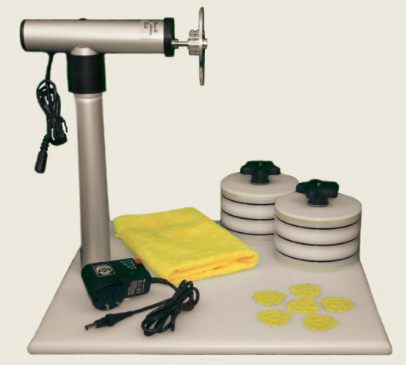
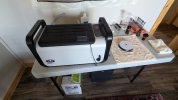
They both have record cleaning attachments. Appears to be the very same ultrasonic machine except that the cheaper one has analog controls and the more expensive one has digitial. The rotisserie that turns the records is also different. The more expensive unit has a stronger setup that can hold 8 records max. The less expensive maxes out at five. Went with the cheaper one because I prefer analog controls (less to go wrong) and I'm not going to do more than two at a time. A whole bunch of people wrote online, including on this site, that it works best with two records max.

God only knows when it will arrive. Has to get shipped from China. Ordered yesterday and hasn't been mailed yet.
It'll work best with 5 no problem. This whole, "it needs at least 1.5" between records", has been debunked many times. The bubbles are microscopic, they'll get into anything you put in the bath. GL, hope it shows sooner than later.
 
Vevor can be hit or miss......took me 3 tries before I got one where everything worked so heads up......customer service was a joke, but Amazon stood behind their reputation and replaced them.
 
Vevor can be hit or miss......took me 3 tries before I got one where everything worked so heads up......customer service was a joke, but Amazon stood behind their reputation and replaced them.
Well, I might be in trouble since I bought it directly from Vevor. Much better price. Got the cheap one for $95. But I might be stuck dealing with their customer service.
 
May the winds of good fortune be blowin' your way amigo......they've probably gotten better with QC since at the time I was reading about frequent returns and that may have helped. In any event, let's see how it goes and hopefully get on with some really good record cleaning!!! If everything works as it should, I'm anticipating you having some "aha" moments.....carry on
 
May the winds of good fortune be blowin' your way amigo......they've probably gotten better with QC since at the time I was reading about frequent returns and that may have helped. In any event, let's see how it goes and hopefully get on with some really good record cleaning!!! If everything works as it should, I'm anticipating you having some "aha" moments.....carry on
Thank you. It went out in the mail today. UPS has the package and it's supposed to arrive in six days.
 
I'm a couple of hours north of Seattle, about 20 minutes from the Canadian border. How about you?
That's a wonderful place to be.....almost moved to Bellingham years ago when I was living in Durango, Colorado but decided to move 35 miles south to Farmington, NM where it's a bit warmer and less snow. When you hover your cursor over my avatar, you will see that. If you input your location in your profile it will show up there. Let us know how it goes, amigo, and I'm pretty sure that ultrasonic cleaning will not disappoint if done properly.....
 
That's a wonderful place to be.....almost moved to Bellingham years ago when I was living in Durango, Colorado but decided to move 35 miles south to Farmington, NM where it's a bit warmer and less snow. When you hover your cursor over my avatar, you will see that. If you input your location in your profile it will show up there. Let us know how it goes, amigo, and I'm pretty sure that ultrasonic cleaning will not disappoint if done properly.....
Thanks. My kids used to attend a wonderful summer camp in Durango. Beautiful place. I don't know Farmington but have traveled extensively through both Colorado and New Mexico. I love both.
 
Here's some worthwhile reading for you, and while Rushton in my opinion takes some things to extremes, the key takeaways are hard for me based on my personal experience with ultrasonic cleaning to find fault with. Particularly, and this is also be discussed in the sticky (Record Cleaning, Developing The Best Possible Methods) above, his formula for the most effective solution in the tank:


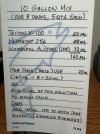
There are many opinions and no doubt other formulas that work, including just plain distilled water as you are intending to use, but I've found this one to be particularly effective. Above all, I believe we all ascribe to the idea of "DO NO HARM," otherwise our best efforts will not result in what we have intended. Here's what my formulation looks like, pretty close to that of Rushton Paul's:

1788625957980.jpeg

The reason you make a concentrate is that the Triton needs to be refrigerated to avoid bacterial growth. Once you have made the mixture, the Hepastat and IPA will keep the bacteria from growing and you are good to go. It's really convenient to have this concentrate (I put it in an empty IPA bottle) so when it's time to refresh your tank (they do get dirty from the detritus removed from the records, witness the stuff on the bottom of your tank after it's been turned off for a while) all you have to do is empty it and clean it, then pour in the 4.5-5qts of distilled and start the formula over again. After looking at the Rushton Paul article, I'd say you would be extremely well-served to delve into the long thread (sticky) I mentioned above. This consists of many, many members experiences, trials and tribulations, and authored by a chemist who really knows his stuff albeit no longer a participant on this site (or, maybe????) ;)

In any case, glad you're along for the ride as that's the only way to find out if this is for you......carry on amigo
 
If you want the best record cleaning results you need to break out your wallet, and roll up your sleeves. There is sufficient labor involved.

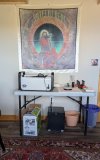
The Kirmuss Record Restoration system. 3 records at a time, 40ml ISO in the tank. Application of suffocate few minutes. Some albums take multiple rounds. I've seen some outstanding results with used records.


PXL_20260905_231238873.jpgPXL_20260905_231356342.jpg
 
Here's some worthwhile reading for you, and while Rushton in my opinion takes some things to extremes, the key takeaways are hard for me based on my personal experience with ultrasonic cleaning to find fault with. Particularly, and this is also be discussed in the sticky (Record Cleaning, Developing The Best Possible Methods) above, his formula for the most effective solution in the tank:


There are many opinions and no doubt other formulas that work, including just plain distilled water as you are intending to use, but I've found this one to be particularly effective. Above all, I believe we all ascribe to the idea of "DO NO HARM," otherwise our best efforts will not result in what we have intended. Here's what my formulation looks like, pretty close to that of Rushton Paul's:

View attachment 3830650

The reason you make a concentrate is that the Triton needs to be refrigerated to avoid bacterial growth. Once you have made the mixture, the Hepastat and IPA will keep the bacteria from growing and you are good to go. It's really convenient to have this concentrate (I put it in an empty IPA bottle) so when it's time to refresh your tank (they do get dirty from the detritus removed from the records, witness the stuff on the bottom of your tank after it's been turned off for a while) all you have to do is empty it and clean it, then pour in the 4.5-5qts of distilled and start the formula over again. After looking at the Rushton Paul article, I'd say you would be extremely well-served to delve into the long thread (sticky) I mentioned above. This consists of many, many members experiences, trials and tribulations, and authored by a chemist who really knows his stuff albeit no longer a participant on this site (or, maybe????) ;)

In any case, glad you're along for the ride as that's the only way to find out if this is for you......carry on amigo
I'm going to start simple. Can always do more if it seems the records could be cleaner. Some folks express concern about over-cleaning and damaging them. Some recommend running the machine for half an hour. Others for 5 minutes max. With all sorts of additives. But then a few say one doesn't even need distilled water. The water here is extremely soft and clean (one of the four cleanest water systems in the country) so I may experiment with tap water.
 
But then a few say one doesn't even need distilled water. The water here is extremely soft and clean (one of the four cleanest water systems in the country) so I may experiment with tap water.

I would avoid tap water. Distilled or RO water, which I believe is better. As far as additives, my recommendation is 40ml 70% ISO, no higher percentage. What this small amount of alcohol does is help break down the bond between the water molecules. This helps create smaller cavitation bubbles.
 
Here's something to keep in mind with regard to cleaning records. And my apologies if this has been gone over already - I haven't read the thread ( too busy listening to records ;) )
Generally speaking our records can have 2 basic issues that are both called 'dirty'. One, is particulate matter on the surface and embedded in the groves, and the second is typically organic residue that can coat ( partially or more) the surface and reside in the groove as well.
Ultrasonic cleaning (in distilled water with nothing added) is a physical cleansing that removes the particulate matter from the surface and the groove better that any other method I know of.
This is accomplished by the microscopic bubbles created by the transducers exploding on the surface and in the grooves of the disc. The force of these exploding bubbles is what 'pushes loose' the foreign particles embedded in the grooves.
That's all the 'ultrasonic' part does. It is purley physical in nature.
Some of the organic residue may be loosened by the ultrasonic action as well, but that will likely need some sort of 'cleaner' to be completely removed, as it is more of a 'chemical issue' re. the 'stickiness' and how organic compounds bond themselves to various materials.
I have found that once I have cleaned my 2nd hand records of the organics they arrived in my collection with, then a once a year run in the ultrasonic with just distilled water and a surficant is sufficient to keep them clean.
The short end of the stick here is, in my experience I don't need to use 'cleaners' in every batch of records I do, just the first time I clean 'em.
Once I've got the gunk off the records, with careful handling and best practices, they don't get so dirty that they need the chemical cleaning again for a while, so I mostly run the ultrasonic with just plain distilled water and a surficant.
As always YMMV.
 
Last edited:
That's a wonderful place to be.....almost moved to Bellingham years ago when I was living in Durango, Colorado but decided to move 35 miles south to Farmington, NM where it's a bit warmer and less snow.
I'm more than a bit off topic, but on both directions of a fairly recent trip between Hondo, TX, and Tacoma, WA, I stayed at a Motel 6 on Bloomfield Blvd. in Farmington and enjoyed fine dining from a nearby Blake’s Lotaburger. Great tasting sandwich!
 
I'm going to start simple. Can always do more if it seems the records could be cleaner. Some folks express concern about over-cleaning and damaging them. Some recommend running the machine for half an hour. Others for 5 minutes max. With all sorts of additives. But then a few say one doesn't even need distilled water. The water here is extremely soft and clean (one of the four cleanest water systems in the country) so I may experiment with tap water.
Starting simple is a good choice. I found that a simple process works extremely well for cleaning records. For my record collection I only used distilled water and a non-ionic primary alcohol ethoxylate surfactant. Typically my cleaning time was 6 min, followed by a 1-2 min spin rinse and finally spin drying in a vertical position. For this entire process my records remained on my spindle assembly. When I first started cleaning my record collection, I typically cleaned 10 records at a time with a 1/2 inch spacing. I used this ultrasonic bath for over 30 years with excellent results.

Here are some key points that we observed in my laboratory using several analytical techniques to analyze sacrificial records before and after varying various cleaning parameters.

Only distilled water should be used. RO water is ok but typically not as pure as properly distilled water. I would not recommend tap water. Even soft tap water (10 to 20 mg/l) in an ultrasonic bath will introduce mineral deposits on a record surface. These mineral deposits can actually bond to the record surface or even be imbedded into the surface making them hard to remove.

Pure distilled water by itself works quite well in an ultrasonic bath but may not remove all contaminants.

Adding a little non-ionic surfactant improves the cleaning efficiency by lowering the surface tension.

Increasing the non-ionic surfactant concentration to the Critical Micelle Concentration improves the cleaning efficiency for more difficult to remove contaminants and contaminants present in higher concentrations.

Adding some Isopropyl alcohol also lowers the surface tension and helps to dissolve some contaminants. However I found that a proper non-ionic surfactant provides better cleaning efficiency.

Rinsing with distilled water is essential if using a surfactant or any other chemical component in the ultrasonic bath.

Regarding optimum cleaning time - We coated numerous sacrificial record samples with known contaminants to see how effective the ultrasonic bath was at removing them. For all contaminants, complete removal was observed within 1 to 2 min in a static (non rotating) ultrasonic bath using just distilled water and a non-ionic surfactant. This translates to ~ 3 to 6 min in a rotating assembly because ~ 1/3 of the record is in the bath at any given time. These experiments are the reason I settled on 6 min for my ultrasonic cleaning time. Longer times provided no cleaning advantage and can lead to some detrimental effects.

Only non-ionic surfactants should be used. Dish soaps typically contain a variety of surfactants including anionic surfactants as well as other non-essential ingredients. These surfactants and other ingredients can bond to the record surface and can be difficult to remove.

Recommended non-ionic surfactants include:
The Dow Tergitol 15-S series of non-ionic secondary alcohol ethyxolate surfactants, especially Tergitol 15-S-7.
TergiKleen, which is a blend of two Dow non-ionic surfactants – Dow Tergitol 15-S-3 and Dow Tergitol 15-S-9.
Ilford Ilfotol photographic wetting agent which only contains 2 ingredients, a preservative and a non-ionic branched alcohol ethoxylate surfactant.
Triton X-100 - which was developed by Dow many years ago, is an example of a non-ionic Octylphenol Ethoxylate surfactant. It works well for cleaning records but is not as environmentally friendly as the above listed surfactants.

 
Starting simple is a good choice. I found that a simple process works extremely well for cleaning records. For my record collection I only used distilled water and a non-ionic primary alcohol ethoxylate surfactant. Typically my cleaning time was 6 min, followed by a 1-2 min spin rinse and finally spin drying in a vertical position. For this entire process my records remained on my spindle assembly. When I first started cleaning my record collection, I typically cleaned 10 records at a time with a 1/2 inch spacing. I used this ultrasonic bath for over 30 years with excellent results.

Here are some key points that we observed in my laboratory using several analytical techniques to analyze sacrificial records before and after varying various cleaning parameters.

Only distilled water should be used. RO water is ok but typically not as pure as properly distilled water. I would not recommend tap water. Even soft tap water (10 to 20 mg/l) in an ultrasonic bath will introduce mineral deposits on a record surface. These mineral deposits can actually bond to the record surface or even be imbedded into the surface making them hard to remove.

Pure distilled water by itself works quite well in an ultrasonic bath but may not remove all contaminants.

Adding a little non-ionic surfactant improves the cleaning efficiency by lowering the surface tension.

Increasing the non-ionic surfactant concentration to the Critical Micelle Concentration improves the cleaning efficiency for more difficult to remove contaminants and contaminants present in higher concentrations.

Adding some Isopropyl alcohol also lowers the surface tension and helps to dissolve some contaminants. However I found that a proper non-ionic surfactant provides better cleaning efficiency.

Rinsing with distilled water is essential if using a surfactant or any other chemical component in the ultrasonic bath.

Regarding optimum cleaning time - We coated numerous sacrificial record samples with known contaminants to see how effective the ultrasonic bath was at removing them. For all contaminants, complete removal was observed within 1 to 2 min in a static (non rotating) ultrasonic bath using just distilled water and a non-ionic surfactant. This translates to ~ 3 to 6 min in a rotating assembly because ~ 1/3 of the record is in the bath at any given time. These experiments are the reason I settled on 6 min for my ultrasonic cleaning time. Longer times provided no cleaning advantage and can lead to some detrimental effects.

Only non-ionic surfactants should be used. Dish soaps typically contain a variety of surfactants including anionic surfactants as well as other non-essential ingredients. These surfactants and other ingredients can bond to the record surface and can be difficult to remove.

Recommended non-ionic surfactants include:
The Dow Tergitol 15-S series of non-ionic secondary alcohol ethyxolate surfactants, especially Tergitol 15-S-7.
TergiKleen, which is a blend of two Dow non-ionic surfactants – Dow Tergitol 15-S-3 and Dow Tergitol 15-S-9.
Ilford Ilfotol photographic wetting agent which only contains 2 ingredients, a preservative and a non-ionic branched alcohol ethoxylate surfactant.
Triton X-100 - which was developed by Dow many years ago, is an example of a non-ionic Octylphenol Ethoxylate surfactant. It works well for cleaning records but is not as environmentally friendly as the above listed surfactants.
Thanks for the advice. I'm going to start very simple, as stated, though I'm not going to be using any records I'm particularly attached to. Free ones that I don't like.

I'm going to begin with tap water because my water is very soft (19.8 mg/l) and the mineral profile really benign. It's one of the four water systems in the nation to achieve the highest ranking available for water systems. I will spray each record after the bath with distilled water just to make sure any tap water doesn't remain on the record as it dries. I will place them in a rack and let them air dry. I'm going to start off with no surfactants of any kind. No alcohol or soap. Nothing whatsoever.

Since I'm not attached to these records, I'll start by running them for a half hour. If the result is good, I'll start cutting the time down and see what happens. I want to make the process as simple as possible. But if it's not doing the job, then I'll consider how best to up my game (distilled water, sulfactants, alcohol???).
 
Back
Top Bottom