
• The move to the new server is done. There are some software and database maintenance updates in process. This has us passing the hat around to help out. We appreciate any donations. Seriously, even a dollar helps. The payment page may be found here - https://www.audiokarma.org/support.html

Red plating. Tech Bs? Need some advice

thomo57

Super Member
I recently purchased a valve amp.
When I got it I noticed the red plating of the 6GW8 valves.
I changed a few of the capacitors.
I had this very same amp a few years ago which I posted on AK and was advised to change these particular capacitors so I changed the same ones on this one.
When I powered it up I noticed the valves were still red plating so not being a tech I thought I'd take it to one.
This guy has fixed a few solid state ams for me over the years and he said he worked on valves.
He had it for about 3 months.
I was in no hurry for it as I'm not short of an amplifier.
Any way, I picked it up a couple of weeks ago.
Got it home, connected some speakers and powered it up.
2 of the valves are still red plating:tears:
I took it back to him and he said that they are red plating because it is a 220 volt model and in Australia we are 240 volt and there was nothing he could do to change that:scratch2:
I'm no technician but my bull **** meter went off.

I need some advice
Is my bull **** meter working.
If so does anyone know someone reputable in Sydney Australia that can fix this thing.
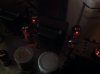
image.jpg
 
Register to hide this ad
Red plating is an effect of to much power loss in a tube. This is normally controlled by setting
"bias" to a suitable value. On some amps its adjustable, on other one might have to
adjust ( cathode resistors | values in some negative bias-chain or, even by adjusting the screen voltage)
Even if an amp has no adjustment methods, any knowledgeable technician can modify an amp in order to get the correct anode current.

What brand and model are we discussing ?
 
Thomo -- I would say you're both correct. If a unit ran the tubes near their limits by design, and then was powered by a line voltage that is nearly 10% high, it could certainly cause there to be color in the plates of the output tubes. Therefore, the tech's explanation is quite logical. However, as Peter said, any qualified tech will know how to make appropriate adjustments to compensate for this, so I would say that the calibration of your BS meter is dead on relative to his statement that nothing can be done about it.

If you consider yourself handy enough, there are plenty of places to go on the net for instructions on building a simple little external "bucking" power source to provide the correct voltage level for your amplifier to operate from. It involves nothing more than a small transformer, line cord, socket, and something appropriate to mount it all on to make the unit up. In your case, a transformer with a 240 volt primary, and a 24 volt 3A secondary (75 VA) would do the trick. The transformer leads are connected so that the 24 volts from the transformer "bucks" the 240 volt local power down to (in this case) about 216 vac to power the amplifier. Then, no internal changes inside the amplifier are needed. We do this all the time here in the states to operate equipment that was originally designed for 110 vac (or so) off of 120 vac of local power. Sometimes, the bucking transformer can even be mounted right on the unit itself if the transformer size and space accommodate each other.

If you do make it up, then take it to your tech and teach him a thing or two!

Good luck with it!

Dave
 
Hmmmm Am I seeing this correct 2 are 2 are not , BUT they are not a " pair " that are red plating? As stated before a model number of the amp would be a help.
Do you have access to a 240 Variac ? My GUT hunch is Bias setting OR resistors that are out of spec ( due to age ).. The Bucking idea will work as well. I would NOT run this amp until you can do some SCIENCE.. As far as the tech goes… that is just SLOPPY ~
Mike
 
Yeah, I don't buy the Tech's story either, Red plating is too much bias, bias is adjustable - even if you have to do it with fixed resistors.

And providing you only want the amp to work on one mains voltage setting, you can set the bias so the amp doesn't red plate - simple.
 
Hmmmm Am I seeing this correct 2 are 2 are not , BUT they are not a " pair " that are red plating? As stated before a model number of the amp would be a help.
Do you have access to a 240 Variac ? My GUT hunch is Bias setting OR resistors that are out of spec ( due to age ).. The Bucking idea will work as well. I would NOT run this amp until you can do some SCIENCE.. As far as the tech goes… that is just SLOPPY ~
Mike

That's right.
2 are and 2 aren't.(diagonal to each other)
It is an SA30 made in Japan in the 60's i believe
http://www.audiokarma.org/forums/archive/index.php/t-414533.html
I had this one a few years ago which I ended up taking to another "Tech" who advised me that he couldn't fix it and I might be better off selling it which I did on eBay.
Another AK member in Brisbane bought it and he tells me it took him 10 minutes to get it operating:tears:
When this one come up I wasn't letting it get away which is why I now question what Im told
 
Thomo -- I would say you're both correct. If a unit ran the tubes near their limits by design, and then was powered by a line voltage that is nearly 10% high, it could certainly cause there to be color in the plates of the output tubes. Therefore, the tech's explanation is quite logical. However, as Peter said, any qualified tech will know how to make appropriate adjustments to compensate for this, so I would say that the calibration of your BS meter is dead on relative to his statement that nothing can be done about it.

If you consider yourself handy enough, there are plenty of places to go on the net for instructions on building a simple little external "bucking" power source to provide the correct voltage level for your amplifier to operate from. It involves nothing more than a small transformer, line cord, socket, and something appropriate to mount it all on to make the unit up. In your case, a transformer with a 240 volt primary, and a 24 volt 3A secondary (75 VA) would do the trick. The transformer leads are connected so that the 24 volts from the transformer "bucks" the 240 volt local power down to (in this case) about 216 vac to power the amplifier. Then, no internal changes inside the amplifier are needed. We do this all the time here in the states to operate equipment that was originally designed for 110 vac (or so) off of 120 vac of local power. Sometimes, the bucking transformer can even be mounted right on the unit itself if the transformer size and space accommodate each other.


If you do make it up, then take it to your tech and teach him a thing or two!

Good luck with it!

Dave

I'm no technician but I do have a pile of nice transformers which I've picked up over the last few years that are suitable for valve amps (got the gear but not the knowledge to do anything with them:D) and I do have a beautifully huge variac.
I start looking at what is involved and it makes me aware of my knowledge and limitations to play with electricity.
Is the variac a good option.
It weighs about 20lb or more so it's no light weight

The VARIAC is a good tool to check if high line voltage is contributing to the problem. However, it's sorta a waste of the VARIAC to use that as the solution (assuming it helps).
 
If its a Japanese amp, especially one that had those lousy grey capacitors installed, it might be worth checking the output transformers for continuity. Check from pin 6 to pin 6 on the 6gw8 socket for the left channel and for the right channel. You should see a couple hundred ohms resistance at most. If it reads open circuit, the tubes are turning red because the output transformer is shot. Sometimes this happens when the coupling caps go bad and cause the tube to conduct too much.

If thats good, try switching the tubes that glow for the ones that do not. See if the issue moves with the tube or stays at the socket.
 
Back
Top Bottom