
• The move to the new server is done. There are some software and database maintenance updates in process. This has us passing the hat around to help out. We appreciate any donations. Seriously, even a dollar helps. The payment page may be found here - https://www.audiokarma.org/support.html

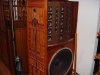
Refrigerator Sized RTR's with 24 Inch Woofer

BentWookie

New Member
I own a pair of 280DRs (four 10" drivers, one downward firing, one left, right, center, two tweeters per side for a total of six) that I absolutely love, and researching the brand I stumbled across this exotic beast--apparently being used in some guy's organ rig. 15 midranges and 18 tweeters JEBUS.

Any info on these? Specs, history etc.?

http://www.leochristopherson.com/about_my_hauptwerk_home_organ.htm
 

Attachments
  • RTR_Speaker.jpg
    RTR_Speaker.jpg
    79.3 KB · Views: 268
Last edited:
Register to hide this ad
While I can't answer your questions, the speaker is an early take on a small line array. The slots in front of the mids/tweets are an interesting way to increase directivity of the cones.

I counted two dented mid dustcaps (with one possibly torn cone) and eleven dented tweeter dustcaps. Given that the tweeters are behind a grille and recessed, who the $%# would go out of their way to punch in the dustcaps?
 
That is one of the coolest looking speakers I've ever seen! Did they have hidden microphones in the confessionals that sent an amplified signal to this speaker? (lol)

The "behind a slot" mounting of the mids and tweets would cause pronounced diffraction artifacts which would detract from what could otherwise be a fine sounding speaker. On the other hand, with organ music it would not be so noticeable. If the drivers were mounted on the front of the baffle, this speaker could sound really neat!
 
While I can't answer your questions, the speaker is an early take on a small line array. The slots in front of the mids/tweets are an interesting way to increase directivity of the cones.

I counted two dented mid dustcaps (with one possibly torn cone) and eleven dented tweeter dustcaps. Given that the tweeters are behind a grille and recessed, who the $%# would go out of their way to punch in the dustcaps?
What looks like a torn mid is actually adhesive. I've seen this on a couple speakers, but not very often. As for the mids, honestly those look like CTS drivers, same/similar as used in Bose 901 and Polk model 7 (or something of that flavor). Fairly common driver, but it was sold as a full range. Of course, nothing wrong with using as a mid.
 
Following up on the comment above...

It was the Polk Model Nine (Matthew & Co's first consumer product) that used the 4-1/2" CTS extended-range drivers (and nice sounding l'il drivers they be).


The very original Model Nine (above), for better or worse, featured no electronic crossovers at all - using a piezo tweeter and a passive radiator to augment LF... the later Model 9A, prudently (from my perspective) replaced the Motorola piezo with the smooth and sweet sounding Peerless silk dome tweeter that would also be used in the earlier versions of the "Monitor Series" Models 7 and 10 (and other later versions of their very popular Monitor Series, incuding the very early Monitor 4, the 5, and the 12 models at least).

Electrovoice used their LS-8 and SP-8B "fullrange" drivers quite effectively as midrange drivers in their Esquire/Royal/Regal line of "ultra-compact, low-resonance" loudspeaker systems. I've lately been using regularly using apair of Esquires at the MA house...


Actually I'm more interested in the Insoniq's ASR10's that have a floppy drive. I highly doubt that's for updating firmware like a modern RS-232 port would do. I notice some ZIP (100MB or 250MB?) drives too.

I remember my school band had dedicated hardware that you could put a special cartridge into the device and it would load up MIDI songs and you picked which instrument you were playing (clarinet or trombone, etc.), and you could practice along with the MIDI instrument. The hardware was connected to an old Mac computer (obviously to run the software), but I thought it was neat that you could pick any song and pick any instrument (or multiple instruments) to hear how the sheet music was supposed to play.

I wonder if that ASR10 does something like that: load it up with floppies with certain songs or accompaniments? Does anyone know what I'm talking about (I never used that device at the school)?
 
Following up on the comment above...

It was the Polk Model Nine (Matthew & Co's first consumer product) that used the 4-1/2" CTS extended-range drivers (and nice sounding l'il drivers they be).


I have enough "spares" to build a set of Nine's. Also have sufficient Piezo tweeters AND have 4 JBL PR-10 passives. Hmmmm......
 
actually i did build a sort of knock-off of the Polk as well as a 'mini Bose 901' with four of the CTS drivers. Actually i bought mine from a company called Auratone which claimed (i now know erroneously) that they 'made' these small drivers for Bose and others. no mention of CTS. they did have a nice deal on them in lots of nine drivers so you could presumably build you own 901. what i did was split it up into four drivers each. i used a piezo like the Polk but quickly changed that to a small peerless cone which was much better. i also later added one facing the rear. i used an old 8" woofer with a small weight on it and the magnet knocked off as a PR. it sounded okay but not the way i wanted so i built the small 901 version i mentioned. i used those eventually as rear speakers with one of those Dyna-Quad boxes. i was content for a short while..
 
Back
Top Bottom