• The move to the new server is done. There are some software and database maintenance updates in process. This has us passing the hat around to help out. We appreciate any donations. Seriously, even a dollar helps. The payment page may be found here - https://www.audiokarma.org/support.html

Relative Newbie Question on Scott 99C Phono Capacitors

Quillgordo

New Member
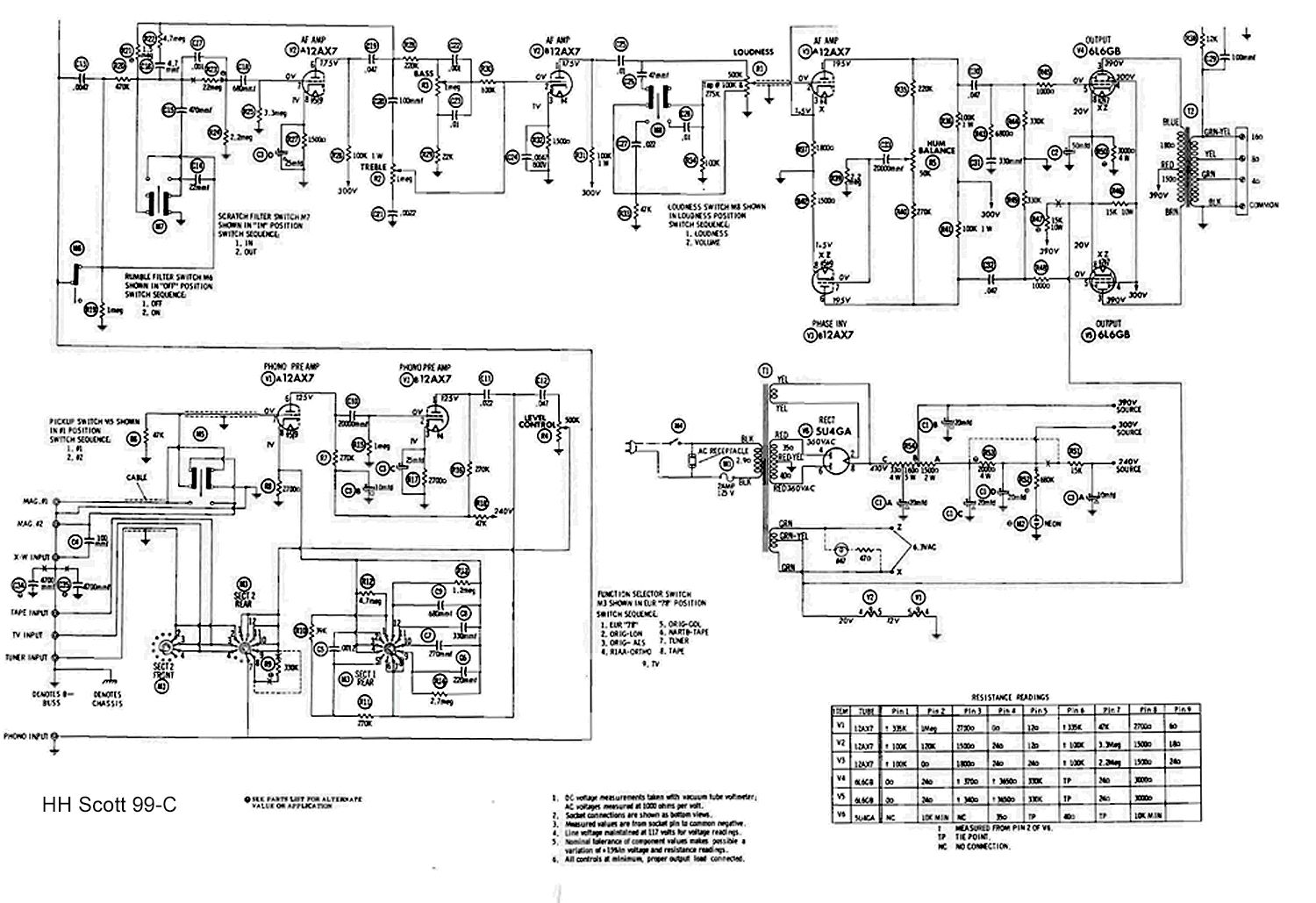
I had my 99c gone over , but there is inconsistency with the bass adjustment, and intermittent severe clipping depending on wich of the 5 phono gains I use. RIAA seems to be the worst with my Hard Bop 33 1/3 lps. It was suggested i replace the capacitors for the phono compensators, which is withn my ability. I have the manual in front of me. Our friend Chat GPT provided the following: AK wont let me attach the schematic, says too large. Can someone tell me if these are the correct caps and values? Also the best site to purchase from? Thank you .

Record Compensator Capacitors — Scott 99C (Phono Section)

These are the capacitors directly responsible for RIAA equalization:

  • C4 — 0.001 µFHigh‑frequency rolloff network, tied to V1 grid circuit.
  • C5 — 0.0047 µFWorks with RIAA midband turnover, connected between V1 plate and selector.
  • C11 — 0.022 µFPart of the low‑frequency boost network; located near phono input wiring.
  • C12 — 0.047 µFSets the bass turnover point; mounted under chassis near V1 cathode circuitry.
  • C13 — 0.001 µFAdditional HF shaping; tied into selector switch phono position.
These five capacitors form the complete RIAA record compensator network in the 99C.
 
Register to hide this ad
Before you replace things, I'd suggest measuring them, or at least measuring the response of the phono section using an inverse network. It may be that the caps have nothing to do with it, or the phono stage isn't the problem. Without knowing the original types its hard to say if they are likely a problem or not. Paper are usually trash, film are generally fine, ceramic can drift, and these are all in a range where any of those 3 are possible materials. Age-wise I'm thinking film is less likely though. It probably was around in the mono era but paper was more common.

also might be worth verifying the other inputs respond correctly, you may be looking in the wrong area.
 
If you provide some pictures of the internals I think it will be alot easier to narrow down. Even just checking working voltages while the amp is running will likely solve your issue, that kind of wonky behavior is characteristic of a circuit operating at the wrong voltage. Sometimes simply reflowing solder throughout the device will solve all of your problems. If you aren't hearing noise and the amp otherwise is working well, it's best to do some basic maintenance like reflowing and checking voltages prior to replacing components.
Kinda like a car acting funny but it hasn't had an oil change for 20k miles, you don't get new spark plugs because it's running poorly.
 
Before you replace things, I'd suggest measuring them, or at least measuring the response of the phono section using an inverse network. It may be that the caps have nothing to do with it, or the phono stage isn't the problem. Without knowing the original types its hard to say if they are likely a problem or not. Paper are usually trash, film are generally fine, ceramic can drift, and these are all in a range where any of those 3 are possible materials. Age-wise I'm thinking film is less likely though. It probably was around in the mono era but paper was more common.

also might be worth verifying the other inputs respond correctly, you may be looking in the wrong area.
I just seems like caps are relatively cheap, and replacing them is something needing done as well as the Pot. I just don't know which caps (brand etc) on on the mauro website are the once i should get. I am not adept at testing. Thanks
 
when in doubt, I usually suggest polypropylene caps, but I really don't know if thats optimal here. Illinois MPW, C-D 940 or 942 would probably be on my short list. Or if that form factor isn't ideal, Panasonic ECW work well too. Radial vs axial, not sure what the physical arrangement is here

but thats just throwing parts at a problem and hoping for the best. I can't say for sure if replacing those parts is going to help or not.
 
e138799d-dd70-4a43-b245-5fd0a7f74272.jpg

Schematic. The cleanest one I could find. Click on the image to enlarge it.
 
those values are all pretty common. As far as sites to go to, there are plenty. I would at least go with some sort of film cap. If your budget allows, you can go more exotic film and foils. You may also want to measure the value of the resistors in the RIAA and make sure they are pretty close to spec. Any deviation will result in a shift in the time constants for the RIAA eq.
 
yeah the resistors will skew this considerably, and may even be the bigger problem. Carbon comp are pretty poor for stability. I'd go metal film or carbon film for replacements, both are much more stable than the originals.
 
Back
Top Bottom