• The move to the new server is done. There are some software and database maintenance updates in process. This has us passing the hat around to help out. We appreciate any donations. Seriously, even a dollar helps. The payment page may be found here - https://www.audiokarma.org/support.html

Repairing water-damaged particle board

IowaNav

Active Member
I just took receipt of my parents' HPM-100's that have been thoroughly abused. Water damage, sun damage, and a few pushed-in dustcaps (one of my earliest childhood memories is the satisfying crinkle of that midrange dome as I punched my thumb into it sometime around the age of 3...)

Dustcaps aside, the drivers are all in excellent working condition, and they sound great. These are the 200 watt versions with the silver port ring.

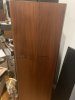
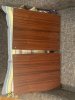
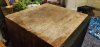
I'm planning a full refurbishment, inside and out, and I'm contending with some pretty serious damage to the top/veneer of one of the cabinets. My mother kept plants on it, and repeated water dribbles caused the veneer to completely split apart, with some swelling of the particle board beneath. Photo attached. Miraculously, the damage is limited to the top of the cabinet.

I'm obviously going to have to replace the veneer. But I'm concerned about the integrity of the particle board beneath. Most particle-board repair guidance calls for wood filler, which seems structurally useless to me.

I have a healthy supply of two-part liquid epoxy used for consolidation of dry-rotted wood. It soaks into softened wood and hardens/waterproofs it. More importantly, it's very strong. My plan is to remove the veneer, sand/scrape away any crumbly particle board, soak the area in liquid epoxy, fill voids with two-part epoxy putty (bonds extremely well to the liquid stuff), sand smooth, and re-veneer.

Any perceived issues with this approach? Has anybody used epoxy for such repairs?
 

Attachments

  • 20210104_170316.jpg
    20210104_170316.jpg
    49.2 KB · Views: 129
  • 20210104_170306.jpg
    20210104_170306.jpg
    89.8 KB · Views: 128
Register to hide this ad
The only thing I'd add is to use a large block for sanding to keep everything level. Good luck!

Edit: I've used Git Rot on a boat transom many years ago and it worked really well. It's essentially a thin epoxy that saturates wood.
 
Last edited:
@drbiggles calling Doc Biggles, Doc Biggles.....

Good luck with this resto. Use a shop vac and be VERY careful, and you can pull that dust cap out, or even try a paper towel roll and some lung pressure.
 
@drbiggles calling Doc Biggles, Doc Biggles.....

Good luck with this resto. Use a shop vac and be VERY careful, and you can pull that dust cap out, or even try a paper towel roll and some lung pressure.

I've been eyeing some info on how to do this. I have a small little detailing kit for my shop-vac that I may employ because it's got some nozzles about the right size to fit over the dustcap. I've also heard that wetting the area with a bit of rubbing alcohol first can work well - is this true?
 
I've used Git Rot on a boat transom many years ago and it worked really well. It's essentially a thin epoxy that saturates wood.

That's similar to the stuff I'm proposing. I also encountered it when restoring a wooden boat hull, and I was impressed with how structurally sound the impregnated wood became. In this case, I'm proposing to use a slightly thicker epoxy manufactured by Abatron. I'm convinced that it'll be the most durable repair approach, but I'm wondering if anybody knows of any downsides I've not considered...

P.S. I see that we've also got a shared interest in vintage bikes!
 
I just took receipt of my parents' HPM-100's that have been thoroughly abused. Water damage, sun damage, and a few pushed-in dustcaps (one of my earliest childhood memories is the satisfying crinkle of that midrange dome as I punched my thumb into it sometime around the age of 3...)

Dustcaps aside, the drivers are all in excellent working condition, and they sound great. These are the 200 watt versions with the silver port ring.

I'm planning a full refurbishment, inside and out, and I'm contending with some pretty serious damage to the top/veneer of one of the cabinets. My mother kept plants on it, and repeated water dribbles caused the veneer to completely split apart, with some swelling of the particle board beneath. Photo attached. Miraculously, the damage is limited to the top of the cabinet.

I'm obviously going to have to replace the veneer. But I'm concerned about the integrity of the particle board beneath. Most particle-board repair guidance calls for wood filler, which seems structurally useless to me.

I have a healthy supply of two-part liquid epoxy used for consolidation of dry-rotted wood. It soaks into softened wood and hardens/waterproofs it. More importantly, it's very strong. My plan is to remove the veneer, sand/scrape away any crumbly particle board, soak the area in liquid epoxy, fill voids with two-part epoxy putty (bonds extremely well to the liquid stuff), sand smooth, and re-veneer.

Any perceived issues with this approach? Has anybody used epoxy for such repairs?

Sounds like you’re going to do really well. If your penetrating epoxy uses solvents, do not use it on water damaged particle board. If you’re using a thicker, no solvent penetrating epoxy, make sure you sand and/or wipe with laquer thinner or similar. You want to make sure the amine blush is gone.

Also, use a heat gun to gently warm the affected particle board, then apply epoxy. This will liquify the epoxy more, cause to to penetrate a bit more. Not hot, gently warm the wood.

Biggles
 
That's similar to the stuff I'm proposing. I also encountered it when restoring a wooden boat hull, and I was impressed with how structurally sound the impregnated wood became. In this case, I'm proposing to use a slightly thicker epoxy manufactured by Abatron. I'm convinced that it'll be the most durable repair approach, but I'm wondering if anybody knows of any downsides I've not considered...

P.S. I see that we've also got a shared interest in vintage bikes!

One possible downside is that the cured epoxy doesn’t flex with the wood. If not, it will distribute the force to somewhere it wasn’t designed to take it. Sometimes it’s just fine, sometimes it’ll tear major or minor pieces of timber like a piece of paper.

Biggles
 
Sounds like you’re going to do really well. If your penetrating epoxy uses solvents, do not use it on water damaged particle board. If you’re using a thicker, no solvent penetrating epoxy, make sure you sand and/or wipe with laquer thinner or similar. You want to make sure the amine blush is gone.

Also, use a heat gun to gently warm the affected particle board, then apply epoxy. This will liquify the epoxy more, cause to to penetrate a bit more. Not hot, gently warm the wood.

Biggles

I'm trying to determine whether the epoxy in question uses a solvent carrier. I'm not sure, but the website describes it as 0 VOC and 100% epoxy solids to do I'm inclined to think it does not.

https://www.abatron.com/product/liquidwood/

Would a solvent based epoxy be bad simply because the solvent would leech into the surrounding particle boad and cause further crumbling?
 
I'm trying to determine whether the epoxy in question uses a solvent carrier. I'm not sure, but the website describes it as 0 VOC and 100% epoxy solids to do I'm inclined to think it does not.

https://www.abatron.com/product/liquidwood/

Would a solvent based epoxy be bad simply because the solvent would leech into the surrounding particle boad and cause further crumbling?

It does use a solvent, but it's not what we're worried about. I don't know why, but organic solvents in an epoxy blend cause water damaged particle board to swell and fail. In no other instance with rotted wood does this happen. Sounds like you're good to go. Use your fingers to scrapple away the failing wood, nothing more.

Biggles
 
It does use a solvent, but it's not what we're worried about. I don't know why, but organic solvents in an epoxy blend cause water damaged particle board to swell and fail. In no other instance with rotted wood does this happen. Sounds like you're good to go. Use your fingers to scrapple away the failing wood, nothing more.

Biggles

Terrific! Thanks for the guidance. I wouldn't have expected a solvent-borne epoxy to interact so badly with particle board!

I'll share the results once I have some to share. And I'll more than likely be back with further questions at some point in the process.
 
I just took receipt of my parents' HPM-100's that have been thoroughly abused. Water damage, sun damage, and a few pushed-in dustcaps (one of my earliest childhood memories is the satisfying crinkle of that midrange dome as I punched my thumb into it sometime around the age of 3...)

. But I'm concerned about the integrity of the particle board beneath. Most particle-board repair guidance calls for wood filler, which seems structurally useless to me.

I have a healthy supply of two-part liquid epoxy used for consolidation of dry-rotted wood. It soaks into softened wood and hardens/waterproofs it. More importantly, it's very strong. My plan is to remove the veneer, sand/scrape away any crumbly particle board, soak the area in liquid epoxy, fill voids with two-part epoxy putty (bonds extremely well to the liquid stuff), sand smooth, and re-veneer.
Any perceived issues with this approach? Has anybody used epoxy for such repairs?

Your plan for the particle board sounds good. I have used different forms of two part epoxy for many successful projects through the years with good results. If two part epoxy was not available my next choice would be several coats of boiled linseed oil with ample drying and light sanding between coats. It will reintegrate your particle board but will not be as strong as two part epoxy.
 
Your plan for the particle board sounds good. I have used different forms of two part epoxy for many successful projects through the years with good results. If two part epoxy was not available my next choice would be several coats of boiled linseed oil with ample drying and light sanding between coats. It will reintegrate your particle board but will not be as strong as two part epoxy.

Interesting! I wasn't aware of linseed oil as a method to consolidate crumbly board - great to know. I am planning on using a linseed oil finish on the veneer once repaired. I've got a soft spot for Rubio Monocoat, which produces some beautiful depth and a very tough finish. I used it on some 100-year old pine floors in my house recently and was thrilled with the results.
 
Just be ready for some long cure times if using as described. It of course dries from the top so when the top gets a top seal the remainder of the drying is sort of like osmosis, and the deeper or thicker the media the longer cure time. A very small amount of Jap dryer mixed with the boiled linseed oil could aid the process but that is JUST A GUESS. Don't try it without research or on a scrap piece of board.
If you are happy with Rubio Monocoat it my have a proprietary ingredient if it is boiled linseed oil. Otherwise try a test against regular boiled linseed oil. You may find no difference in the results.
If it's a certain color you are after then go with a Zar stain prior to the linseed oil. Again long dry times.
 
Last edited:
Here are the right side pics of my rosewood L1590’s
They even book matched the rear panels.
wish I had the PA-1’s. But I figure I grabbed these for $150 locally so if I can find some amps all the better.
Cheers
BT

32905455-1415-4CE9-840A-E7743338AA6F.jpeg 9F6E9E98-CECE-4812-BC5F-E2B1FDFD5404.jpeg C4CABC09-9989-45CF-9D64-60B8B4B824E5.jpeg
 
Last edited:
Just be ready for some long cure times if using as described. It of course dries from the top so when the top gets a top seal the remainder of the drying is sort of like osmosis, and the deeper or thicker the media the longer cure time. A very small amount of Jap dryer mixed with the boiled linseed oil could aid the process but that is JUST A GUESS. Don't try it without research or on a scrap piece of board.

I'm going to stick with the 2-part epoxy for rebuilding/reinforcing the particle board substrate. Once I've glued veneer on, I'll rub it down with the linseed oil finish. The stuff I'm talking about is also a 2-part finish - there's a hardener that speeds up the cure time. From first wiping on to dry is about 24 hours.
 
I'm going to stick with the 2-part epoxy for rebuilding/reinforcing the particle board substrate. Once I've glued veneer on, I'll rub it down with the linseed oil finish. The stuff I'm talking about is also a 2-part finish - there's a hardener that speeds up the cure time. From first wiping on to dry is about 24 hours.
You are going the correct route with the epoxy as the drying/cure is a chemical reaction and doesn't depend on evaporation
I looked up your Rubio. It is linseed oil with added stain or pigments to get the shade/color you want. And just a guess is that their 2C is Jap dryer.But if it pleases you then why not pay for a boutique linseed oil. You trust it like it, what else matters?
 
Back
Top Bottom