• The move to the new server is done. There are some software and database maintenance updates in process. This has us passing the hat around to help out. We appreciate any donations. Seriously, even a dollar helps. The payment page may be found here - https://www.audiokarma.org/support.html

replacement zener diode for capacitor analyzer restoration

moewillis

just to recap, i love recapping
i'm kind of a weirdo and have a soft spot in my heart for old meters and test equipment. recently a local contractor sold out and i picked up an old imperial a4 capacitor analyzer. it went for next to nothing (no one bid against me) so i bought it, restored it and it is now in use at our shop for sort of a novelty. i replaced the lone cap and the black diodes (1n4005 and a 1n4007).


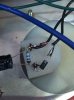
i cant find any diagrams for this unit and the diode i want to replace is marked with a 6 and c3 below it. it is located on the back of the gauge itself. i should be able to snag a pick of the underside if needed. if anyone could suggest a replacement i would be grateful

thanks guys and gals

before
5605604_0.jpg

after
IMG_1937.JPG
 
Register to hide this ad
That's fine, looks like the diodes are for meter protection, but I am puzzled by the wire going to the junction of the diodes, sorry, not sure what to make of '6' & 'C3' :idea:

Perhaps take it out of circuit and measure it with a battery and a limiting resistor? - to see if it IS a zener diode - then substitute if you want, or leave it as it is?

here's a shot of the underside

IMG_1940[1].JPG

the reason for replacement would be when i first got it, it read about 4-5 mfd low on a 50 mfd cap. i found all the resistors to be in spec but i changed the cap (it read about 20 mfd high on 100 mfd) and each diodes 1 by 1. it now reads 1-2 mfd low. i notice the gauge needle buzzes quickly when testing and i was just taking a last ditch effort to try and get it back on the nose. im starting to wonder if this was ever really all that accurate to begin with...
 
It's a nice looking meter, especially now ;) but 1-2mfd low isn't very much? - depends on the capacity of the measured capacitor as a percentage?

Presumably you are testing the same capacitor on two testers, maybe it's just the vageries of the two testers and possibly different test frequencies?
 
It's a nice looking meter, especially now ;) but 1-2mfd low isn't very much? - depends on the capacity of the measured capacitor as a percentage?

Presumably you are testing the same capacitor on two testers, maybe it's just the vageries of the two testers and possibly different test frequencies?

thank you! it was a fun little project. it was made in chicago IL. i feel like this kind of stuff represents a better time for America. back when people made things with their hands. someone went to work and made these things everyday and i hate to see that discarded in favor of a new digital meter.

im kinda wondering if this is putting 115v ac voltage into the cap whereas the digital meter we use uses minimal dc voltage from the battery to do the testing. that could maybe have something to do with the discrepancy. the digital meter reads a little high actually.
 
Yes, that little transformer is there as a source of 120Hz - I believe this is a standard test frequency for capacitors.

The reason I mentioned the test frequencies earlier, was that I have just bought a 'Peak' ESR Tester and its test freq is 100Khz.
 
Last edited:
2mfd low on the 0-60 scale is about 3% of full scale. Probably within spec.

I'd say you're right. I have been using a 50 mfd (440v) cap for testing and I get a pretty consistent 48.5-49 mfd on "annie". If I use my multimeter on the same cap I read from 51.5-52. So what do I believe? I can calibrate annie up but the needle rests above zero with nothing on it. I need to test a range and see if it is proportional or not. I have a feeling a 10 reads about right

I guess ultimately I have no true refrence.
 
Pm member; ConradH... he'd love this might have a mod or idea or two... (or maybe our new server will pm for me on a quote? hmm)

that I didn't quote so somebody bump him. so testing.
 
That looks like an Imperial Eastman logo maybe it was originally aimed at HVAC techs? I recognize it because I have a few of my grandfather's old tubing tools, and that's one trade that I can think of that would require both tube fab and being able to test capacitors...

In any case they are still around, might want to drop them a line, if there's any guys there like us they might get a kick out of seeing it.

It is an hvac meter. I manage a local hvac wholesaler and actually bought this from a customer who went under. It is an imperial and I am a rep for them. I tried contacting them on a whim and got nowhere.

It is actually going to be used to test ac caps again (we test quite a few over the summer) if I can get it reading to my satisfaction. I didn't want to deal with any "English" if you know what I mean

From time to time we get a cap that tests in range but a replacement fixes our problem. I wonder if this might show them weak better than out multimeter
 
Pm member; ConradH... he'd love this might have a mod or idea or two... (or maybe our new server will pm for me on a quote? hmm)

that I didn't quote so somebody bump him. so testing.

I think putting an @ in front like @ConradH may alert him.

I'm open to any suggestions
 
Hey, that worked! Never seen one of those before, but it looks pretty simple. I'm guessing here but it looks like they apply some low voltage 120 Hz signal to the cap in series with a resistor, forming a divider, then read the result on the meter. Two resistors for two ranges. It has to be rectified and filtered so the meter can read, thus the diode and cap. Not sure about the other diode, maybe protection as speculated. The resistor right across the meter is probably calibration, if you wanted to tweak it. Given what it's for, a few percent is just fine, so I'd probably leave it alone. Short test lights the light, but you'd have to trace it out to see just how it works- too late here for that, plus I can't read the color codes. Not sure how much voltage gets applied. Most bridges don't bias the caps, but aluminum e-caps don't seem to care. I wouldn't test a tantalum on it! Still a cool find.
 
I'd say you're right. I have been using a 50 mfd (440v) cap for testing and I get a pretty consistent 48.5-49 mfd on "annie". If I use my multimeter on the same cap I read from 51.5-52. So what do I believe? I can calibrate annie up but the needle rests above zero with nothing on it. I need to test a range and see if it is proportional or not. I have a feeling a 10 reads about right

I guess ultimately I have no true refrence.

You should be able to get some 1% selected film cap pretty easily, and there are known cap standards out there as well, probably non-electrolytic.
 
Thanks for all the help guys! I have virtually any value of 440v cap in stock to play with so i may test a range to get a better idea what's going on.

I wondered if the resistor Conrad mentioned wasn't for calibration so when I had it out I checked it well. It's a 909 and read 910-12 on a couple different meters I have at the house. It was a tight tolerance resistor too (1-2% can't remember).

I guess it just bugs me it reads low for some reason. If it was the same amount off only higher I don't think I would care.
 
i emailed our csr @ stride tool (who bought out imperial) to see if they had any info, schematics, or manuals for this thing and this was the response i got.

Good Morning Morgan,


Unfortunately, this item was obsolete after we bought out Thermal from the original owners. We do not have the manuals for a-4 capacitor analyzer “annie” that you restored. I did a search on Ebay. They have one that is similar to what you might be looking at, “SPRAGUE TO-4 TO4 Tel-Ohmike Capacitor Analyzer Manual”. But I don’t know much about this Thermal product, but I am seeing if it might work with what you are looking for.


Good Luck in your search.

I wish I could be more of a help.

Have a nice day!


at least they responded
 
i gather imperials name has been passed around a few times. stride must have bought the name "imperial" from someone with thermal in their name. its sad, people dont realize how often names are bought and sold. the company that was awesome in the 70's may have been transferred a dozen times since then and are really only a name slapped on a chinese product
 
Back
Top Bottom