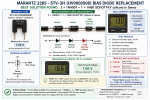
I would like to share my experience replacing the STV-3H (HV0000508) bias diode in a Marantz 2265.
One channel of my receiver had the original STV-3H removed by a previous technician and replaced with a jumper. Surprisingly, the amplifier was still operating, but I wanted to restore the bias circuit correctly.
Like many others, I first tried the commonly suggested replacement of three silicon diodes in series (3 × 1N4148). In my receiver this did not work. The bias current was much too high and could not be adjusted down to the service manual specification.
Next I tried two silicon diodes in series (2 × 1N4148). This produced the opposite result: the bias was too low and the amplifier was close to Class B operation, with insufficient adjustment range.
I also tested 1N4007 diodes. Interestingly, in my measurements the forward voltage of the 1N4148 and the 1N4007 was very similar under the operating conditions of the Marantz bias circuit. The main difference I noticed was that the 1N4148 appeared to respond more quickly to temperature changes.
The successful solution was:
2 × 1N4007 + 1 × 1N60 (Schottky) diode in series.
The 1N60 contributes approximately 300 mV less forward voltage than a silicon diode, bringing the total voltage very close to the original STV-3H.
My measurements were:
- Original STV-3H: 1.63 V
- Replacement (2 × 1N4007 + 1 × 1N60): 1.66 V
After adjustment, the idle current was set exactly to the service manual specification of 13 mV.
I then performed extended listening tests and thermal stability tests, comparing the repaired channel with the untouched original channel that still uses the factory STV-3H.
The results were excellent:
- Stable idle current after warm-up.
- No evidence of thermal runaway.
- Both channels behaved essentially the same.
- Excellent sonic performance.
After completing my tests I discovered that Pyramid Audio (Austin, TX) offers commercial STV replacements using a similar concept: 2 × 1N4148 + BAT54 Schottky diode. That independently confirms the idea that simply using three silicon junctions is not necessarily the closest electrical replacement for an STV-3H.
My conclusion is that there is probably no universal "3 × 1N4148" replacement for every STV-3H application. The important goal is to reproduce the original forward voltage under the actual operating current while maintaining good thermal tracking.
"Be aware that modern '1N60' diodes are not necessarily germanium devices. The one I used is a Schottky silicon diode with an approximately 300 mV forward voltage under my test conditions."
I hope these measurements may be useful to others restoring Marantz equipment.