• The move to the new server is done. There are some software and database maintenance updates in process. This has us passing the hat around to help out. We appreciate any donations. Seriously, even a dollar helps. The payment page may be found here - https://www.audiokarma.org/support.html

Residential electric question - BX conductor insulation

N8Nagel

Addicted Member
Posting here because I'm guessing there might be a few electricians on here.

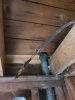
Yesterday, I helped a friend rewire his bathroom. Job was pretty straightforward, except when I went to splice into an existing run of BX (from the early 40's) in the attic, I found the insulation was incredibly brittle, and had apparently melted, fused to the cloth and paper, and literally crumbled in my hands when I attempted to pull off the armor to make the splice.

My initial theory was that this wire had experienced a significant overload, looking at what appeared to be evidence of a small fire in the wall in the distant past (downstream, but on the same circuit, with the original wiring having been replaced with Romex in that area). Obviously, once I saw the condition of the insulation, my original plan of reusing the original BX was out the window and we cut a couple holes in the adjacent wall to replace that BX entirely with new Romex. How this ran was breaker box -> receptacle in bedroom -> up into attic, then to wall light in bathroom. It was the last run that was badly disintegrating when we messed with it.

Oddly, the BX from the wall receptacle to the breaker box was in fine shape, and we left it, as the breaker panel will be replaced soon anyway so I told him to just ask the electricians to replace that run then.

Now my current theory is that this degradation of the insulation was simply caused by the heat of the attic (this was near the side of the house, so the roof was maybe a foot above this run of BX at the point where I was trying to splice it) which is OK ish. I know that when Romex was first introduced the insulation was rated at 60C and today (and for the past few decades) it's been rated at 90C, so I am comfortable that what we did will last for many decades to come. I have no idea if there even was any such rating back in 1940-whatever when this house was built. However, this prompts the question, does this mean then that we should be planning on replacing pretty much any run of BX in the attic if it is in any way touched? It seems like that's the prudent plan to operate on. The good news is that I have been advising him and it sounds like the electricians he's called for the panel replacement are savvy as well and we are all in agreement that we will be using AFCI breakers nearly universally (and the dedicated circuits that would be exceptions are likely all going to be pulled using new cable anyway) so there's some protection there until we can get the job all done.
219714157_530260321522059_8397243391061995543_n.jpg
 
Register to hide this ad
thanks for the reply. Do you think my theory may be correct, that the insulation simply degraded from attic/roof heat? The only similar experience I had was at a house I owned maybe 15 years ago, but there, the BX was only in the basement, and I mostly left it unless I had a reason to replace it, as it was all still intact and flexible.
 
I'm sure the environment added to its degradation. Constant exposure to heat and cold extremes hastened its demise.
 
I wouldn’t worry about why - just replace as much as you can get to, even stuff not in the attic.
 
I have seen dried out insulation in bx cable where it entered a light fixture, also probably due to the heat. I've found that cutting the bx back a few inches will usually reveal perfectly sound insulation, and this was in bx installed in 1928! It definitely doesn't like heat, and I agree with the poster above who recommends replacing as much as you can easily, since it is getting old. Protected from heat though, it probably still has plenty of life left. Just my experience - YMMV.
 
I have seen dried out insulation in bx cable where it entered a light fixture, also probably due to the heat. I've found that cutting the bx back a few inches will usually reveal perfectly sound insulation, and this was in bx installed in 1928! It definitely doesn't like heat, and I agree with the poster above who recommends replacing as much as you can easily, since it is getting old. Protected from heat though, it probably still has plenty of life left. Just my experience - YMMV.

That's what I'm trying to figure out... was it just attic heat or overcurrent that destroyed this particular BX? If it was the former, then pretty much all BX in the attic is suspect (which is OK, there's a bunch of ceiling boxes that need to be replaced as well - pretty much every room has a ceiling fan but not a fan rated box - but it's a lot of work) whereas if the latter then we probably need to follow that one circuit and replace all of the non-Romex wiring on that.

Edit: the picture was cut back a good 18-24" from the end of the run; originally that BX went into the light fixture box for the bathroom. It was basically laying on the top plate of the exterior wall, running between the bath and the 2nd bedroom. I was going to use a 1900 box in the attic as a junction to transition to the new wiring, but you can see why that plan got immediately 86'd and we just replaced the whole cable.

Of course, a complete rewire is the ideal solution, but that would involve cutting a LOT of holes in walls. (the one receptacle that we replaced was directly below a window...!) If it needs to be done, it needs to be done, though.
 
Last edited:
depends if its rubber or PVC insulated. Either way its probably heat + age degradation but PVC seems to survive a lot better in lower temps. Rubber just dies from age, doesn't seem to matter so much about the temperature. If the insulation was fine at the box end, its probably not an over-current situation. I'd expect the whole thing to have gotten hot if that was the case. Would probably have needed to be a penny in the fuse box to get it hot enough for long enough to actually damage the insulation like that.

If you have any in good shape it should be fairly easy to figure out what it is, PVC is the same stuff Romex is insulated with, so shiny plastic. Rubber is softer and a much duller finish. I'd feel a lot more comfortable with PVC in the walls than rubber just because it seems to age better overall.

The other thing with old wiring is that it often doesn't give any trouble unless disturbed, even if the insulation is in really poor shape. The air space between the conductors is a pretty good insulator, so even if the rubber or plastic goes away it will continue to work so long as things don't get smooshed together.
 
Of course, a complete rewire is the ideal solution, but that would involve cutting a LOT of holes in walls. (the one receptacle that we replaced was directly below a window...!) If it needs to be done, it needs to be done, though.

Something to keep in mind that might help - they make crown molding and baseboards that have provisions for electrical wiring. Might get you out of a tough spot.
 
That's what I'm trying to figure out... was it just attic heat or overcurrent that destroyed this particular BX? If it was the former, then pretty much all BX in the attic is suspect (which is OK, there's a bunch of ceiling boxes that need to be replaced as well - pretty much every room has a ceiling fan but not a fan rated box - but it's a lot of work) whereas if the latter then we probably need to follow that one circuit and replace all of the non-Romex wiring on that.

Edit: the picture was cut back a good 18-24" from the end of the run; originally that BX went into the light fixture box for the bathroom. It was basically laying on the top plate of the exterior wall, running between the bath and the 2nd bedroom. I was going to use a 1900 box in the attic as a junction to transition to the new wiring, but you can see why that plan got immediately 86'd and we just replaced the whole cable.

Of course, a complete rewire is the ideal solution, but that would involve cutting a LOT of holes in walls. (the one receptacle that we replaced was directly below a window...!) If it needs to be done, it needs to be done, though.

The BX I dealt with had a cloth insulation coated with a waxy substance that seemed absolutely fine once you cut back to a fresh end. Disturbing the connection is what seems to be the kiss of death, and the heat of the light or motor causes the problem. In my case, the cable had not enben subjected to any excessive heat except at the connection end. Having once replaced all the wiring and receptacles in my oldest daughter's home I don't envy you the project. I'm rooting for you, FWIW. :)
 
Is there any sort of local Code there that mandates using something like BX, MC, or conduit rather than "Romex"?

For example, I believe Chicago local/city Code requires wiring, including residential, to be installed in conduit.
 
Last edited:
Is there any sort of local Code there that mandates using something like BX, MC, or conduit rather than "Romex"?

For example, I believe Chicago local/city Code requires wiring, including residential, to be installed in conduit.

Not to my knowledge, no. I think it was at one time in VA, it seems to have been common practice to run anything exposed in BX and then concealed in rag wire (that proto-Romex non-metallic cable). Looks like ALL the original wiring in this house is BX, but AFAIK NM everywhere is perfectly fine today (and all the subsequent alterations are in NM/Romex; all the wiring in the current house I'm living in and the last one as well are NM/Romex.)
 
could have been a light fixture over lamped installed there at one time. had a call where the customer couldn't remove the bulb from a ceiling fixture in their hallway.

It was one of those square plastic fixtures normally seen on a porch, the whole fixture was melted. The fixture had a plastic socket and was rated for a 60watt lamp, they had a 150watt in there lol.

removed the fixture and there was a square hole in the ceiling the same size as the light, the heat had completely destroyed the drywall, they were lucky the light stopped working.

16065_1_1__76719.1556432506.jpg
 
thats the cool thing about LEDs, 60w of LED is a LOT of lumens, far more than a regular filament bulb can offer.
 
Back
Top Bottom