Restoration of JBL l46 - should I recap?

LordLunatic

Member
I found these near mint condition L46 at a local thrift store - didn't know what they were, just saw big JBL's, beautiful walnut finish and thought it was too good to leave (my dad has always been a JBL fan)IMG_1478.jpgIMG_1480.jpg

I just replaced the rubber surrounds on, and that was quite the undertaking compared to foam. But at least it was possible - had to import rubber surround from Midwest Speaker Repair from the US (great service), as they appear to be the only ones in the world selling rubber surrounds for the 117H-1 drivers. Everyone else seems to replace the rubber surrounds with foam for some reason.
I ended up risking doing it without removing the dustcaps, as the new ones didn't quite match the colour correctly, and would have visually bothered me. (not quite the right black colour).
They're now drying, so hoping to hear no scratching when I fire them up tomorrow. Ended up not quite as neat with the glue as I'd have liked, but its the first time I've replaced a rubber surround. Second if you count the foam on some infinities, but that was much easier.
IMG_7739.jpg
Now, my question is if it would be audibly worth recapping the crossover, considering it looks visually like its in perfect condition - they'd be around 43 years old?
I also can't quite find nice polyprop caps that match the 7uf and 14uf (polyprop only come in 6.8uf and 15uf) so would have to go electrolytic to match exactly, and I don't know what the tiny yellow 0.068k 250vdc components in parallel with the caps are.
IMG_7741.jpg
 
Last edited:
Register to hide this ad
Dear Lord .... nice score!
There is a separate JBL forum on this site and a 'Lansing Heritage' ( a sister site) that might help with more research on this speakers. Forty six year old caps are candidates for replacement. JBL experts often say that JBL sourced higher quality components. Perhaps you should just listen to the speakers and decide if they need improvement, the JBL sites would have suggestions on what cap type and manufacturer are best to use. The yellow devices are capacitors and the practice of installing small caps in parallel with large ones is know as 'bypass' caps. Search AK for more information on these.
Again nice score and good luck.

As an example: https://audiokarma.org/forums/index.php?threads/jbl-l46-crossover-recap-questions.483110/
 
Last edited:
If you think you're going to be doing more restorations like this in the future (or indeed, any electronics work), it might be worth investing in an inexpensive multimeter with a capacitor test function.
 
If you think you're going to be doing more restorations like this in the future (or indeed, any electronics work), it might be worth investing in an inexpensive multimeter with a capacitor test function.
Good point, I have like three of those, I’ll see if one of them has that function - my dad is a radio/radar technician/mechanic by education (though he never technically worked as it I don’t think), so I was brought up messing around with those - just don’t have any formal education in it :)
 
The quick and dirty test for caps by ear; does the tweeter sound recessed or muffled? If so you know the caps have excessive ESR and they need replacement.
 
The quick and dirty test for caps by ear; does the tweeter sound recessed or muffled? If so you know the caps have excessive ESR and they need replacement.
I just got them running, they definitely don’t lack treble, remotely. If anything It’s just one the verge of too much, without crossing it.
 
Maybe because of the by-pass caps? Some people don't prefer their sonic signature.
Might be, don’t know exactly how/if those affect it, but so far they sound stellar - just would want more treble. Remind me a lot of the JBL I’ve heard at current hifi shows. Except these cost me a fraction of those.
 
without something to compare to, that would not be a definitive test

True, but most people know what they like in a balanced treble. If it sounds muffled it makes sense that the caps can be at fault.

in numerical terms, what would be "excessive ESR" ?

I think some people have reported as much as 1-1.5 ohms which could really mess with the tweeter output.
I just recapped some old KLH 20 that had no tweeter output at all. The caps measured 25% higher capacitance which would just lower the high pass frequency. I don't have a way to measure ESR but I must assume it was pretty high, because the tweeters have good output with the new capacitors.
 
Of course, you should upgrade the caps and the resistor. No testing needed as what's in there is crap.
It would really be helpful to the AK community if you could start a thread that shows in detail the extensive scientific testing you've done that proves all capacitors, other than the ones you approve of, are indeed "crap"
 
Seriously!?! You think those caps and resistors aren't crap? That you don't use your ears to tell you what sounds good or not so good? That you rely on "extensive scientific testing" to tell you how reproduced audio sounds?
 
Seriously!?! You think those caps and resistors aren't crap? That you don't use your ears to tell you what sounds good or not so good? That you rely on "extensive scientific testing" to tell you how reproduced audio sounds?

I think that's the point. Using ears rather than eyes and bias; looking at a cap and assuming it sounds bad or that it would be better with another, just based on "it looks crap" isn't using ears either. At least with "extensive scientific data" you'd know whether there is a difference/what it is, and that it isn't based on thinking it looks crap and that a mundorf cap looks nice and expensive.

But I suspect thats not a debate any of us will gain much from having here.

I'll probably double check if any of the caps have aged/gone bad, and consider if I'll update them to some sturdier ones based on that. I wouldn't want to risk changing the sound of them, by swapping, as film caps and electrolytics have slightly different ESR profiles, meaning swapping electrolytics to poly-caps could theoretically change the sound very very marginally (0.1 dB or there about) - with no guarantee it'd for the better.
 
The drivers have cured now, and been reseated - and I am astounded. These speakers sound bafflingly good!
When I found them I didn't know their age, and after purchasing, when I found out they were from '82 I was worried they'd be stuffy/wooly soundling like I've experienced with many spekers of that era or related to it - most recently Tannoys (no shade at those who enjoy those, just not my thing) - but I'd repair them to sell at least, to make my money back.
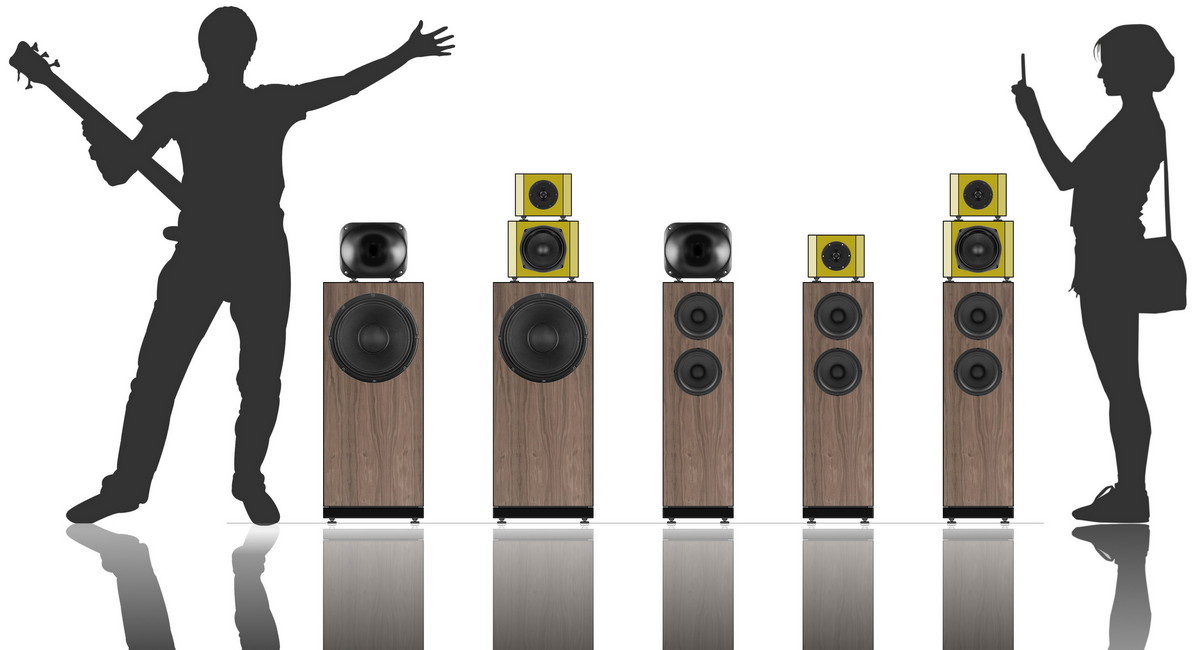
But these won't be leaving any time soon! The sound is crystal clear, and the imaging is spectacular - and bass is adequate, considering these aren't enormous floor-standers (like the ones behind them).

However the restoration might not be done, as I noticed at certain frequencies, the board holding the crossover, and the speaker terminals, with resonate, causing a sound a cabinet vibrating during a storm. So I'll likely have to remove the boards, and add a rubber gasket and/or some more secure mountings.

In that process I'm considering adding some modern 5-way binding posts - I feel like it would clash with them, and be a shame in terms of design/aesthetic, but would be nice to be able to use banana connectors rather than just bare wire.

IMG_7744.jpg
 
Seriously!?!
yes
You think those caps and resistors aren't crap?
I didn't say they were or were not
That you don't use your ears to tell you what sounds good or not so good?
The op stated that he likes the sound as they are, so if his ears tell him they sound good, why should he change them?
That you rely on "extensive scientific testing" to tell you how reproduced audio sounds?
I never said that either. Your posture is very defensive....:idea:
 
Last edited:
I think that's the point. Using ears rather than eyes and bias; looking at a cap and assuming it sounds bad or that it would be better with another, just based on "it looks crap" isn't using ears either. At least with "extensive scientific data" you'd know whether there is a difference/what it is, and that it isn't based on thinking it looks crap and that a mundorf cap looks nice and expensive.

But I suspect thats not a debate any of us will gain much from having here.

I'll probably double check if any of the caps have aged/gone bad, and consider if I'll update them to some sturdier ones based on that. I wouldn't want to risk changing the sound of them, by swapping, as film caps and electrolytics have slightly different ESR profiles, meaning swapping electrolytics to poly-caps could theoretically change the sound very very marginally (0.1 dB or there about) - with no guarantee it'd for the better.
I use my ears, not my eyes and not the price.

Electrolytics and resistors such as those were chosen due to availability in large quantities and especially the cost.

Considering that electrolytics average lifespan is 10 to maybe 15 years the sound you are hearing now is not what the speakers sounded like when new.

Choosing the wrong film caps would likely result in disappointment. Choosing the right ones would likely result in nirvana.
 
yes

I didn't say they were or were not

The op stated that he likes the sound as they are, so if his ears tell him they sound good, why should he change them?

I never said that either. Your posture is very defensive....:idea:
So, what crossovers have you upgraded and with what components?

Defensive...ummm, no. Tired of your trolling...definitely.
 
I use my ears, not my eyes and not the price.

Electrolytics and resistors such as those were chosen due to availability in large quantities and especially the cost.

Considering that electrolytics average lifespan is 10 to maybe 15 years the sound you are hearing now is not what the speakers sounded like when new.

Choosing the wrong film caps would likely result in disappointment. Choosing the right ones would likely result in nirvana.
Personally I’m also of the mind that I would ideally want some objective proof or at least hint that there would indeed be audible differences between different film caps, before I’d generally trust anything subjective - unless I hear it myself and it’s staggeringly obvious (which hasn’t been the case either). Given how reliably the human brain/ear can be fooled/fool itself.
Problem is that would be quite hard as well since swapping crossovers/caps fast enough for a blind ABX or the like would be a lot of work/dedicated equipment.
And currently all data I’ve seen would point to the opposite; that film caps behave sound the same generally.

Anyway, as far as if it’s the original sound or not, I’ve yet to bother desoldering the components and testing how they’re performing now.
Whatever they’re doing, what I do know is that the speakers sound astonishingly good to me - I’ve heard plenty of modern high end speakers costing thousands that didn’t grab me like these do at the moment.

Whatever the reason is, new toy syndrome or not, for now I’m just going to enjoy them. Then ill consider experimenting with caps if I’ve the time/money and am bored at some point - since nothing critical appears to be wrong for now.

“Trust but verify” I think sums up my relationship with doing things by ear.
 
Film caps absolutely do not sound the same.

These observations, for the ones I have experience with, mirror my own.

Considering the average results of blind ABX tests are 50/50 should tell one that it is a seriously flawed method and fast switching is equally worthless.

Anyway, enjoy your speakers.
 
Back
Top Bottom