• The move to the new server is done. There are some software and database maintenance updates in process. This has us passing the hat around to help out. We appreciate any donations. Seriously, even a dollar helps. The payment page may be found here - https://www.audiokarma.org/support.html

Restoring Bozak E-300 cabinets

mrphilco

Well-Known Member
I have a pair of Bozak B-300 speakers (E-300 enclosures) which I purchased from an AK member two or three years ago and am very happy with them. They have the original coaxial speakers and sound fine. :thumbsup:

But here is the problem:

Both are missing their original risers/bases. At some point, the original bases were removed and casters put in their place.

In the process of restoring the cabinets (replacing the top and bottom trim, refinishing the top, replacing the grille cloth), I would like to remove the casters and replicate the bases. Can anyone give me the detailed measurements? I need to know how much the bases are inset from the outer edges of the main cabinets, how thick the boards are that are used for the bases, and what sort (if any) of inner support they may have.

Pictures of the underside of a complete E-300 would be a big help.

See picture below - the red arrow is pointing to the base which I need to replicate.

I suppose I could find some brackets and attach Mid Century tapered legs to the bottoms of each, but I would rather restore them to their original appearance.

Many thanks in advance for any/all help.
bozak_base.jpg
 
Register to hide this ad
To bring this full circle...

I did contact the eBay seller, who was very kind and helpful. He gave me lots of measurements for the bases and even took extra photos.

Now all I need is a table saw, and I'll be building some reproduction bases for my speakers...hopefully before this summer has ended...

Thanks MarZutra for the tip.
 
I have started the process of restoring these two cabinets. I've already made some mistakes along the way which I have learned from, so I am posting as I progress, in the hopes that it will help someone else out there who may be contemplating a restoration of these fine cabinets.

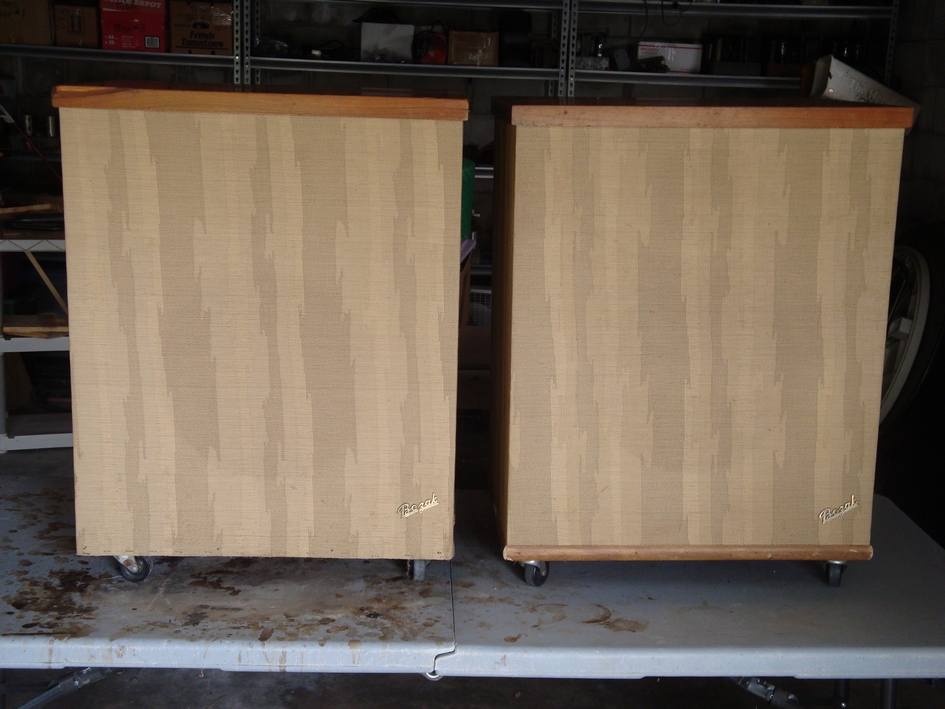
Here are the candidates:

bozak_001.jpg


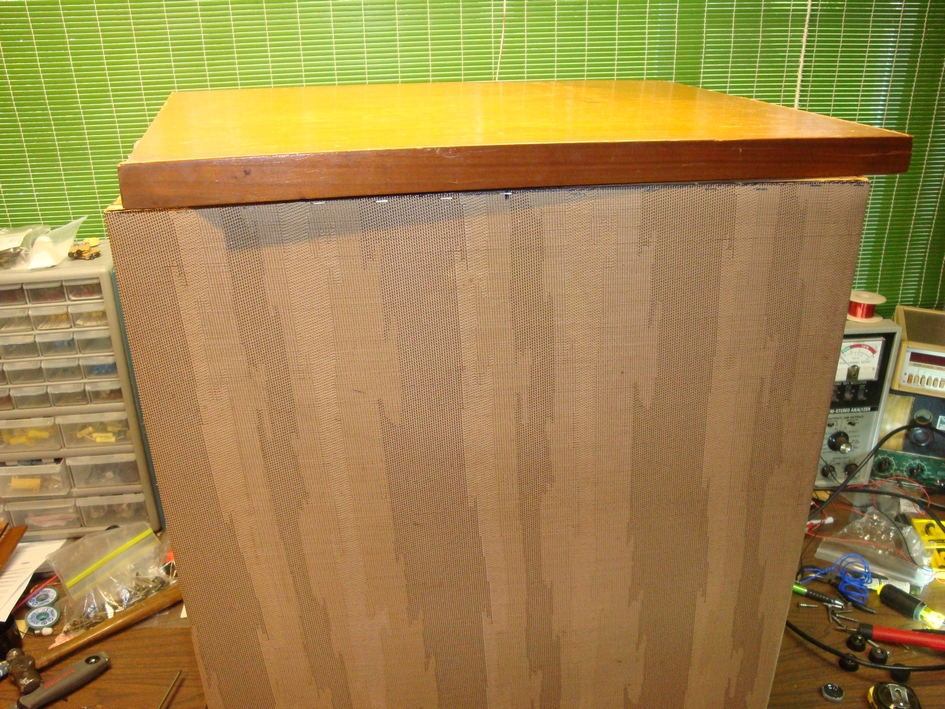
I don't think the grille cloth is original; I've never seen any cloth that looks like this on any of the Bozak E-300 photos I have seen.

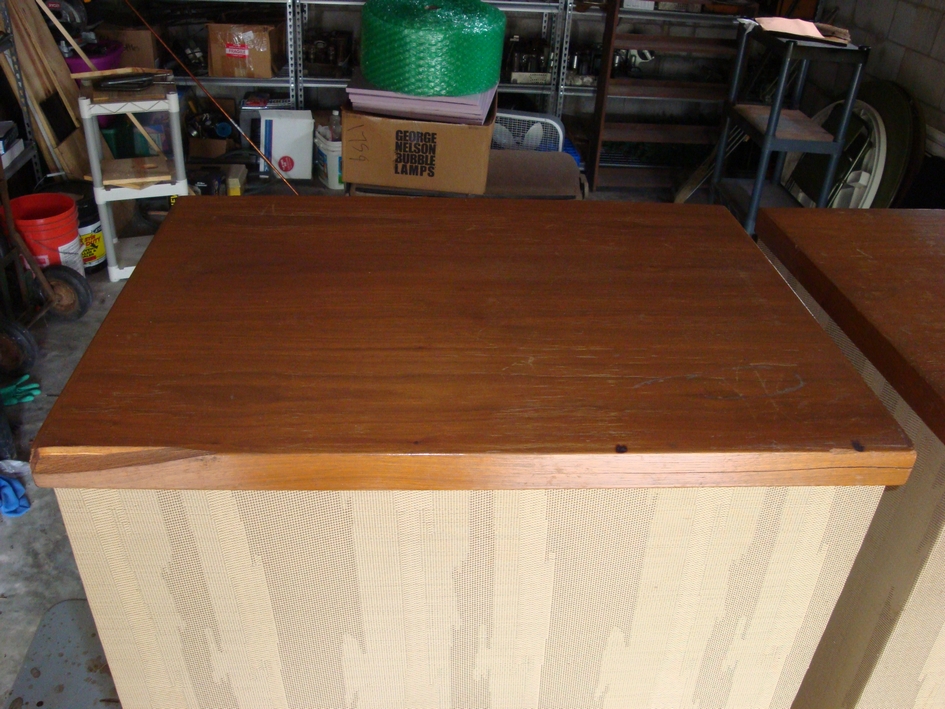
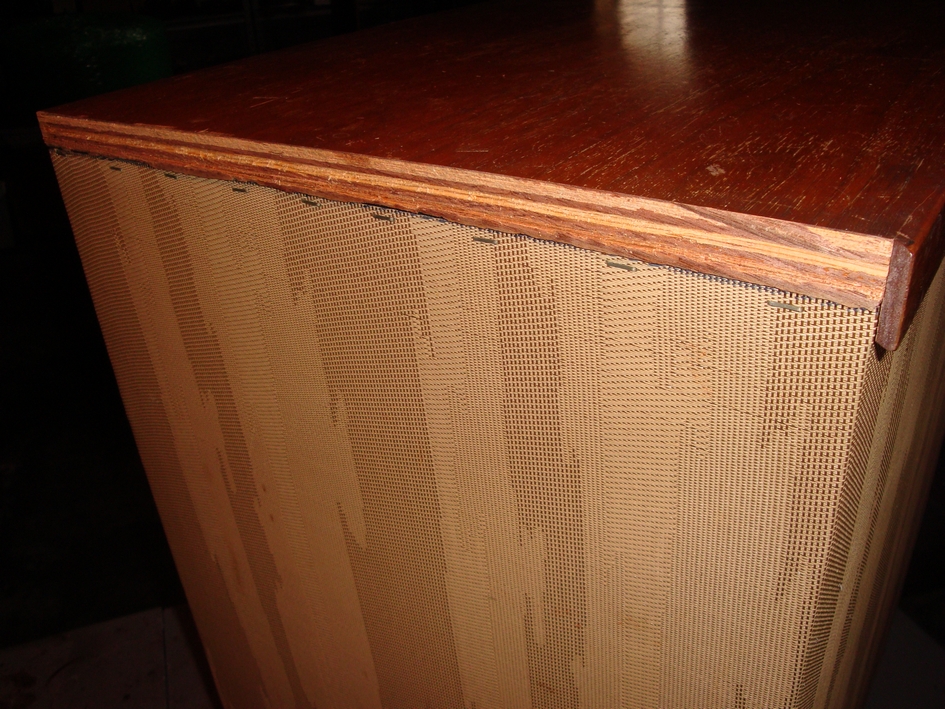
The cabinets are pretty rough. They are getting close to 60 years old, and they show it. Here's a close-up of the top trim on one of them:

bozak_002.jpg


The bottom trim had been replaced by some cheap home interior trim some time ago, and the risers were removed and casters added. I suspect these boxes were put on casters due to their weight; casters would make them easier to move around but it removes the originality.

I had planned on replacing top and bottom trim as part of this project. The top trim has to come off in order to get the old cloth off and to install the new cloth.

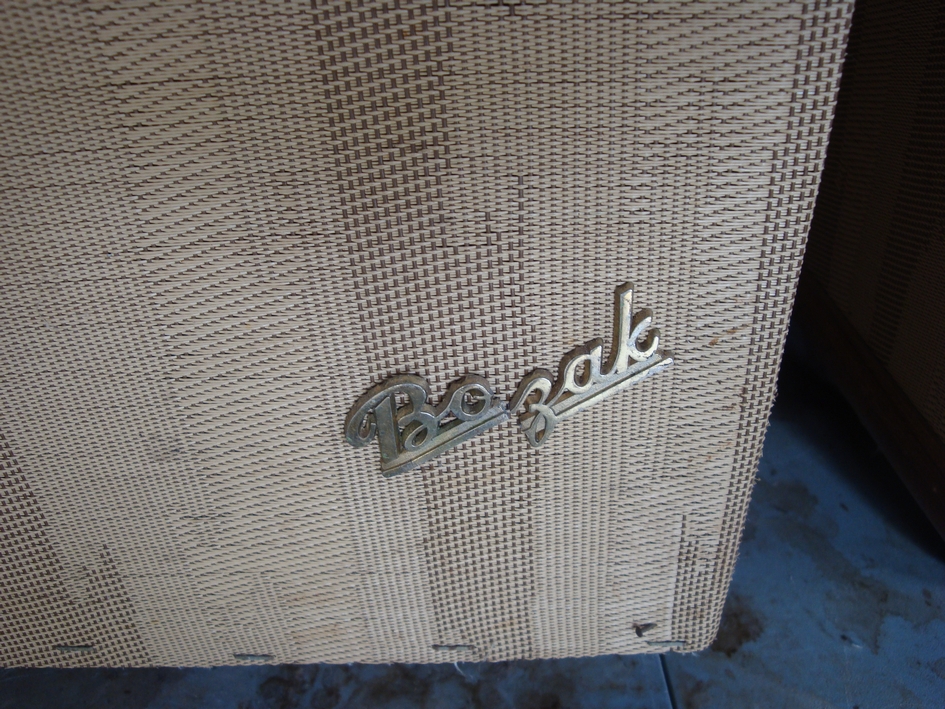
I noticed something else I had previously overlooked:

bozak_003.jpg


Yes, one of the Bozak nameplates is broken. :(:eek::oops:

I will attempt to glue it back together with J-B Weld later.
 
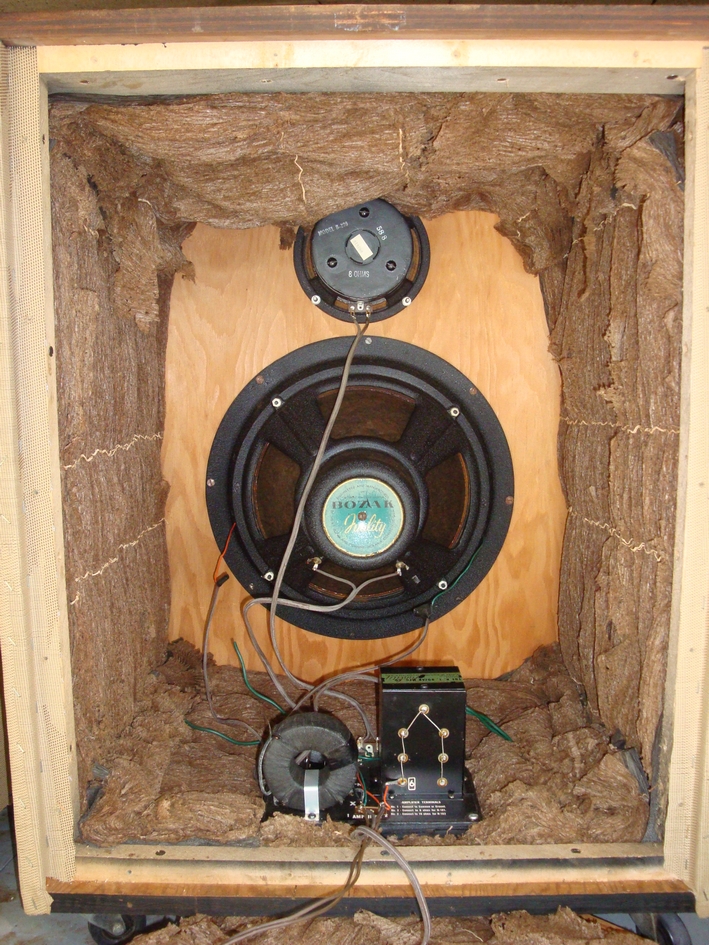
Upon opening one of the cabinets, I found a surprise waiting inside...a most excellent surprise:

bozak_004.jpg


Yes - a B-209 midrange speaker and a Bozak 3-way crossover network! :banana::thumbsup::jump::rockon:

So these are B-302A speakers, not B-300s. That is a great thing. I guess I had forgotten that these have the midrange speakers. :oops:

I had read elsewhere on this site that the Bozak nameplates are just pressed into place. Whoever posted that information was exactly right - carefully, using a putty knife, I was able to easily remove both Bozak nameplates from the front of each speaker without damaging either one. :thumbsup:

The backs of both speakers have been modified, more than once. Both have extra phone jack speaker terminals, with holes cut into the backs to accommodate them. Hmmm...
 
I removed woofer/tweeter combos, midrange speakers, and crossover networks from both cabinets.

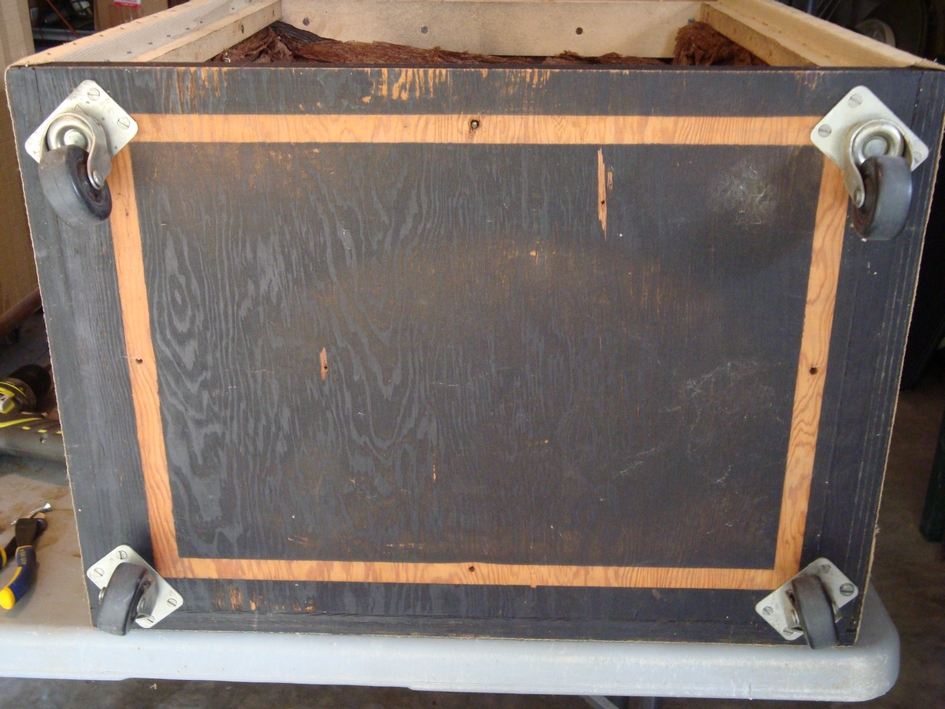
Looking underneath one of the cabinets in preparation to remove the casters, I made an interesting discovery:

bozak_005.jpg


An outline of the original riser!

The risers must have been flat black, as the paint under this cabinet is flat black.
 
I began an attempt to remove the top trim from one of the cabinets.

I discovered that these trim pieces were not nailed on - they were glued on. :wtf:

I was able to get one top side piece off...

bozak_006.jpg


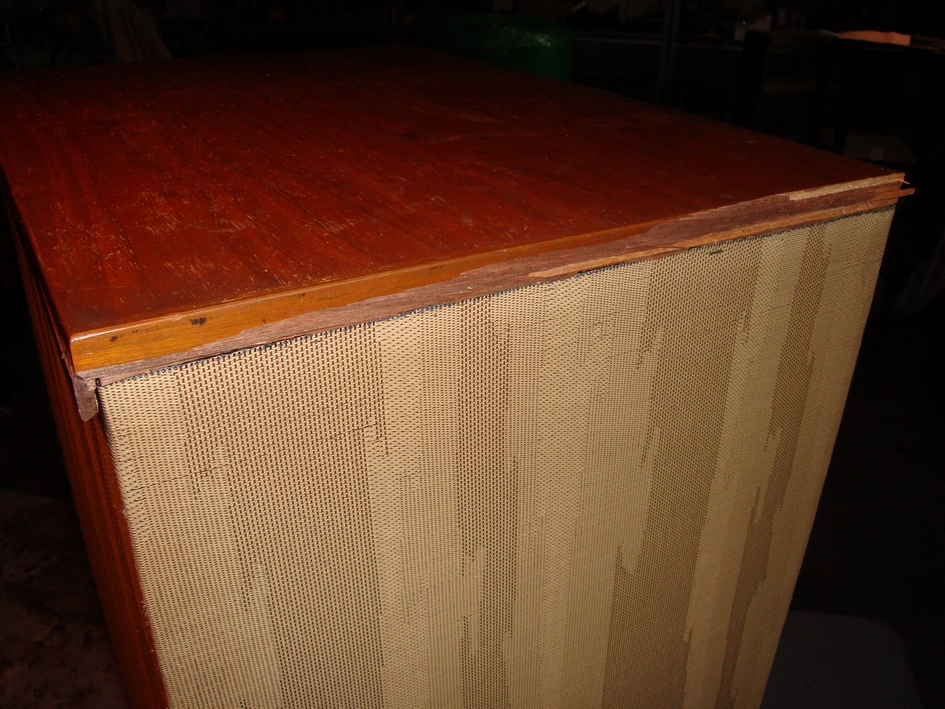
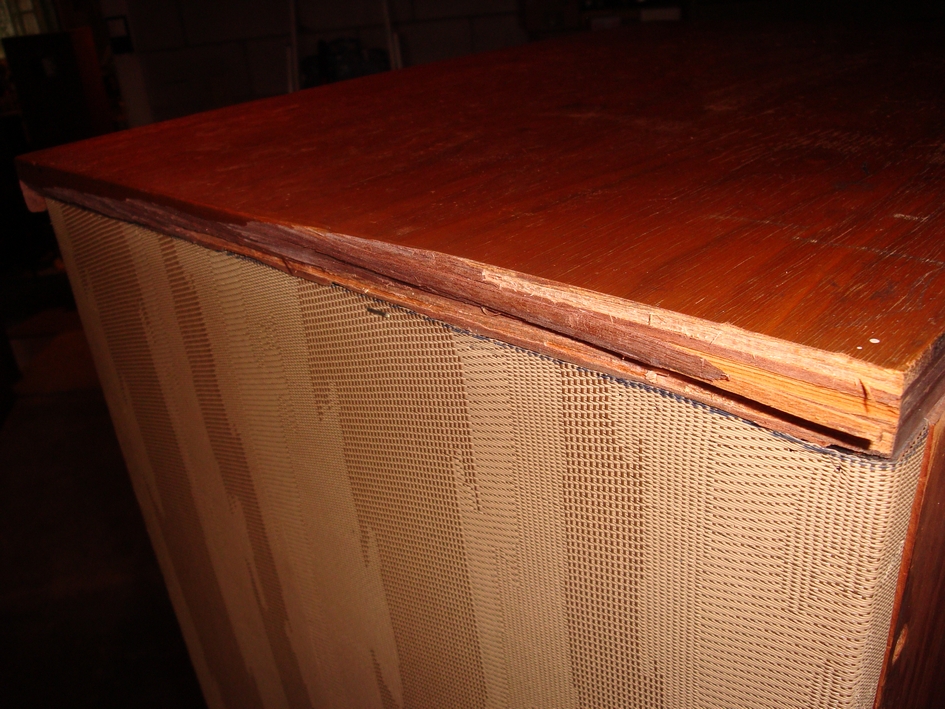
Unfortunately, my attempt to get the trim off the other side did not go so well.

bozak_007.jpg


bozak_008.jpg


Now I am in a dilemma. How do I get these trim pieces off without damaging the top of the cabinets?
 
A friend of mine suggested using a lock blade knife, sliding it between the molding and the top, to try and get the molding off the top. So I tried it. But after the top started to splinter at the joint, I quit...

Then guess what I found.

The tops are removable!

bozak_009.jpg


bozak_010.jpg


Big mistake #1. The top and the molding on this cabinet were in pretty good shape...:eek::oops: I should have practiced on the top with broken molding...or better yet, examined the speakers more closely before doing this.

In the case of the cabinet I was trying to remove the top molding from, I had to remove the paper insulation from the underside of the top in order to get to the attaching screws. Then it was a matter of removing the screws...and the top simply lifted off.

Well, it looks like I'll be investing in a table saw, as I have decided to construct new tops for these cabinets using 3/4" furniture grade plywood.

The molding is 1/4" x 1-1/4" and that should not be difficult to find. I found it on Home Depot's website, in that very size, listed as "lattice molding".

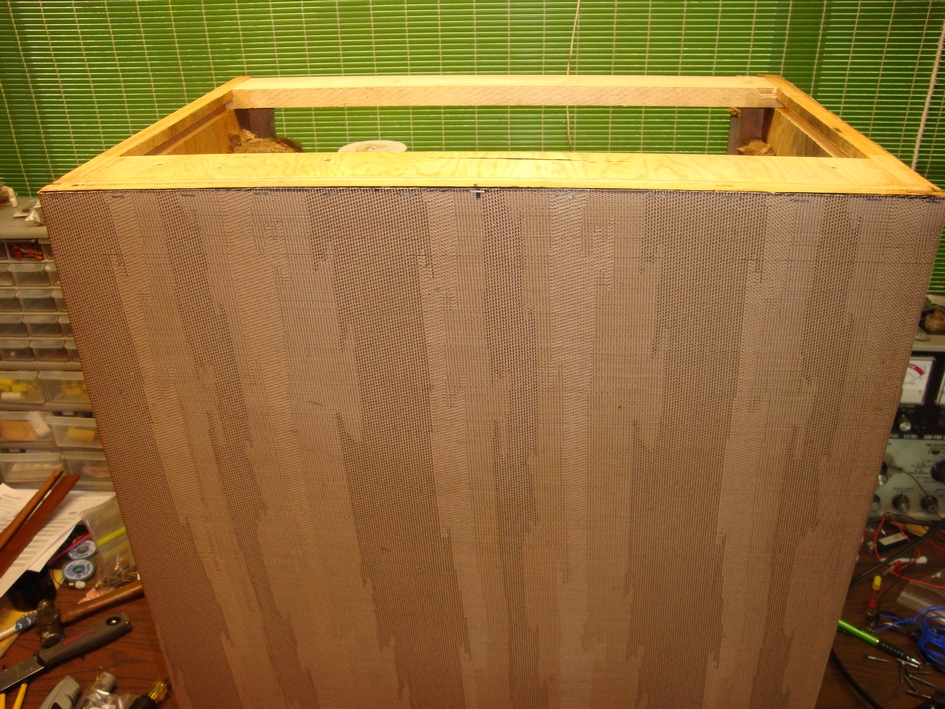
Now I know how Bozak was able to finish the tops and upper molding without damaging the grile cloth. The molding was glued onto the top, then the assembly was finished. I shall repeat that process...assuming my clamps are long enough...if not, I may have to invest in two or three more...
 
I removed what seemed to be a million staples from the top and bottom edges of the grille cloth.

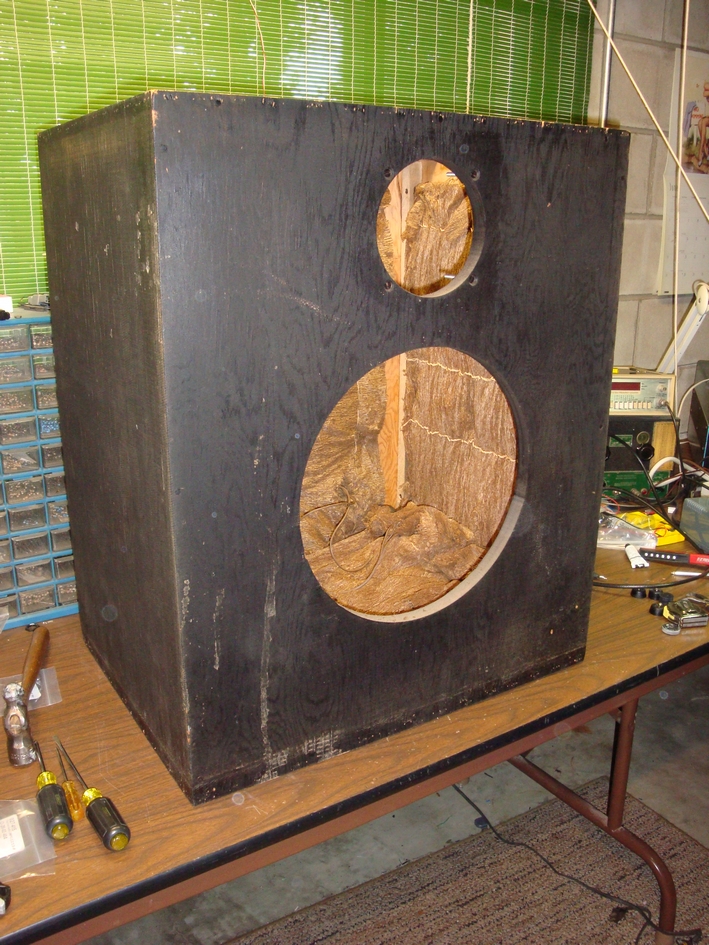
Afterwards, the cloth simply fell off and I was left with this:

bozak_011.jpg


When I was finished, I repeated the process on the other cabinet.

It looks like there are several more staple holes other than the ones left by the staples I removed, so I am now sure the cloth I pulled from these cabinets was not original.

I plan to go over the front and sides with a touch-up coat of flat black paint before I begin to install the new cloth.

In case you're interested, the new cloth I selected is made by Mellotone and is beige and brown in color, patterned after a vintage Fender cloth. I bought mine from Parts Express. It should look really well when it is all finished.
 
Last edited:
Since I'm going all out on these cabinets, I've also decided to go ahead and build new backs for each one.

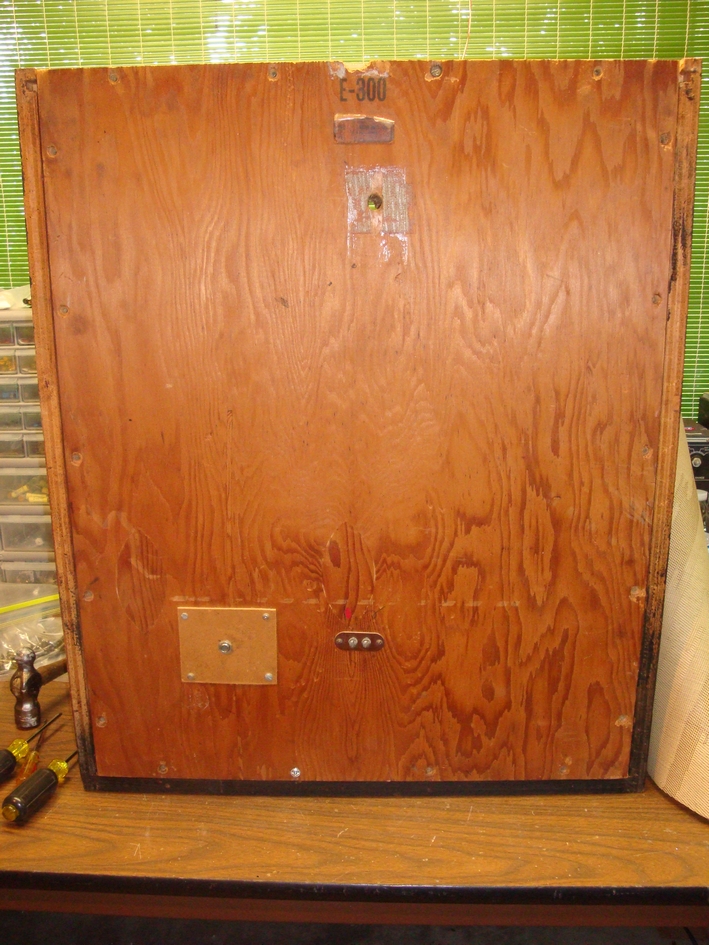
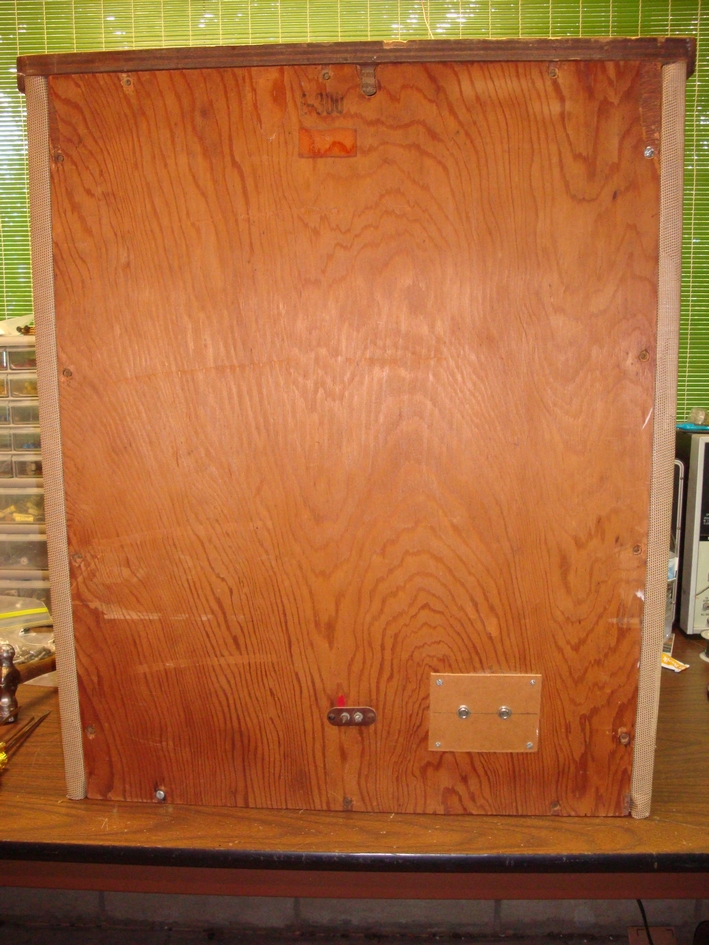
If you are wondering why, let's look at the original backs:

bozak_012.jpg


bozak_013.jpg


All of the extra holes that have been put into these backs really detracts from their appearance. While I know that no one will see the backs when the cabinets are finished and in my home office, I would prefer that they have no holes so that the cabinets can be sealed as they were intended to be.

I can use a lesser grade of plywood for the backs, at least. I will have to fill in the original holes used to fasten the backs to the cabinets, as they have become well worn over the past several decades and use multiple sizes and types of screws to hold the backs in place. I want to use one single type of screw as was done originally.

As these cabinets are made of 3/4" plywood and not particleboard, I think they are well worth the investment of time, energy and $$$.
 
Hey man!

I wanted to stop by and say I've been right where you are with other similar projects. You don't learn anything if you don't screw a few things up. Congratulations and looks like a GREAT project, I'm jealous.

Now I'm going to offer my opinion. It's nothing more than that and I'm not telling you what you must do. I suggest you keep the backs as they are and see if you can't actually restore the original tops. The veneer banding around the top's sides can be replaced and stained to sorta match. These speakers are old, they have a story to tell. They're survivors and they're not new speakers you bought at the local mega electronics store, they're old. Restoring what you can and leaving as much as you can original saves their story, who they are.

I'm in the process of restoring a pair of very old DIY Bozak B302A's, very similar to yours. While mine are homemade, I'm attempting to keep them as original as I can. My lower trim was lousy in construction and implementation, that's going to be replaced. My upper banding, just like yours, needs to be replaced.

Of course, those N10102 crossovers will need to have new capacitors. Those originals are leaky and will sound lousy compared to their new counterparts. They should be updated to Pat Tobin's design and the schematic can be found by searching for the 104T schematic.

Bozak302F001.jpg


Biggles
 
Mrphilco,

OoOoOo, your backs are stamped, E-300. That's important. If you do want to make new backs, just keep the old ones and set them aside. If and when you pass them on, the new owners are going to want those.

MarZutra,

Please be wary of what you ask for there budro. I would start with asking for a nice shop to do the work. Storage areas can go nearly anywhere! Trust me.

Biggles
 
Beautiful work! Your next upgrade should (in my opinion) be to put B-200Y tweeter in place of the sorely lacking B200X units that most likely are in front of your woofer, and then modify the crossover to N104T spec. You won't know how you lived without them.
 
Great speakers, great work, great thread! We're swimming in greatness, here. Very much looking forward to seeing the progress and the finished product, and hearing your impressions. If you're taking a poll, I too would vote for keeping the original backs. The original markings far outweigh a few extra holes, and the holes are part of "the story," the life these things have lived.
 
Great fun to be had with these Bozak speakers and cabinets. I too am looking forward to purchasing the cloth...leaning towards the acoustone based on recent threads. Keep posting pics!

Bill
 
First off, let me say that I really appreciate all of the comments!

Dr. Biggles, I especially appreciate your post. Perhaps some background on myself is in order...

I started collecting antique radios when I was 14 years old. That was, oh, about 100 years ago. I became interested in vintage stereo equipment only a few years ago.

My wife and I live in a house that was built in the middle of the Mid Century era (we're the second owners), and it is furnished mostly in Mid Century furniture, lamps, etc. We kept the original tile in the bathrooms, etc.

My point is...I do have a huge appreciation for all things vintage.

The problem with the tops is that I can't get the damn trim off of them. Bozak really glued the trim on well. Too well. A friend suggested using a lock blade knife to try and separate the trim from the tops. I tried that...and the banding of the top started separating/splintering at the joint instead, so I quit and made my mind up to just make new tops. The friend has insisted on cutting new tops for me. He's also built a set of risers for both cabinets. Great fellow. I'm not sure how he intends to get those parts to me from another state...but anyway...

Yeah, I think you guys are right and that I should keep the original backs, patching them up (on the inside where the patches will not show) as best as I can. New backs won't have that E-300 stamping...If I had replaced the backs, I would have kept the originals around just as all of you have suggested.

Now as to the crossovers, the capacitors were replaced by the previous owner (and an AK member), using Dayton Audio film caps from Parts Express. I listened to the speakers after I brought them home from Ohio and I liked how they sounded. :thumbsup: Even if the original tweeters may be considered "inferior" I'm going to keep them original.

I do not foresee ever letting go of these Bozaks, especially after putting all of the time and effort into restoring the cabinets. These are definitely keepers. Call me crazy, but I sold a pair of Klipsch kg4.5 speakers and kept my Wharfedale W60s and W70s. See, my favorite speakers are all Mid Century...
 
I cannot stress enough the importance and upgrade of replacing the tweeters with B-200Y's and changing the crossover to 104T spec. You won't be able to tell except for the lack of silver domes shining through the front cover, ,and they are original Bozak parts which were highly recommended from te factory as an upgrade.

I could be wrong, but I believe that Bozak had a program where they could send in your tweeters for a nominal fee and have them reconed with the latest and greatest parts.

I know this is an overused bit of audio tripe, but it's like removing horse blankets from your speakers. I sort of understand keeping the Wharfedales if you have bright solid state gear as opposed to the KG4.5's.
 
Hey MrPhilco,

Hooyah, I get it. When I read how people stripped the original veneer off their cabinets with nary a whisper, it makes me cringe. I know all too well what it generally takes to remove veneer from 50 + year old cabinets. I have a thread here where I was attempting to remove the veneer from a top of an ADC-18. Nada. I even used a propane torch to light the veneer on fire (there should be a picture of it), it did not loosen the veneer, not by one little bit. I bought a belt sander and armed with 80 grit, I finally got the veneer off. And even then, it took about 30 minutes. They have small tops by the way. So, when I hear people worrying themselves into a corner and "doing no harm" to veneer, I kinda giggle. Have they ever attempted to actually remove veneer by grinding it off? I doubt it. Thankfully the banding around my DIY Bozak B302A is literally falling off.

I am behind Vinyldavid's advice x 9 million. There is no shame or harm to the value or awesomeness of your speakers if you upgrade your tweeters to the newer Y version with the aluminum cones. If you do a little search for the B200X, you will read others opinions and they're not good for anything but the recycling bin. They are not inferior, they are garbage and should be treated as such.

That being said, there's a hump in the frequency response of the B200Y. It'll get a little shrieky at a certain frequency. Even the venerable Wharfedale Super 3 tweeter has one at about 7k. There is a modern solution for taming these humps, and Pat Tobin used it to tame the hump. It's called a Zobel network and that's part of the new 104T network design that he came up with. The other is using a 7.5 ohm resistor to balance the volume of the Y tweeter with the rest of the drivers. When you combine modern crossover techniques with these older drivers, you get a presentation in sound that was never thought possible back then. It's not just a good idea or something to consider, it's a modification that's necessary to bring your speakers up to date so they can be the best they can be. If Rudy Bozak had computer analysis back in the 60's, he would have integrated this into his original design.

Of course you don't need to do all this today. However, I would begin on a quest to search out affordable tweeters and the parts for the crossover upgrade. I built a pair of the upgraded crossovers for a friend's Rhapsodies. Admittedly, Rhapsodies were built later in Bozak's history. The original crossover is complete !@#$. But now? A pair of speakers that would probably been long since sold off, are now living front and center in his living room. He is absolutely floored by the improvements with the new crossovers.

Biggles
 
The problem with the tops is that I can't get the damn trim off of them. Bozak really glued the trim on well. Too well. A friend suggested using a lock blade knife to try and separate the trim from the tops. I tried that...and the banding of the top started separating/splintering at the joint instead, so I quit and made my mind up to just make new tops.

Depending upon the adhesive, you may be able to use dry ice to cool the veneer and the different coefficient of expansion can sometimes crack the bond. It depends. Be very careful as you can give yourself frostbite.

You also may remove veneer with a plane, chisel, and sanding, or a combination of the above. It isn't difficult.

I agree with Biggles that one should use the original parts if at all possible. You can get the veneer off. Worst case, you can veneer OVER the original.

Now as to the crossovers, the capacitors were replaced by the previous owner (and an AK member), using Dayton Audio film caps from Parts Express.

The Tobin mod shifts the crossover point from 800 Hz to 400 Hz, dramatically improving the sound, and undoes (if performed) the midrange phase reversal. It's a whole different speaker. And you don't need to do anything except change the inductor taps! Easy experiment to try.

I listened to the speakers after I brought them home from Ohio and I liked how they sounded. :thumbsup: Even if the original tweeters may be considered "inferior" I'm going to keep them original.

The B-200Y is regarded as a significantly better tweeter because of the aluminum cone. You can always borrow a set of the B-200Y and give them a listen. If you prefer the original, so be it. When you haven't heard the alternative you don't know how good these can sound. Good enough is often the enemy of great.
 
I am behind Vinyldavid's advice x 9 million. There is no shame or harm to the value or awesomeness of your speakers if you upgrade your tweeters to the newer Y version with the aluminum cones. If you do a little search for the B200X, you will read others opinions and they're not good for anything but the recycling bin. They are not inferior, they are garbage and should be treated as such.

Biggles is very passionate about his Bozaks.

I wouldn't go so far as to say garbage, but I would say not nearly as good and you can do better. I might even say inferior. But if I were on a desert island with a pair of B-302s with paper cone tweeters I could live with it.

The B-200Y uses the same design as the B-209B midrange. It is a very nice tweeter. Paper cone tweeters are generally not much good beyond 10K, and the B-200Y will go beyond that.

The B-200X is proportional to the other drivers while the B-200Y is much louder, so if you go down that path, you will need to add the Zobel in the Tobin modification to re-establish the balance.
 
I agree and back up Retrovert's impression of my passionate plea regarding the two versions of Bozak's B200 tweeter. I do get a little over zealous, from time to time.

Now? It's time for a chocolate chip cookie.

Biggles
 
Back
Top Bottom