• The move to the new server is done. There are some software and database maintenance updates in process. This has us passing the hat around to help out. We appreciate any donations. Seriously, even a dollar helps. The payment page may be found here - https://www.audiokarma.org/support.html

Revisiting an old JVC AX–R97 thread

Sternwheeler

New Member
Hello everyone!

I was following this thread -

http://audiokarma.org/forums/index.php?threads/jvc-ax-r97-r843-resistance-value.752967/

but have no idea if this fellow ever resolved his problem.

I have the same problem. On my unit (JVC AX-R97), both front panel lamps were blown, and resistor R843 looked good, physically, but had no continuity. Here is the weird part.

The service manual states this is a 10 ohm resistor. The markings indicate it is a 920 ohm resistor (white, red, black, black, brown). When I use a pair of 460s in series, as no 920 was available, the output voltage is much too low. If I use a 10 ohm, 1/2W, so much current flows that the resistor immediately goes up in smoke.

According to the schematic, there should only be about a 1.4 V drop through the resistor which hints at the 10 ohm being correct. Would a short farther down the line possibly be consuming all the current that is frying the 10 ohm? Could I possibly be reading the original, dead resistor incorrectly? Advice on the previous thread recommended checking transistor Q802 and Zener diodes D812 and D815. All the YT videos seemed geared more toward identifying the characteristics of components than pass/fail. Not really sure how to do it or how bad Zeners could cause my problem. But I am no electronic repairman either. This is all kind of new. There is plenty that I don’t get yet.

Ultimately, I want the lights to work, but I'd also like to learn WHY they don't, so any help would be appreciated.

Thank you everyone,

Tracy
 
Register to hide this ad
If D812 or D815 fail shorted, it will burn the resistors. I'm having trouble following the schematic but from what I can tell, the zeners would allow one bulb to remain lit if the other burns out. There is a service bulletin published for some of JVC's receivers that will cause to much current to flow through the zener when a bulb burns out. This results in a failed zener diode (shorted) and possibly a burned circuit board. I would replace the zeners - D812/ D815 (and maybe D831, D832, D833) and resistors and use the correct 12V 150mA lamps here.
 
Last edited:
Thank you very much. I see lots of videos about checking zeners that really are only about identifying their voltage. Is there a test that a typical multimeter can perform to check one on the board? Also, is there a chance I was reading my resistor wrong?
 
Much thanks. After getting access to underside of the board, I can see the area of these diodes is singed. All the traces still have continuity to the down-the-line components, thank goodness. I will put your information to use at my very first opportunity. My work schedule is incompatible with my hobbies, unfortunately. Any ideas about that resistor? I’ve contacted Mouser tech department but have not received a response. When I put one in, I want it to be the right one.
 
Just thinking out loud here...
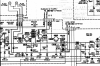
D831, D832, D833 are 5.1V zener diodes. So that would be a 15.3V drop across all three. The bulbs are 12V / 150mA , so using Ohm's law, we can consider those to be 80 Ohm resistors. We will just ignore D812 and D815 for now. They only come in play if the voltage is over 11V. R843 is 10 Ohms. I'm having trouble reading the schematic, but I think it says 37.2V on the emitter of Q802. If so...37.2V-15.3V=21.9V Since the voltage is below 22V to the bulbs, D812 and D815 should have little effect on the circuit until a bulb burns out. If I figured correctly, there should be a 1.29V across R843. Using Ohm's law there will be 0.16641 Watts dissipated at R843. R843 is rated 1/4W.

So yes a 10 Ohm 1/4W flameproof resistor makes sense here. I would also check R809-811... three 270 Ohm resistors in parallel should read 90 Ohms in circuit.


JVC AMP LIGHTS.PNG
 
Wow... mind blown. Please understand that I’m not lazy, just very ignorant. I’m reading/studying/watching everything I can on the subject. Still, I don’t always understand how to apply what I’ve learned, and you have been a great help.

Using the zener testing guide you sent, I’ve already removed D815 because it is totally shorted. And just as you said, it was accompanied by blown bulbs.

I will print your last post and with it and amplifier at hand, work on understanding more about what I’m doing before I proceed.

I began this project after receiving the simplistic advice that the power meters were fed through the bulbs, and that was all. I didn’t even know what a zener diode was. Now that I’m into it, I just can’t bear the thought of it licking me. I’ve had this thing since I was 19, on and off with my brother-in-law, so I felt like it deserved a little TLC.

Thank you again!

Tracy
 
I'm no pro. Just a tinkerer. I took electronics in high school 35 years ago. I have been down this road before on a JVC receiver. I don't understand why the damned circuit is so complicated to light a couple of bulbs. The problem is that when a bulb burns out, then the zener diode is handling all of the current. In the case of the receivers linked above, it causes the diodes to overheat and short out. When this happens, the resistors burn up. I have one receiver here that actually burned a hole in the PCB from this problem. I was able to fix the lighting but it has some other problems. I just haven't been motivated to work on it anymore...

750v - 17 dollar.jpg
 
Absolutely. I was in Charleston, SC one day before I even knew about the diodes. I checked the specs and found the bulbs at a place called Industrial Electronics Wholesalers. He said I was so lucky that he had them that I should buy a lottery ticket. I figured I was so unlucky, that I bought all of them that he had because I planned on blowing a few fixing this thing.

So, if you know anyone in the same situation, and they can’t find them, I’ll mail them a couple.
 
Last edited:
Back
Top Bottom