• The move to the new server is done. There are some software and database maintenance updates in process. This has us passing the hat around to help out. We appreciate any donations. Seriously, even a dollar helps. The payment page may be found here - https://www.audiokarma.org/support.html

Reviving a SX-3800 but audio drops on both channels with high load

justinbroken

New Member
Hello,

I have a Pioneer SX-3800 that I am restoring. It was DOA and was a victim from a cracked transistor socket.

I first replaced the sockets with phoenix connectors. I then replaced all the caps and transistors on the power supply board and replaced 3 resistors and 1 transistor that tested bad on the power amp board. Also did a thorough deoxit treatment. The four output transistors were not damaged at least!

I am able to set the DC balance and idle current according to the service manual and upon my initial full power testing all is good.

It was not until I turned up the volume very loud to where it almost maxes out the display meters that the volume lowers equally on both channels. This occurs with or without speakers connected/selected. I by-passed the pre-amp with a different source and it does the same audio drop too...as well as if speaker A or B is engaged or not.

Pin 22 & 23 on the power amp board read normal until I hit that loud volume threshold and then the readings jump back and forth and up and down .mvs to .vs.

Since both channels seem to be equally affected should I concentrate on the power supply? Or is there an area on the power amp that equally affects both channels that I should troubleshoot? What am I missing?

I appreciate any suggestion or guidance offered.
 

Attachments

  • 20190623_142402.jpg
    20190623_142402.jpg
    78 KB · Views: 9
Register to hide this ad
The power amp does not have any overt circuits to reduce power.

As I understand it, the results can occur without ANY speaker load at all. Also that the protect is NOT activating and disconnecting the speakers.

Experiment with just one channel (at a time) driven, to see if it can be located to a specific channel.

Yes, watch the regulated power.

I suspect your outputs may not have escaped unscathed.

On final testing, you may want to swap the outputs over to the opposite channel to confirm that the problem moves with the outputs.
 
Hello,

Thanks for your input.

1) Correct, same volume drop out results without any speaker load at all and the protect is not activating when I turn up the volume - the speakers stay connected even during the volume dropout event.
2) I removed one jumper at a time from the pre-amp and confirmed that both channels behave the same way when the volume is turned up past 3. I also by-passed the pre-amp and confirmed left and right behave the same way with the audio fed directly that way too.
3) To be sure I swapped the output transistors around and each channel exhibits the same exact behavior. The right channel appears to drop volume/distort slightly earlier than the left channel.

The left channel will fill the entire meter before the volume drops and becomes distorted. The right channel will almost fill the entire meter ( minus 2 blocks and will never go beyond that level) and the right channel volume will drop and become distorted. I also noticed that when testing with only one channel that the other channel meter will display one level for a split second when the volume starts to drop. (I am not sure if that means anything, but I thought I would mention it.)

The stereo sounds fantastic as long as I keep the volume below 3 which is what stumps me. It would be so much easier to troubleshoot if I experienced distortion or some degradation at any volume but when I start stressing it is only when the volume drops and it becomes distorted. That is why I wondered if I should pay more attention to the power supply since it might not be supplying enough power when the power amp needs it?

For clarification, I recapped the power supply, but I did not replace the 2 main filter caps.

Once again, I appreciate any suggestion or guidance offered.
 
The main filter caps are the power reservoir, if they are low capacitance, high ESR or leaky they can exhibit the problem you are seeing. Consider Replacing them with larger capacitance if you can find ones that fit physically, just do not go down in voltage or temp rating. Up to a 50% increase should not cause any problems, it may increase the power supply idle voltage a bit. Going too big may stress the rectifiers or transformer at power on surge. Even up to a 100% increase is probably ok, but may not be cost effective for the small possible improvement. The output transistor Safe-operating-area then becomes the major concern.
 
Last edited:
Hello,

Thanks Merlynski.

Looks like finding the correct sized caps is my next challenge. I did not see any suggested replacements in the forums for (SX-3800 or SX-D5000 PS)

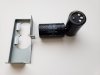
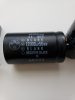
The 2 main filter caps (C225 & C226) on GWR-122 (REV B) are 12000 uF 56 Watts. There is a metal bracket that holds them in place that constrains the width (35mm) but it appears to be more structual - so could modify if needed.

Measures 35mm x 60mm.

Mouser search:
https://www.mouser.com/Passive-Comp...0j7ksZ1yzxdq3Z1z0x1fnZ1z0j22eZ1z0wun0Z1yzxe0i

Does 661-ESMH800VNN123MA6 look like a suitable replacement? 12000/80 - 35mm x 65mm

Any input is much appreciated.
 

Attachments

  • 20190701_084912.jpg
    20190701_084912.jpg
    32.8 KB · Views: 13
  • 20190701_084922.jpg
    20190701_084922.jpg
    20.7 KB · Views: 13
  • 20190701_084928.jpg
    20190701_084928.jpg
    20.8 KB · Views: 12
Your choice should work.

Another option could be to go up to 15,000uf / 63V 35mmx63mm ESMH630VNN153MA63T

Or go up to 105 deg. higher endurance and 15Kuf... KMH series EKMH630VSN153MA63T . If I recall the SX-3800 runs pretty hot. Maybe another more experienced AK'r could way in if the KMH series will work here as good as the SMH (described as ideal for power supply filter circuits) . Here is KMH datasheet: Datasheet.
 
Back
Top Bottom