• The move to the new server is done. There are some software and database maintenance updates in process. This has us passing the hat around to help out. We appreciate any donations. Seriously, even a dollar helps. The payment page may be found here - https://www.audiokarma.org/support.html

Revox B790 underdamped speed regulation

lsorrentino

New Member
Hello all, I have a Revox turntable in working condition, I've replaced all the capacitors, diode bridges and whatever is reasonable in such an old machine, the regulators I remember, in practice all the components that Revox experts recommends to change.
The speed is OK, from time to time fluctuates the least significant digit but the service manual itself says that this is normal.
What is not normal is the approach to the final speed, is noisy and under-damped, I will try to upload a video to better explain the problem, the same thing happens when I change speed from 33 to 45 or vice versa. The brake action at the stop is OK and noise free.
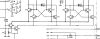
I have to say that I've checked each and every component, and compared every waveform with the ones reported on the service manual and all appears good, perfect. My analysis was based most on CARRIER FILTER stadium, I've replaced tantalum caps with two electrolitycs,I've verified PCB tracks, resistor values, solder joints, the last attempt was to simulate with LTSpice the circuit and compare the output waveform with the real one and were quite the same, I'm an electronics designer.
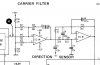
Carrier FIlter.JPG
Other things I remember I've look into were the power transistors, the motor current absorption, very little I remember something around 20mA or even less.
All of this analysis was done on my last Christmas holiday, so some weeks ago, now I have some time to dedicate to this table and I would like to solve this issue, but is not easy at all. In the last few days I've run into a phone app that can record the graph speed of the table when I start or stop the platter, and this is very very interesting! I gave 5 stars to this app (RPM Speed & Wow) that permits to me to better represent the fault of this Revox.
Start and stop at 33rpm, you can see the oscillations around final value, brake action is OK:
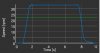
33rpm start stop.JPG

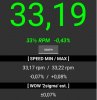
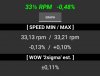
Steady state fluctuations, absolute value is slightly incorrect due to integration error of the app I guess:
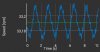
33rpm steady state.JPG
33rpm steady state b.JPG

Starting at 45rpm, changing to 33 and back to 45:
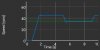
45 to 33 to 45.JPG

Dropping a 70g wood block in the outer side of the platter and checking regulation capability:
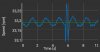
Dropping a weight.JPG

And finally, just to compare, the start action of my Lenco L75 and the steady state variations:
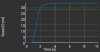
Lenco Start.JPG
Steady state of this table is more random, it depends I suppose on temperature, pulley centering imperfections and so on:
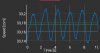
Lenco SS.JPG Lenco SS wow.JPG

A video of the Revox damping problem:

Other considerations, clues: a very few times, for a very short period, the problem disappears, so is intermittent, obvious I've sprayed moved every connection, IC in his socket ect, but nothing, swapped pll ic's, opamps...

Finally, is there anybody that have any idea on how to fix this turntable? Maybe someone expert in control theory that looking at the circuit can guess what's going on.

Any suggestion is welcome, remember that I've already attempted all the obvious, ie supply voltages and so on.

Anybody can do the same measurements and uploads results to compare behaviors of his Revox with mine?

This was my setup:

Phone Setup.JPG

Bye,
Luca

P.S. Sorry for my basic English, I write from Italy.
 
Register to hide this ad
In my understanding the TT is original and during very short periods does not shows the problem, is intermittent as I wrote. Thank you.
 
I have fixed a motor control board on a B795 last year that had similar issues (oscillation in speed change and not locking speed). Since the speed indicator is showing the speed fluctuation, I suppose the problem is not in the detection part but in the feedback/correction section.
Not having worked on a B790, I would offer some guesswork. How about checking the break sense and control part? IC14/19 and IC5? In my case, one 4558 had an op amp fried and a second one had one op-amp marginally functioning. It did give output but it was not stable, predictable and varied (would not go as far as say it oscillated).
One other thing to check would be to see how rail voltages hold up when you change speed. If they sag, it could be an indication the circuit is starving of current to control the speed change. In such a case, I would guess that starting up to 45rpm would sag more than changing speed from 33 to 45. Even having replaced the power supply and motor control electrolytics, there are some in the tonearm section that may be leaking a bit.
 
I have fixed a motor control board on a B795 last year that had similar issues (oscillation in speed change and not locking speed). Since the speed indicator is showing the speed fluctuation, I suppose the problem is not in the detection part but in the feedback/correction section.
Not having worked on a B790, I would offer some guesswork. How about checking the break sense and control part? IC14/19 and IC5? In my case, one 4558 had an op amp fried and a second one had one op-amp marginally functioning. It did give output but it was not stable, predictable and varied (would not go as far as say it oscillated).
One other thing to check would be to see how rail voltages hold up when you change speed. If they sag, it could be an indication the circuit is starving of current to control the speed change. In such a case, I would guess that starting up to 45rpm would sag more than changing speed from 33 to 45. Even having replaced the power supply and motor control electrolytics, there are some in the tonearm section that may be leaking a bit.

Hi SaSi thank you for your prompt and accurate reply.
I have to say that I have not significant fluctuation of the speed, just from time to time the least significant digit of the display 33.34 〈〉 33.33 and this is considered normal.
Regarding IC14/19 and IC5 I've tried to replace them all with new JRC ones without any effect.
Rail voltages are spot on during transitions, I've checked it all with the oscilloscope, and I've replaced every component on the supply board, even the PTC protections.
You can see the plot starting at 45rpm, is not so different from the 33 one, just less pronounced overshoot.
All the caps of the tonearm board, tantalum ed electrolitycs was replaced, and I've conducted all my investigation with the arm board completely disconnected with the same exact simptoms.

:(
 
I have the same problem with my B790, but slightly worse. The platter will usually rattle when accelerating up to speed, but then remain stable. So I'm very interested in a solution, and grateful for any answers. PS. I upgraded the player with the Power Board kit from Revox-Online and also replaced the electrolytic capacitors on the Arm and Motor Boards.
 
Could you post a video of the turntable starting until it stabilizes? Rattling sounds ... serious. Does it make a rattling noise of vibration? It would be interesting if such sounds could be captured in the video.
 
Many thanks for answering! It is just like in Luca's video in the first post, but a little bit more so. If you turn the volume up, you will hear the rattling noise. The vibrating and rattling with my player lasts for about half a second. But after that it will stabilize and spin with no deviation.
I am wondering if it could have anything to do with stiction in the motor bearing. I have axcess to another B790 that works perfectly, and the platter on that one will go on spinning for 7,5 revolutions if I cut the power. On mine the platter will spin for 5,5 revolutions if I cut the power when it's spinning at 33.33. So 25% less. But I can't find any obvious ways to get at the motor bearing.
 
Last edited:
My 790 makes a kind of musical sound as the PLL locks , which the 795 does not . The 790 motor has a big rotor, that seems to transduce the drive voltage's momentary oscillation into sound. Function and specs are all normal.
 
Hello all, I had forgotten this post but my problem is still there. Still no solution found, but I've made further analysis. Below the results for posterity :).
SDS00003.png BodeSetup.jpg Cattura.JPG
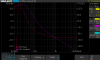
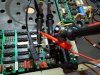
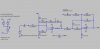
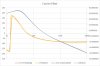
The bode plot and the connection for signal ignition and reading. To do so I disconnected the motor and IC18, signal was injected through a 4.7uF to R42 and read at IC8 output, a 390K resistor was added to bias first opamp stage.
Then result was compared to a LTSpice simulation to determine if something is out of specs but everything is fine in my understanding, look at the plots below.
LTSpice.jpg Excel.jpg
I have not important differences between expected and measured behavior of the carrier filter, mystery continues...
 
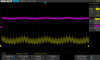
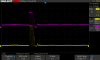
More measures, current absorbed by the motor is surprisingly low, around 10mA, 24V*10mA=0.24W :thumbsup: so I suppose no significant friction in motor assembly.
SDS00007.png
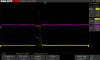
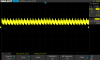
Here is the current measured at R17 during 7 seconds.

This plot is speed change from 33 to 45 with plenty of under damping oscillations
SDS00008.png

This last one is speed from 45 back to 33:
SDS00009.png

I forgot, violet trace is IC8 opamp output.

Just to complete, I observed that maximun current of the motor is around 320mA when it starts or during speed changes, in my knowledge this is due to the driver implementation, limited base current of Q6 Q7 and so on.

upload_2020-9-28_10-15-22.png
 
Last edited:
Many thanks for answering! It is just like in Luca's video in the first post, but a little bit more so. If you turn the volume up, you will hear the rattling noise. The vibrating and rattling with my player lasts for about half a second. But after that it will stabilize and spin with no deviation.
I am wondering if it could have anything to do with stiction in the motor bearing. I have axcess to another B790 that works perfectly, and the platter on that one will go on spinning for 7,5 revolutions if I cut the power. On mine the platter will spin for 5,5 revolutions if I cut the power when it's spinning at 33.33. So 25% less. But I can't find any obvious ways to get at the motor bearing.
Hi Basso,
have you solved? I read in some german forum that someone has disassembled the motor and superglued something inside, and by the way greased teh bottom bearing, you can find the post googling for "revox b790 motor geräusche".

Regards,
Luca
 
Hello all, finally I close this thread with the solution! It was of big help this german forum and the translator which guide me to fix my turntable.

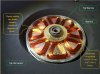
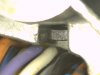
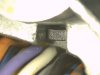
The problem was in the motor, particularly the coil assembly was not anymore strictly mechanical connected to the stator, during the years it developed a play between the metallic part of the stator and the plastic bobbin where all coils and the hall sensors are placed.

ezgif.com-gif-maker (1).gif

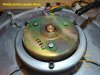
Ok, this was my procedure, first of all I've opened the bottom of the motor takig off the three screws in the picture.
Step1.JPG

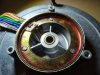
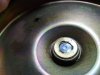
Below the thurst pad assembly there is the tacho disc and coil with old sticky grease!
Step2.JPG

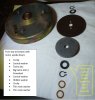
Removing two circlips with appropriate plier in the sequence pictured below you can carefully pull the rotor out and remain just with stator mounted on the platter assembly.
Step3.JPG 1601887047024.jpg 1601887047051.jpg

It's not really necessary to dismount the stator from the platter base, in my case I have done it, I didn't know, I wanted to try to push the starlock that retain the bobbin to better fix plastic to metal and eliminate the play but I can't, I've done it with a tube and a bench vise, but when I pressed, plastic bobbins stopped to move respect to metal stator and when release everything moves like before. I didn't go further with the bench vise, I was afraid to break something.
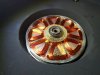
When pull out the stator some resistance is opposed by a heavy ferromagnetic disc below the coils, that is attached to the rotor, don't be shy, pull! With coils at sight I can see the wire isolation was scratched form a couple of adjacent ones, fortunately no short circuited wound were present, I put afterward some insulating coating varnish, I don't know if it was me scratching the rotor, but I've learned that is necessary to pay attention when the thurst bearing is removed and do not push the rotor towards the coil assembly beacuse maybe, the magnet can rub the coils!
Step4.JPG image0007.jpg

If you dismount the motor form the base, pay close attention to annotate each shim washer present and where, they have different thickness and position and serves to align platter to tonearm!

To be continued....
 
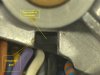
Finally to lock the plastic to the metal I've used a drop of epoxy glue in the notch where the plastic tooth go inside, I probably would have done a better job putting a drop of cyanoacrylate gel adhesive istead for better penetration and good looking job but this was the first attempt...
I can not rule out there was some glue in that point that over time has dried and broken, picture below is after isopropyl alcohol cleaning.
Step5.JPG
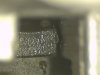
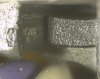
This pictures are before cleaning.
image0003.jpg image0004.jpg
I'd like to upload an animated gif of the play but I don't know how to do it!
image0005.jpg image0006.jpg

Before reassembling the motor I've cleaned with alcohol top and bottom bearing, the spindle, and put a drop of 5W40 oil in each.

Thurst platter deserve special attention, I've cleaned with a small brush and kerosene (I'm not sure of the english name) to remove the old sticky grease. Be careful because there is a thin wire to ground connect the rotor, don't bend it! Then apply fresh PTFE grease "et voila"!
1601887046992.jpg

Well, when I turned on first time after reassembling the tt I was afraid that scratched wires can play a role but I had good luck and the table started without any noise!!!

One thing I like, how to measure the improvement if any? First of all I have no more fluctuation of the last digit of the display, let's check the motor current and compare it with the one in post #11
SDS00015.png
Current is flat at first sight and the value is reduced to 8.25mA averaged! It means less friction and less friction variation in one turn!!! Great goal, consequently less wow, flutter probably the same due to the non uniformity of magnetic field and so on...
1601886906455.jpg1601886906455.jpg
:beerchug: W&F dropped to 0.02, before was 0.07.

Conclusion: is not true that motor does not need any maintenance and is lifetime lubricated, for a consumer producer, also the very well regarded Revox lifetime means around10 years, my turntable has 42, and yours?

Regards,
Luca
 

Attachments

  • 1601886906464.jpg
    1601886906464.jpg
    34.4 KB · Views: 42
  • 1601886906482.jpg
    1601886906482.jpg
    33.9 KB · Views: 40
Last edited:
Just reporting back after I have serviced my 790. Same symptoms and same solution. I have made a small shim using "aerospace grade beer-can material" folded a few times and epoxied it in place.

Everything inside was smaller that I was expecting, quite a fiddly job but it seems I have managed to not brake anything.

Thanks for the instructions Luca, it was very helpful.

Now the only things that is left bothering me is the transformer buzzing when warm. I will try to decuple it a bit form the bottom chassis, to see if that helps.
 
The transformer on mine was buzzing and I was getting a very slight variation in speed. It turns out that the bridge rectifiers on the power supply board were bad. Once replaced the table worked fine again. There is a thread here when I was trying to fix mine.
 
The transformer on mine was buzzing and I was getting a very slight variation in speed. It turns out that the bridge rectifiers on the power supply board were bad. Once replaced the table worked fine again. There is a thread here when I was trying to fix mine.

I see, I have only replaced the electrolytic capacitors and the 3 rectifiers on mine, I might go back in and do the regulators, thermistors and diodes. The transformer hum is mostly gone away but I'm still getting +- 0.01 rpm variation (in the digital readout), I'm not sure how much to worry about that...
 
I see, I have only replaced the electrolytic capacitors and the 3 rectifiers on mine, I might go back in and do the regulators, thermistors and diodes. The transformer hum is mostly gone away but I'm still getting +- 0.01 rpm variation (in the digital readout), I'm not sure how much to worry about that...
That is what mine was doing. The hum and that same very slight speed variation.
 
Back
Top Bottom