• The move to the new server is done. There are some software and database maintenance updates in process. This has us passing the hat around to help out. We appreciate any donations. Seriously, even a dollar helps. The payment page may be found here - https://www.audiokarma.org/support.html

Revox Model 40 Motorboating

AngelAT

Well-Known Member
I am experienced working on solid state units and recently started expanding my portfolio with tubes.

I bought a Revox model 40 stereo amp. Seller said it was not turning anymore. It came to be the power switch - was jammed and not moving properly. This was an easy fix.

Then a resistor for the phono tube was split in two. This was also replaced.

One of the channels (left) was intermittent- came out that the banana binding post was not making proper contact. Also the resistors looked a bit dodgy so also replaced them.

Now my main problem: the amp starts to oscillate after a few minutes. Came out that it was due to one pair of the output tubes. When switching the pairs the problem moved to the other channel.
My question is could this oscillation be caused by a defect component or is it just the tubes?
I have already ordered a new set of tubes but would like to fix everything before installing the tubes. The problem is this unit has a strange design and all components are in a circle below the tubes. And I don’t want to mess around unless necessary.
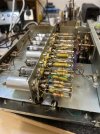
IMG_9265.jpeg

Are there any particular components that require attention. Someone has worked and one of the rectifiers was replaced.
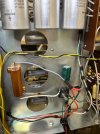

IMG_9269.jpeg

Thanks in advance!
 
Register to hide this ad
You had "motorboating" in the title of your thread. Most motor boating noises I've run across were due to failing filter capacitors in the power supply.
I also ran across a loud kind of low tone "wah,wah,wah!" That was an oscillation noise due to a bad coupling cap.
 
If by motorboating you mean a put put put put sound, I had that happen with my Elekit TU-8200. Turns out it was an old KT88 tube going bad.
Yes! Motorboating is usually a tube issue. Dirty or oxidized contacts in the sockets. Or a weak tube.

Sometimes cleaning the sockets and tube pins with Deoxit D100L — then removing and re-inserting them, like 10-15 times — is enough to remove any oxidation that is causing the noise issues. Including motorboat noise.

If that doesn't work, try rotating similar-type tubes between sockets and see if that breaks up the noise. Like rotating 12AX7s from one socket to another.

If you don't have access to a tube tester, you can also rotate a new 12AX7 (or whatever tube type) socket-by-socket until the noise goes away.

Also, clean all RCA jacks and plugs.

See if these help before diving into the wiring.

Good luck! :thumbsup:
 
If its single channel and it moved with the tubes, I'm going with not power supply. Don't know the specific tube problem but it seems highly likely that its one of the tubes you moved. Push-pull amps generally need them replaced in pairs, but might need it replaced in a set of 4 depending on the bias setup and how tired the other set are.
 
Thanks for the replies everyone!
Yes the put put put sound moved with the tubes. I switched the left channel set of output tubes to the right and the sound moved with them. This made me think it is not PS related.
But I will just clean the pins to the best of my ability just to be on the safe side.
Also I tested the 3 multi cap PS filters. When I power up the amp the voltage goes above the spec but then goes to spec after a few seconds. (Not sure if this is absolutely ok).
I read that these mustard capacitors (widely used here) are generally ok.
 
the voltage spike is common with solid state or direct heat rectifiers. Not typically a problem, most caps are rated for an amount of surge voltage for a limited time. If you replace them I might bump that voltage rating so it doesn't get exceeded though. No solid proof but more of a feeling that modern caps aren't quite so loose with their ratings, and exceeding it just doesn't seem like a great idea for reliability reasons.

the "mustard" caps are some flavor of film, polyester/mylar I believe. Generally film caps are very reliable but not a bad idea to check them for leakage just out of caution. Can typically do this by just measuring voltage on the grid side. In most things one end of the cap goes to a tube plate, the other goes to a grid, and there is a grid to ground resistor. Measure voltage across the grid resistor, do a bit of math, and see what the leakage current is. You want single digit microamps or less typically. Or just look at the voltage, if its in the low millivolt range, its fine.
 
Yes the put put put sound moved with the tubes. I switched the left channel set of output tubes to the right and the sound moved with them.
It's one of the tubes that was moved from channel to channel.

Now, start replacing one new tube into each socket — one at a time — in the channel that has the putt-putt noise, until it goes away. You are trying to isolate that one bad tube.

It is possible there are two bad tubes, but replacing one should make a big difference. The putt-putt noise should diminish a lot.

If there is still a little noise. keep the new tube in and start replacing the others until the noise goes away.

Good luck!
 
A quick update:
I was able to locate the faulty tube. It was the second output tube (when counting from left to right). The problem was moving with that one.
I got the new tubes and replaced first the outputs. Then I also replaced the other 4 tubes.

IMG_9398.jpeg

A defective rca cable made me chase my tail for some time. While doing it I replaced the speaker cable binding posts. Also cleaned the switch one more time.

This Revox Modell 40 sounds really nice!

I just noticed that the third tube from the left lights brighter than the others. Is this normal behavior?

IMG_9396.jpeg

...not sure if it is very distinct here at the picture. But in reality it is brighter than the one to the left.
 
img_9396-jpeg.3848953

I just noticed that the third tube from the left lights brighter than the others. Is this normal behavior?

...not sure if it is very distinct here at the picture. But in reality it is brighter than the one to the left.
Thanks for the reply! Glad it worked out! :)

Do not worry about 9-pin miniature tubes with different brightness levels. This is due to how the heater filaments are exposed. Even within the same manufacturer and lot, heater brightness can vary. They will function the same as long as they test the same.

:thumbsup:
 
Back
Top Bottom