• The move to the new server is done. There are some software and database maintenance updates in process. This has us passing the hat around to help out. We appreciate any donations. Seriously, even a dollar helps. The payment page may be found here - https://www.audiokarma.org/support.html

Rework Stations Overview, and Hakko FM-206 Rework Station Review (2025)

FriedChicken

Active Member
Introduction and Overview

This is a little bit left of field for this forum, but given how much DIY information/instructions/advice/guidance are posted on here (shoutout @avionic), and given how helpful this forum has been (for the most part!), a review like this could serve as a small contribution.

Very recently I did a board repair that saved me at least a thousand if not thousands of dollars and a lot of headache (board repair for car). With that, I made an executive decision that my budget for soldering and rework tools gets a no-nonsense significant bump.

I've found that electronic rework/repair is very much like woodworking: Even for the most basic task you quickly find yourself reaching for the entire workshop of tools: table saw, circular saw, miter saw, biscuit joiner, router, planer, chisel, glue, etc. etc. etc. This is touched on in this stickied post. On top of that, you don't want shitty/terrible versions of these tools either. They get in the way, they're limited in functionality, they'll put you in the hospital if they're not designed/built right, thus negating any and all savings.

Additionally, for all the incredible amount of details and reviews and offerings and information and obsession on different audio gear of various shapes/sizes/form factors/functions/prices/countries, generations; there is comparatively nothing when it comes to electronics repair gear/equipment. In that same vein, there's very little guidance on what to actually buy, how much to spend, what companies to buy from. This is unfortunate, because the landscape is incredibly confusing.

Let me save you some of that headache now. Here are the players when it comes to soldering/rework gear, based on the research I've done, and also what technologies/innovations to look for:
  • Endless plethora of Chinese Junk (just don't)
    • These get a lot of attention b/c they're considered affordable... until they set fire and burn your house down
    • There could be some gems in here but IMO it's not worth entertaining
    • Even if you get one that works well and meets your needs *now*, will it have a library of accessories for down the road?
    • Will it have support/parts if it breaks in 10 years?
    • Does it get those little details right? Probably not.
  • Pace
    • Good old fashioned American Awesome
    • Used by the U.S. Navy
    • Probably wrote the rulebook for soldering tools
  • Metcal
    • I'm not familiar
  • Ersa
    • I'm not familiar
    • Make the super big and expensive automated machines
  • Hakko (What I use)
    • Japanese with all its Japanese trappings (high quality, reliability, a bit small and finnicky)
    • Been in the business over half a century
    • This is the "Inexpensive" option
    • Excellent support for old/discontinued products
  • Weller
    • German staple
    • Slightly more expensive than Hakko
    • I put them on the level of Pace as being institutions of the industry, just the German version
  • JBC
    • Considered the Mercedes S-Class/Rolls Royce of hand Soldering/Rework tools
    • Spain
    • A significant but not ludicrous premium price over other options
    • Offers useful benefits and innovations; has that "luxury" element with very nice details that do matter
    • Review of their ultra station/system:
Additionally there are some trends and considerations in the slow-moving soldering/rework industry worth pointing out.
For the most part hand soldering and rework employs the same technologies and techniques now as in the 80s, with a few small but not insignificant changes. That might explain why there are so many old guns around here ahaha
In fact, if you're looking at learning to solder, IMO there's only one place to look: the soldering/rework videos put out by Pace in the 1980s or something. HERE is a reddit post linking-to and cataloging those videos:

reddit post said:
Cannot recommend the vintage PACE soldering tutorials enough. They have a series for basics, rework and repair and advanced rework and repair.
Basics is self explanatory and is a fantastic place to begin as it starts at square one and does require any previous knowledge. From there it teaches you the meanings of soldering specific terminology, its behavior, etc etc. Then it proceeds to how to sections, soldering specific terminals, pads and pins
https://youtube.com/playlist?list=PL926EC0F1F93C1837
Rework is much more advanced and instead of telling you how to not **** up (like the basics) it basically teaches how to fix someone else's ****ups (and natural damage that will occur). It also provides much more knowledge on PCBs with segments on construction, properties and technicalities. I also highly recommend this if you are serious about soldering, even disregarding repair.
https://youtube.com/playlist?list=PL958FF32927823D12
The last one is advanced rework, or multiplayer repair specifically. This one is more for gits and shiggles since it's often an unnecessarily advanced/specific repair. It does contain some important knowledge here and there though.
Normal
https://youtube.com/playlist?list=PLZ4bp4FXracL-vD26gqx3HqpK7pLcoZZ3 Super weird goofy version

Anyway, here are some significant things that have changed since the Reagan administration:
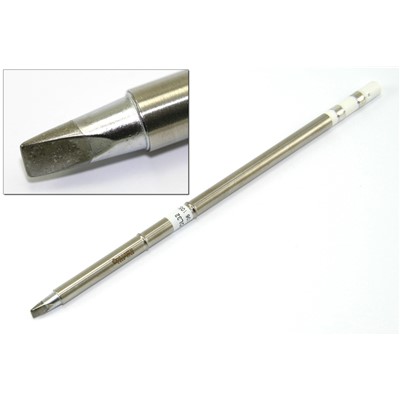
  • Cartridge style tips/wands
    • Instead of replacing tips using a screwdriver or something, you replace the entire heating element, thermistor, and the tip as one unit
    • Once you use this you won't want to go back to the old fashioned style
    • I believe JBC pioneered the fast, hands-free tip changing for these
    • Cartridge tips are a lot more expensive than just the simple front tip element
    • This is a huge reason to not get a vintage behemoth soldering unit, it's really nice for even the simplest of jobs.
h001-002491-hakko-t15-dl32.jpg

  • Sleep Stations for the tools
    • Soldering irons get hot, but if they're hot for too long, they'll start to degrade/oxidize
    • Solution: A rest station for the tool connected to the controller; it senses when the tool is placed on it and lowers the temperature or completely turns the iron off when not in use
    • Not an issue, because the stations also have:
  • Temperature-Feedback controlled Tip Heating
    • Old and cheap soldering irons are a simple resistive heater hooked up to a variable power supply (if even that lol), offering slow and imprecise but reliable tip heating
    • New soldering units have a thermistor probe built into the tip allowing two important details: 1. precise temperature control, 2. a LOT of power can safely be applied
    • Precise temperature control: very important when working around electronics. You don't want to overcook (or undercook) things, and you can use the ideal temperature for the solder you're working with
    • Power application: having the temperature feedback means the power supply can supply a significant amount of power to initially heat the tip, and also keep applying power as it's depleted from use (say on a large solder joint). This makes soldering irons very "fast"
    • This allows tips to be a lot smaller for their power output, b/c you're no longer relying on the thermal mass of the tip to keep things hot
    • Pace calls this "sensatemp" or "intellitemp" or something, and uses it in all their marketing in lieu of actual english, compounding the confusion.
    • The real magic here is how that's controlled, which leads me into the next innovation/change:
  • Digital Bullshit
    • Used for broadly 2 things: 1. Control and Operation 2. The User Interface
    • Control and Operation
      • The aforementioned tips and their performance are strongly dependent on the nuance and details of how its controlled.
      • Goal is: maximum (fast) heating, and fast precise control for the desired tip temperature
      • How this is done is a large part of why you want a premium station and not chinese junk
      • JBC has 130-watt soldering irons that go from 0 to Ready in like 3 seconds lol
    • User Interface
      • I'm not a luddite but sometimes I feel like the industry and the world wants me to be one
      • JBC has managed to make an entire rework system that takes 30 seconds to boot up (although the tips heat up faster?)
      • It has a retarded, slow-as dogs touch interface that offers such wonderful feature unit conversion, as if we didn't have smartphones now :rolleyes:
      • Pace's latest has stuck with the simplest possible user interface, mimicking analog, but under the hood has the latest and most advanced circuitry for tip control (I like this!)


Yeeeeeeesh. That's a lot, isn't it? Yeah, imagine how deep I went down this rabbit hole to decipher all of this for myself.

So anyway, now to the
 
Register to hide this ad
Hakko FM-206 Rework Station Pre-Review

Like I mentioned above, Hakko slots itself as the inexpensive of the rework offerings, but that doesn't mean you're going to find their stuff at the dollar store. Again I want to warn about the Chinese offerings. Do yourself a favor, preclude the temptation, and don't even look. Pretend it doesn't exist. Whatever you have to do.

In the wake of the thousands saved by the non-trivial rework job, I clung to my fundamental beliefs "buy once cry once".
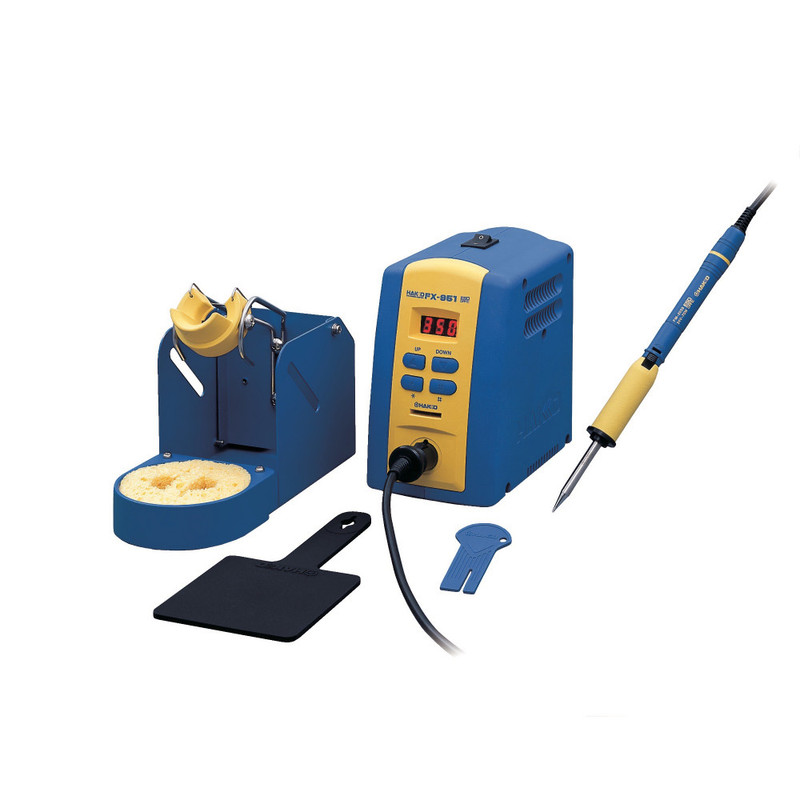
My old soldering station is a Hakko FX-951 (just replaced a few months ago by the FX-971):

FX951-62-1000x1000.jpg


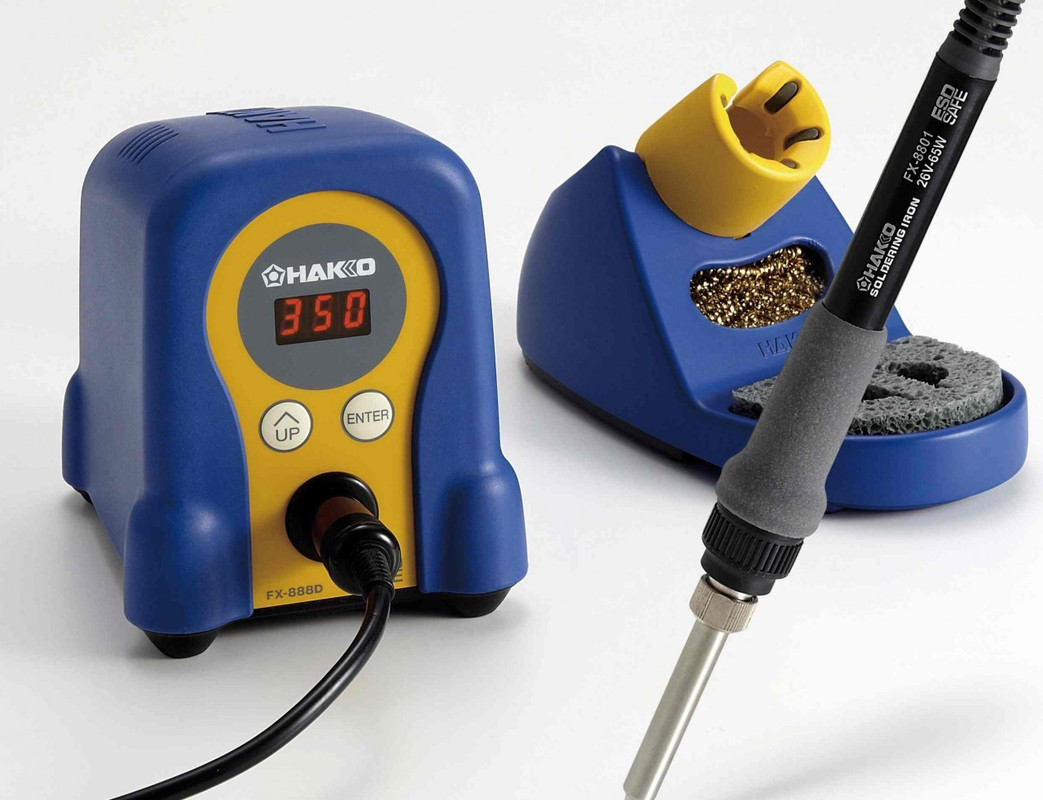
Even this unit is already a step up from the basic and ubiquitous FX-888D (since upgraded to the Hakko FX-888DX):

R.jpg


The FX-951 works with Hakko's integrated wand tips with thermal feedback control and 70 watts of heating.
It has a notoriously clunky/unusual user interface, that even after years I still have no idea how to use. I appreciate its digital minimalism, but it feels like programming a VCR every time you use it. Shocker: I would have preferred an analog dial.

That said, the performance is good with nothing to complain about.

Confused by all these Hakko Numbers? OH BOY it's about to get a LOT worse!
Hakko is in a transitory phase right now as of writing with the release of the FX-972 dual port soldering station. I expect more things to change soon, but that neither means the old stuff will stop functioning, nor that everything is going to get replaced.
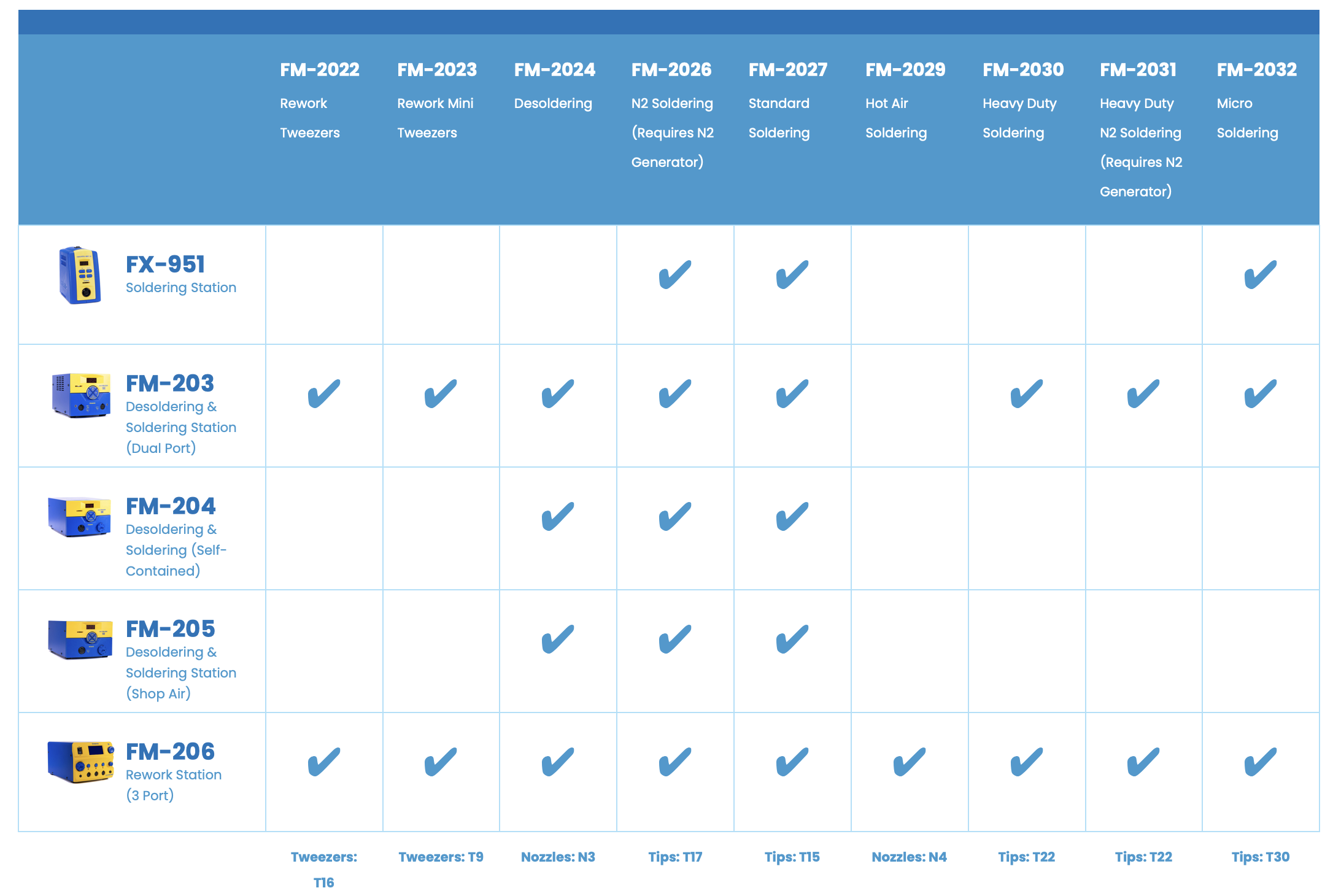
Here's the chart w/Hakko's mid tier offering of basically the past 15 years for serious solder/rework:
hakko-confusion.png


Notice two things: 1. My old FX-951 2. How the FM-206 has ALL the checkmarks >:D

At the top you find the various different soldering/rewok accessories offered for this line of hakko stations, and notice how they're not all compatible. To compound the confusion, the FM-2024 vacuum desolder tool comes with two versions: one (very expensive) version with an additional separate vacuum pump that can be controlled with the FM-203 and FM-205, and one (expensive) version that can only be used with the FM-204 and FM-206 (as these have built in vacuum pumps).

I could go on here about what the different Tweezers/Tips at the bottom mean, and also Hakko's lineup and options for separate standalone units, but it's getting long, I have to draw a line here. If you're interested in these options, you can do your own research and probably find excellent deals on eBay, but beware the price of accessories and tips!

Long story short, weighing a lot of options, pros and cons, I decided the hunt was on for a Hakko FM-206 Rework station for a number of reasons:
  • It's compatible with my existing collection of tips and wands from my FX-951
  • It's an all-in-one unit; my bench space is limited and although I'm a bit hesitant on all-in-ones, the Japanese can usually pull off the necessary reliabiltiy
  • It's the Top-of-the-line: it powers all the accessories, so if I find needs or deals in the future I don't have to worry about it
  • It's a three-port workhorse; I would say two is a minimum, but even having only done a couple jobs I've already used all three channels simultaneously
  • Adding to that: it doesn't use the indecipherable UI/controls of the other units, but has its own much more powerful interface
You can get decent deals on these, but as someone on the eevblog forum explained to me: the continued usefulness, and aforementioned unchanging nature of rework technologies, means there really is a price floor on what you're going to find. I'll spare the details of the lengths I had to go through to get one at an affordable price, but will add: I didn't scrounge for something bottom of the barrel, and I still bit the bullet. Hard. "Buy once cry once" doesn't mean "no crying at all ever", and two month purchase process were filled with self-doubt, squirming, second-guessing, endless researching (to y'alls benefit here), scrounging, debating, ludicrous ideas; a process probably not unfamiliar to many on these forums.

However...

FM-206 Review for real:

BEHOLD THE MAGNIFICENCE!


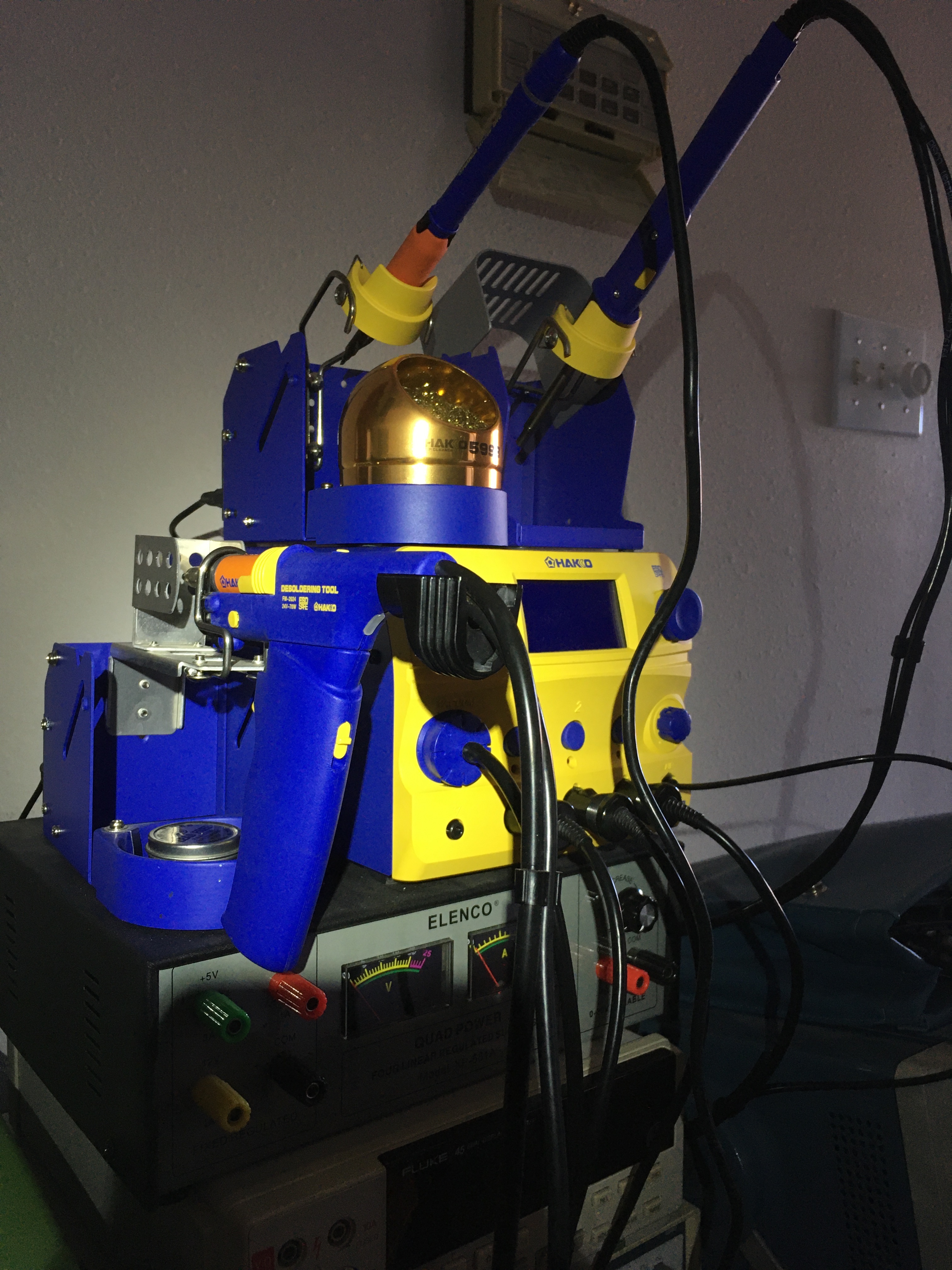
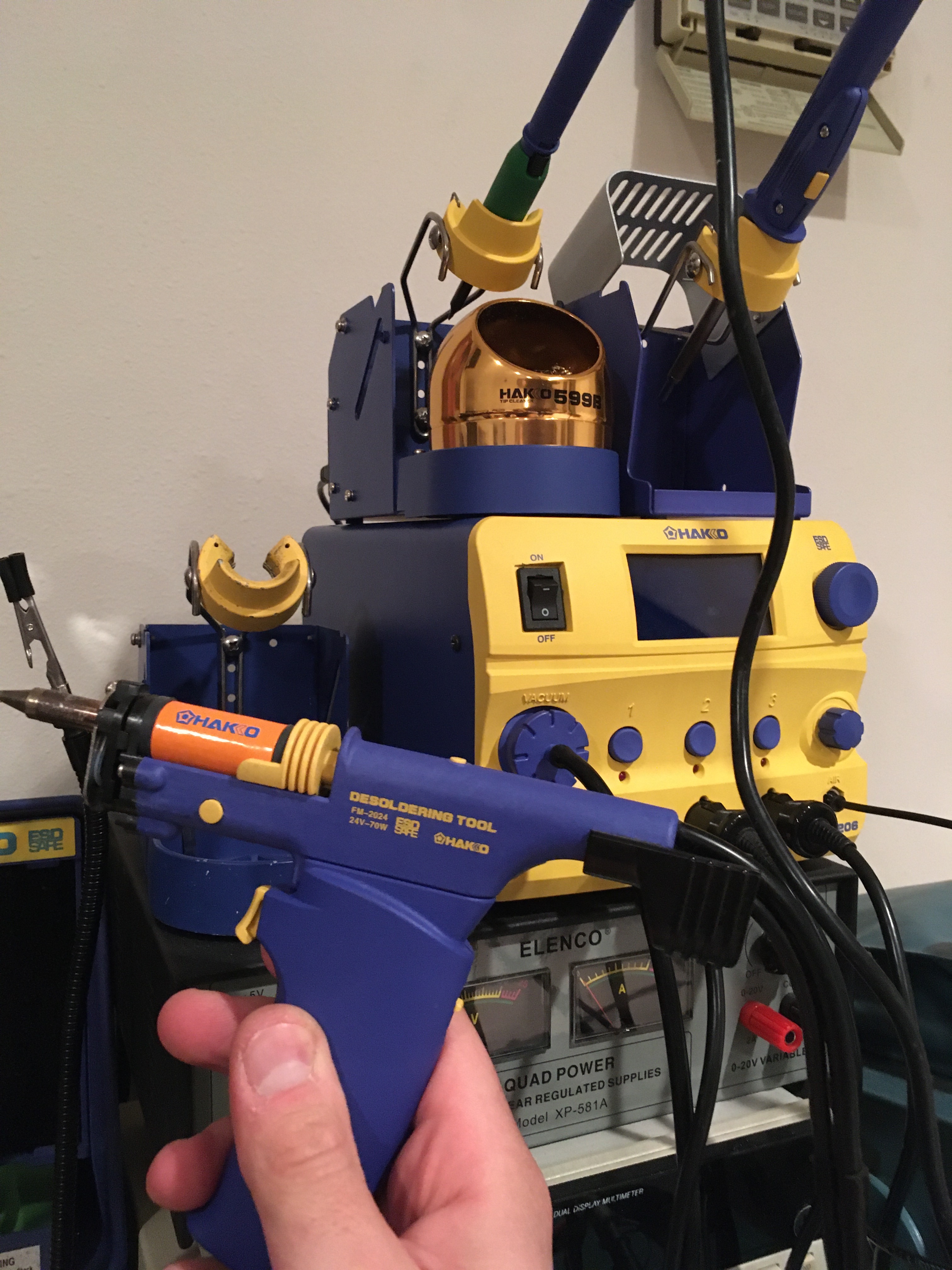
The FM-206 is sold by Hakko in various configurations, depending on which handpieces. They will all come with a Standard FM-2027 Soldering Iron and two additional handpieces for a total of three, along with their appropriate rest stations. What you are looking at is my configuration: The FM-2027 Soldering Iron, FM-2024 Vacuum Desolder Gun/Wand, and the FM-2029 Hot Air Pencil. The FM-206 has a built in vacuum and air pump for hot air; so these are the handpieces I decided to go with.

I managed to get a brand new FM-206 Unit with very lightly used or even brand new handpieces. I won't say the unit is gorgeous, but it's definitely not ugly.
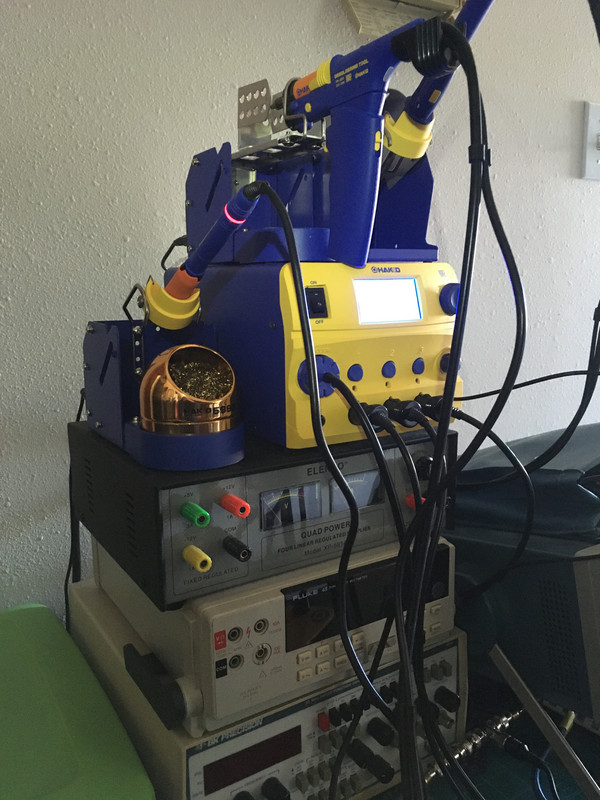
The room I work in is relatively dim, so I don't have any good pictures to show it off, but here's one with flash to get an impression of the how striking and beautiful the Hakko colors are:


The whole thing feels solid... not like it's machined out of a brick of metal forged in the fires of mount doom, but also not like a piece of taco bell cheese forged in the oil refineries of chevron. The On/Off switch is exactly what you want from an on/off switch, actuates easily but unambiguously; solidly embedded with no fuss, movement, vibration, flimsiness. It's Japanese; like a toyota camry. Quality where it needs it, gives the impression it'll last a long time, even with misuse, but not with bejeweled swarovsky dials (that's more JBC's milieu). Japanese.

It sits flat on all sides, so you can stack on top of it and flush besides it; something i've already taken advantage of.
The control/power chords for the handpieces are arranged at the front. Cable management is a mess, there's no way around that (except JBC has a solution of course). The back of the unit has three 3.5mm plugs and a male-to-male connecting cable to plug the rest stations. These work on a simple physical switch principle: the weight of the tool pivots the receptacle that closes a switch in the rest station, telling the main unit to sleep/power off the appropriate handpiece thus preserving tip life.
The rest stations themselves are made of metal, and have a nice.... Japanese.... feel to them (JBCs rest stations have die-cast brushed aluminum). Hakko has an integrated tip cleaner receptacle into most of them. Either brass wool or a wet sponge. Elegant. The tools slot in decently elegantly and confidently. You're not going to have it fall off on you from misplacing it, and you're not going to fiddle and fuss trying to get it in (heh). These. Details. Matter.

Whence you power on the unit, you're greeted by an elegant blue glow of the LCD screen, a loud audible beep, an annoyingly noisy cooling fan, and the red LED lights for the different channels as well as the red LED lights on the handpieces. As soon as the switch is flipped the tools start heating up to max temperature, before powering down again to their "sleep" temperature (unless it's not sitting on its rest station). "Booting" takes about 4 seconds from actuating the switch to all info being displayed on the screen and ready to go, including changing settings, etc. I reiterate: the handpieces start heating up as soon as the switch is flipped, even before booting is complete.


I can't stress enough how nice that instant on functionality is. If you so choose, you can treat the unit like a light switch. By the time you've flipped the switch and gotten the tool at the workpiece, it'll be hot and ready to go. I've found myself quite a few times now needing to turn the unit back on after having prematurely turned it off. Additionally, the base unit gives an audible beep every time operating temperature is achieved. This functionality is the same across the entire FM lineup of workstations, including my FX-951 I'm pretty sure. This allows me to remove the handpiece, situate myself on the board preparing the solder job, and as soon as I hear the audible beep I can begin soldering. We're talking an order of <10 seconds here. (JBC's handpieces, pushing a full 130 watts, are so fast you'd have to be an olympic solderer to get the handpiece from the rest station to the solder target before it's fully heated up).

Soldering performance? As far as I can tell it's exactly identical to the FX-951. The specs reflect this. Theoretically with the thermistor-feedback controlled soldering tip you'll get identical performance no matter the temperature you set, so long as it's above your solder melting temperature. The unit will simply pump heat into the tip as its drawn out by the solder. In practice I've found this to not be 100% true; setting a higher temperature will get your work done slightly faster. (JBC claims their controllers are so good, they're safer for the board as you can solder at a lower temperature than you would with other, lesser, peasant rework stations). I rate the performance 4/5.

Ok, it powers on and solders... what about the interface? Am I going to miss my wall-plug soldering iron, or otherwise be overwhelmed by a desire throw the thing into a tree mulcher?

There's no other way to say this: it's nigh on perfect.

I'll spare the intricate details, but if you're curious, you can click: here, here, here, here or here.

Hakko has always notoriously terrible 1980's VCR-style interfaces for their soldering stations (including my old FX-951). There are ample opportunities to **** up, and I have a very strong bias towards analog things. The user interface on this is even better than what Steve Jobs' apple put out. It's not so stupid easy that you'll instantly have it figured out the first time you use it, but the tradeoff is once you spend the 15 minutes or so to figure it out, you'll be able to navigate it almost blindfolded. It's such an excellent balance between retarded and autistic, it's just *muah*. Chef's kiss.

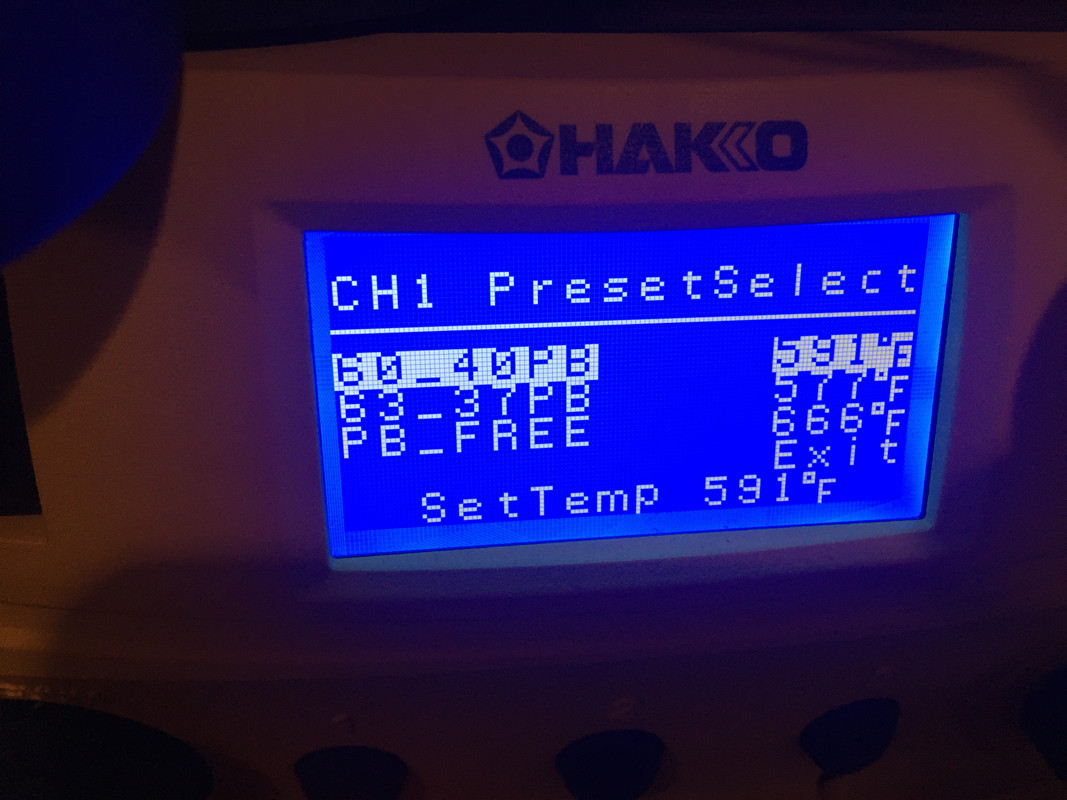
I sometimes wonder if Hakko never got the memo that transistors are now cheap and inexpensive, because it's almost like they made every attempt to not waste a single byte in its construction. I'm tempted to open the unit and see if each transistor is hand soldered in there, because it really is that "tight" (JBC's soldering station can play .avi video files). In lieu of a dial to set the different temperatures, pressing the button for each channel brings up three programmable temperature presets. These change depending on which accessory it's detected you have plugged into that channel. For soldering, I set mine up as follows:


IMG-8399.jpg


I still prefer analog dials/gauges, but this allows me to set the exactly perfect temperature for the solder I'm using without thinking about it, and without having to look it up every time. Somehow Hakko managed to make me a believer. In fact the only annoyance I've noticed with the interface thus far is that if the tool is "sleeping", to change anything I first have to wake the tool by either lifting it or pushing the channel button, before again pushing the channel button to enter into the settings. That was the only "huh what's going on" moment I've had thus far, and probably the only one I will, b/c I don't see myself needing to do anything else with the interface. I've set my sleep time to immediate, I've dialed in the temperatures I want, I've turned off the alarm for if the station doesn't detect a tool attached...

Hakko nailed it

Finally I need to touch on the other handpieces, because this entire ordeal was set off by a need to for a vacuum desolder tool, specifically the Hakko FR-301. It's what started the agonizing process.

I've done a few board recaps now my manual solder sucker, braided copper, and the soldering iron, but just from seeing the vacuum desolder tool in action it was obvious this is what you want.
The FR-301 is a large standalone unit with the vacuum pump and everything built into the tool. From reading online, it works but it's large, cumbersome, and cannot be used as a wand. That's partially what pushed me to the FM-206, because it's compatible with Hakkos FM-2024 vacuum desolder tool.


It boasts the advantage of being extremely small, and can be disassembled and used as a wand. A tool like this is where the details *really* matter. I looked at reviews of many cheap chinese garbage alternatives, and while they seem to work, once you have to go and actually clean them; it's a nightmare. Lead solder crap everywhere, you have to take it to the sink, the things aren't designed right so they'll clog up, parts not available, filters don't work right so you just get clogged up and then you *really* have to waste your time getting everything cleaned up.

With this unit, cleanup is so simple as to be comical. Pull the yellow tab at the top back, and that releases a disposable cardboard tube with a ceramic filter element in the back that's collected all your solder. Chuck it and put a new one ine. Done. On the front housing of the FM-206 where the vacuum port attaches is another easily replaceable filter element if you were to stupid to clean the gun right. On the back of the gun is a black piece you can use to remove and reset the tip/nozzle for replacement/cleaning while it's still hot. Hakko has a really elegant system where you can somehow rotate it 90°, apply heat but poke out whatever solder from the inside. It's all really well thought out, and I can't stress enough just how important these details matter.

How does this actually work in use, compared to a manual solder sucker and/or copper braid?

It's not even funny LOL. We're talking not one, but two orders of magnitude faster/safer/more reliable.

My reaction was very similar to this guy's:

It's legitimately not even funny, and is why I say you want the whole suite of tools for electronic rework. Can you mop a kitchen with a toothbrush? Yes. Should you? No. That's how it is with the vacuum desolder gun. Unfortunately tips specifically for the FM-2024 cost a fortune at $50 each.

Holy **** I can't believe how much I've already written, and I still haven't touched on the hot air pencil.

I'll keep it brief: it's a pencil, but it's so stupid convenient when you need it. Will it do SMD rework? Yes. Is it as good as a dedicated rework device? No. Would I get it again? Yes. The FM-206, unlike all the other FM workstations, has a built in pump (or does it use the output of the vacuum pump?) for controlled amounts of air. It's a stupid thing that makes a stupid noise, but gets the job done. The amount of air is controlled digitally using an analog dial, and ranges from a tiny little droplet of air, to an athsmatic frog breathing through a straw at max power. For tiny SMD capacitors, I could see this being useful, but if you're doing serious work, it won't quite cut it.

That said, it's really nice even for stuff like activating any flux that escaped your soldering iron, prewarming chips for soldering, softening gunky adhesives you want to remove, or shrinking heat shrink tubes. It eliminates my needing to get the butane iron out of the garage.
So that's my review of the FM-206. I hope this fines some use. I am very tired/exhaustive now from writing this unexpected essay.
If you want one, get one. Don't think about it. Mine has already done about $600 in repairs in the first month of ownership, and hopefully it'll last for the coming decade. Buy once cry once.
End.
 
Last edited:
Pace
  • Good old fashioned American Awesome
  • Used by the U.S. Navy
Airforce Avionic shops as well. :thumbsup: It has a NSN so any one of the branches has access to a workstation. If they can justify its need --pretty low bar to hurdle. :biggrin:
Just talk BS to the right person. :biggrin:
 
Last edited:
UPDATE:

As was to be expected, Hakko has finally replaced the FM-206 with a new FX-973 which promises more better, but with tip incompatibility, and a new updated price (and a new line of tips/nozzles to boot):

Looks like: Faster tip change on new base stations, new user interface that includes a web/computer setup, totally new vacuum desolder gun (no longer one unit that converts from a gun to a wand/pencil style - two separate units), instant wireless (IR) temperature offset sharing with their tip temperature probe thing (FG-100B), more power, separate new micro hot air tool (FR-850 for $850 lol).


As it stands, my FM-206 didn't explode upon release of this significantly more expensive new unit: likely deals are to be found and its usefulness remains intact.
 
Back
Top Bottom