deckar01
New Member
Hello,
I’m a 34 year old software engineer in Tulsa, Oklahoma (USA) that just completed an associates degree in Electronics Technology at my local community college (TCC). I am considering continuing at OSU in the fall. I previously studied CS and Math at NSU (Tahlequah) and have been an open source software contributor for over a decade. I also took a few drafting classes at TCC to get proficient with Fusion for 3D printing.
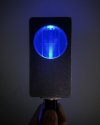
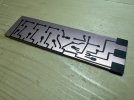
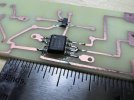
I am currently fixing analog audio equipment for local musicians to sharpen my skills (and convince them to let me be their vocalist). I recently started building passive and active ribbon mics (from scratch) using original designs. I have been acid etching my own PCBs using vinyl masks, and have scaled down to 30mil traces for 2 layer SMD/SOIC layouts.
I wrote a linear circuit solver in python (PyLACC) designed to run on TI-nSpire calculators (w/o CAS). Recently I started working on a component optimization tool for analog prototyping. It calculates discrete component values for a circuit, then tunes the model using measurement feedback. In an active band pass filter the textbook solution was up to 25% off the targeted gain, bandwidth, and center frequency. After two iterations it drops the error below 1%. It still needs work, because SymPy is unwieldy, but I have rapidly tuned a few opamp circuits with it. I’m calling it dtrim, because it’s like trim pots, but with discrete components during the design process.
I’m a 34 year old software engineer in Tulsa, Oklahoma (USA) that just completed an associates degree in Electronics Technology at my local community college (TCC). I am considering continuing at OSU in the fall. I previously studied CS and Math at NSU (Tahlequah) and have been an open source software contributor for over a decade. I also took a few drafting classes at TCC to get proficient with Fusion for 3D printing.
I am currently fixing analog audio equipment for local musicians to sharpen my skills (and convince them to let me be their vocalist). I recently started building passive and active ribbon mics (from scratch) using original designs. I have been acid etching my own PCBs using vinyl masks, and have scaled down to 30mil traces for 2 layer SMD/SOIC layouts.
I wrote a linear circuit solver in python (PyLACC) designed to run on TI-nSpire calculators (w/o CAS). Recently I started working on a component optimization tool for analog prototyping. It calculates discrete component values for a circuit, then tunes the model using measurement feedback. In an active band pass filter the textbook solution was up to 25% off the targeted gain, bandwidth, and center frequency. After two iterations it drops the error below 1%. It still needs work, because SymPy is unwieldy, but I have rapidly tuned a few opamp circuits with it. I’m calling it dtrim, because it’s like trim pots, but with discrete components during the design process.