Roman68
Active Member
Hey everyone,
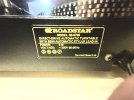
I wanted to share some bench notes on a Roadstar RS-5750 I recently finished restoring. While the Roadstar name doesn't usually command much respect in audiophile circles, this 1978 model is a legitimate "sleeper" with some serious engineering under the hood—and a few odd budget choices.
This unit needed more than just a light dusting. To get it back to spec, I performed the following:
At 9.5kg, this is a heavy beast. The main plinth is solid MDF, but the finishing touches show where they saved money.
The Cons:
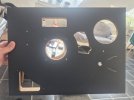
The Bottom Plate: Here is the biggest flaw. While the main plinth is MDF, the bottom cover is made of pressed cardboard (hardboard). The non-adjustable feet are screwed directly into this cardboard. Over time, the weight of the machine causes the cardboard to warp or sag, which means the feet eventually sit crooked, making it a nightmare to level the table properly.
The reason you don't throw this table away is the tonearm and the motor.
The Arm: It’s a completely metal assembly. If you run your fingernail over the tube, you can feel the fine concentric rings from the lathe. It’s a precision-machined instrument.View attachment 3659900
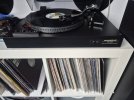

I wanted to share some bench notes on a Roadstar RS-5750 I recently finished restoring. While the Roadstar name doesn't usually command much respect in audiophile circles, this 1978 model is a legitimate "sleeper" with some serious engineering under the hood—and a few odd budget choices.
This unit needed more than just a light dusting. To get it back to spec, I performed the following:
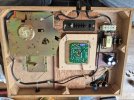
- Electronics: Both pitch potentiometers were in bad shape—one was physically snapped. I bypassed the contact cleaner and simply replaced both with new pots. After a quick calibration, the Matsushita motor locked speed perfectly on both 33 and 45.
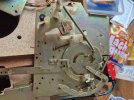
- Mechanical Overhaul: Since about 80% of the automation is metal, the original grease had turned into thick "glue." I completely stripped, cleaned, and re-lubricated the entire mechanism.
- Hydraulics: I replaced the oil in the direct-drive motor and replenished the damping fluid in the tonearm lift (cueing) mechanism. It now drops with a buttery-smooth motion.
At 9.5kg, this is a heavy beast. The main plinth is solid MDF, but the finishing touches show where they saved money.
The Cons:
The Bottom Plate: Here is the biggest flaw. While the main plinth is MDF, the bottom cover is made of pressed cardboard (hardboard). The non-adjustable feet are screwed directly into this cardboard. Over time, the weight of the machine causes the cardboard to warp or sag, which means the feet eventually sit crooked, making it a nightmare to level the table properly.
- The Finish: The MDF is wrapped in a vinyl furniture film, not real wood veneer. It looks okay from afar, but up close, it’s clearly budget-grade.
- The Start Lever: It looks exactly like a manual car window crank. It’s not exactly "elegant," though it provides a very satisfying mechanical click that plastic buttons just can't match.
The reason you don't throw this table away is the tonearm and the motor.
The Arm: It’s a completely metal assembly. If you run your fingernail over the tube, you can feel the fine concentric rings from the lathe. It’s a precision-machined instrument.View attachment 3659900
- The Motor: A high-torque Matsushita DC Servo, very similar to the ones used by Saba, Telefunken, and early Technics.