• The move to the new server is done. There are some software and database maintenance updates in process. This has us passing the hat around to help out. We appreciate any donations. Seriously, even a dollar helps. The payment page may be found here - https://www.audiokarma.org/support.html

Russco QRK Gates turntable Nidec / Bodine Motor is extremely hot

Mr_Technics

New Member
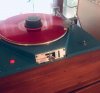
I have been restoring a few old broadcast turntables I collected over the years. The few tables I have got going get alarmingly hot when running for a few hours. One table I restored has a newer Nidec motor and the other has the original Bodine. I search for a definitive on what an acceptable temperature is but only found people saying that they run "hot". Unfortunately I don't have a probe all though I think I could get one. The only thermometer I have is my hand. I would estimate the motors get around 150 F. I can only touch them for a few seconds before pulling my hand off.

Is this normal? How hot should I expect these motors to get? How can I lower the temperature. I tried cleaning and oiling them using the blue 3 in 1 motor oil. Still burn-your-hand hot!

They look great but it's hard to relax when listening to records when you think the turntable may burst into flames at any moment.

IMG_1563.jpg IMG_1564.JPG
 
Register to hide this ad
All I can tell ya is people call 'hot' what's hot to the touch. We start getting skin burns taking baths at 48°C (120°F) which is about as hot as domestic hot water should ever get. You'd get blisters from 60°C (140°F) water - which some domestic heaters unnecessarily allow. In contrast - my Thorens TD-124 15 watt shaded pole induction motor (E50) runs comfortably at 70°C (158°F) for weeks unending without a glitch. Put your finger on it for more than a second - and it bites - but that's just comfortably warm for a motor (e.g working temperature). Transistors and their heatsinks can run way hotter - but for some reason it scares the layman off. Tubes run way hotter - but that's not deterring anyone - so why worry?

Oh, BTW, that's a handsome piece of gear there...
 
Last edited:
Agreed, I am a layman and I am officially scared. Your responce does put me at ease. I will track down a probe to get an exact temperature but it sounds like I should expect somewhere in the range of your Thorens. 70°C (158°F)
 
Call me crazy, but.. I would try water cooling. Way back when, people used to make a coil of copper tubing then wrap it around electric model boat motors. Water was pushed through the tubing, drawing motor heat away. In the case of the boat, it moving through the water was what forced water through. In the case of your turntable motor, it could use some sort of thermosiphon system, using one of the old Mac G5 water cooled radiators.. or similar

Sorry; just thinking out loud, but that’s what I might try.
 
A lot of industrial motors are rated for a 40 degree centigrade rise in temperature from ambient temp when under full load. If it spins free with no drag I wouldn't worry to much about it.

BillWojo
 
Agreed, I am a layman and I am officially scared. Your responce does put me at ease. I will track down a probe to get an exact temperature but it sounds like I should expect somewhere in the range of your Thorens. 70°C (158°F)

I just used a probe to measure the temperature after running the turntable for several hours. Almost exactly the same temperature as your Thorens. The Nidec also runs at 70°C (158°F). I am going to try to move on to the "why worry" phase and relax a bit when using it. I also noticed that it does say "AMB 40°C" on the side as BillWojo mentioned. I didn't understand what that meant. It sounds like burn-your-hand hot is how these tables are meant to operate.

Thanks all. I was really happy with how it turned out visually and was worried that the motor temperature would not allow e to actually use it. Now it is time to dig into the rest of them.
 
Good news! 70°C (158°F) sound ideal for June. You'd see a drop at winter. I've kinda noticed that 3 in 1 oil by WD40 likes 70°C very much and becomes ideal viscosity wise.
If you keep the motor running overnight - keep monitoring for a steady temperature. If it stays around 70°C you can fuggetaboutit for a long while.
 
Beautiful table. What are the others in the collection. Always wanted one of those industrial looking beasts. This example is particularly handsome.
 
Get your self a meat thermometer and place the probe on the motor it will tell in a few seconds. I'm sure you are lubing the motor properly with a synthetic periodically. They never turned the motors off in the broadcast studios at the radio station I worked at as a kid. I kept the records of changing Tubes, lubing motors, replacing stylii, tracking pressures, clean heads, pinch rollers, changing belts etc. I had fun while in High School and starting college and I didn't have any college debt either.
 
Spotmaster.jpg

Update: I just finished a similar looking Spotmaster. Thanks again for all your help. I realize this thread is now veering off course and I probably should start a new one but you were extremely helpful in regards to the motor temp.

I am wondering if you can recommend a suitable 608z motor bearing. One of the Russco's has a Nidec Motor with bearings rather than bushings. All the bushing style motors I clean out and they seem to function well. I tried the same treatment with the bearings but it continues to yell at me when in motion. It makes a distinctly audible Wrrrrrring that I can hear from the other room, which I assume will not translate well when I actually throw a record on. I tried a few different bearings I had on hand with similar results. The internet has an infinite selection of bearings.

Any guesses how to quiet this beast?
 
Beautiful tables for sure. Do you own a caliper? You can narrow your search quite a bit if you measure the bore diameter, outer diameter and height. Have you looked carefully to see if the bearing has any markings on it?
 
Beautiful tables for sure. Do you own a caliper? You can narrow your search quite a bit if you measure the bore diameter, outer diameter and height. Have you looked carefully to see if the bearing has any markings on it?

I know they are "608z" bearings but my issue is finding quiet bearings. I put some brand new bearings in I bought at a skateshop and they were probably even louder.
 
I know they are "608z" bearings but my issue is finding quiet bearings.
Decoding bearing numbers is a science on it's own. The printed number on the bearing is usually just the tip of the iceberg and provides just the very basic specs about the ball bearing.
  • first digit means type code. "6" = single row deep groove
  • 2nd digit means bearing series (toughness of the bearing). "0" means extra light
  • 3rd (single) digit means inner diameter size. "8" means 8mm. When there's 3rd and 4th digit, 01 to 03 means 1mm to 3mm respectively, but then you start multiplying by 5, so '08' means a 40mm
  • letter suffix refers to sealing. "Z" means one side shielded.
There's tens if not hundreds more suffixes sometimes manufacturer specific. There's also mfgr specs and codes for quiet running bearings.
You should probably consult a professional rep.
 
Decoding bearing numbers is a science on it's own. The printed number on the bearing is usually just the tip of the iceberg and provides just the very basic specs about the ball bearing.
  • first digit means type code. "6" = single row deep groove
  • 2nd digit means bearing series (toughness of the bearing). "0" means extra light
  • 3rd (single) digit means inner diameter size. "8" means 8mm. When there's 3rd and 4th digit, 01 to 03 means 1mm to 3mm respectively, but then you start multiplying by 5, so '08' means a 40mm
  • letter suffix refers to sealing. "Z" means one side shielded.
There's tens if not hundreds more suffixes sometimes manufacturer specific. There's also mfgr specs and codes for quiet running bearings.
You should probably consult a professional rep.


In searching there seemed like an infinite number of variables and turns out.... I was right. Sounds like I need to consult an expert in bearings. I will look into it. Thanks again.
 
If available try and get a class 5 bearing at least or if not to expensive a class 7 bearing. The tolerances are held much tighter the higher the class. Class 7 bearings are typically used in machine tool spindles and other high precision applications.
NSK is a good bearing company, stay away from Chinese stuff.

BillWojo
 
Back
Top Bottom