
• The move to the new server is done. There are some software and database maintenance updates in process. This has us passing the hat around to help out. We appreciate any donations. Seriously, even a dollar helps. The payment page may be found here - https://www.audiokarma.org/support.html

Russian tubes test bad on EMC tester.

AAA3330

Super Member
I just bought an EMC 213 tube tester. It seems pretty reliable on vintage tubes, but a new pair of Tung Sol 12AX7 test very poor on it. One triode tests excellent, while the three others test very weak. A new set of Mullards test excellent on all triodes. A pair of Sovtek tubes of unknown history test very weak on all four triodes also.

I put the Tung Sol's in the preamp and they sound great. Perfectly balanced and all. I also contacted the seller. They said that their tubes are tested before shipping and that it would be rare for them to ship a bad tube. My seller also offered to test them and to replace them if bad. I don't really want to bother them with this if the tubes are good though.

Anyone else ever came across this problem of new tubes testing bad on their tube testers.
 
Last edited:
Register to hide this ad
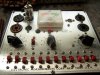
Photo of EMC

I attached a photo of my EMC tester. Not a high end checker, but seems to be a pretty decent basic tester. The tube in the photo is not Russian, but a vintage GE 12AX7 that tests like new. It detected a short in one of my tubes, although the tube seemed ok in my amp. So I'm pretty happy about that.
 

Attachments

  • good tube-1'st triode.jpg
    good tube-1'st triode.jpg
    89.2 KB · Views: 29
Last edited:
I've noticed that a LOT of newer production tubes just don't test as high as their vintage counterparts. But, if they're WAY off the mark I'd be looking for an explanation from the seller and/or a replacement.

. . Falcon
 
pin 1 on an AX7 is the section 1 plate while pin 2 is the grid. These would never be tied together internally (old or new).:no:
 
The one who sold me the Tung Sol reissues has generously offered to retest them on their regularly calibrated military spec tube tester. They test the tubes before they ship. As stated before, for the pair, on my emission tester, 1 of the triodes tests excellent, while the other three test extremely weak. They sound fine in my preamp, so are most likely ok. Will be nice to know for sure though. When I get them back, I will post the results for everyone to see.
 
The one who sold me the Tung Sol reissues has generously offered to retest them on their regularly calibrated military spec tube tester. They test the tubes before they ship. As stated before, for the pair, on my emission tester, 1 of the triodes tests excellent, while the other three test extremely weak. They sound fine in my preamp, so are most likely ok. Will be nice to know for sure though. When I get them back, I will post the results for everyone to see.

There's a very simple trick for checking if the emission of a tube's cathode is actually weak or not.. try lowering the filament voltage. On a new tube changing 6.3 to 3 volts should result in very little drop in conductance. Or at least (if it is switched while on) it should stay steady at first then drop as the filament cools more. Conversely if the tube is suspected as weak raise the voltage briefly to 12 volts and see if the conductance goes up to where you think it should be. Indirectly heated filaments are very tough, this won't burn out the filament, though it would be preferable if the tester had a metered, variac-controlled filament setting like my old Eico tester, where the filament voltage can be wobbled up and down while checking Mutual Conductance.

The key is that the gain and conductance of the tube should NOT vary with moderate changes in filament voltage around its specified voltage. If conductance DOES vary considerably with filament voltage change then the cathode is on its way out and has already become weak.

Thus if neither option changes the conductance all that much then the tube is ok. If you KNOW the tube is weak through actual use, yet it stays within a close too-low or too-high range during these tests, then the tube is gassy or in rare cases has an interelectrode short. Or if it stays very low even with the filament voltage doubled then the cathode is truly shot, but by this time the tube should look dark around the base or the glass is coated with white stuff, it would be a well-worn tube.

This works for either mutual conductance testers or the cheaper emission-only testers. (Though for MC testers gassy tubes could not normally read too-high.)

And incidentally doing the filament voltage wobble test with a couple of the same model tube is the way to determine the proper MC-bias setting for a tube that is not on the tester's charts.
 
Last edited:
Back
Top Bottom