• The move to the new server is done. There are some software and database maintenance updates in process. This has us passing the hat around to help out. We appreciate any donations. Seriously, even a dollar helps. The payment page may be found here - https://www.audiokarma.org/support.html

SA-300: Ghost in the machine

tutor_turtle

AK Subscriber
Subscriber
I friend brought me his Fisher SA-300B with a ghost issue.
The unit has undergone a full restoration that was done beautifully.
All high quality low ESR, power supply caps and super quality film caps for the signal path.
The problem happens only occasionally and always on a cold startup.
The Rectifier tube filaments (both) won't light.
All the 6 volt tubes light up, so we know it's getting power.
Every time I try it, it works.
If it were only one tube, I'd call it a bad socket, but not both.
Once it lights off, it sounds beautiful.
My friend loves this amplifier, but the ghost is driving him crackers.
Could he have a bad transformer?
I'm guessing this transformer would be next to impossible to source, were it were proven to be faulty.
Any ideas are welcome.
-Steven
 
Register to hide this ad
1st thing is to clean all rectifier pins, and tighten and clean the rectifier tube sockets. Reflow the rectifier tube socket wiring connections to ensure good connections.
The tube pins are plated steel and sockets are brass. Different cold co-efficients will affect tightness and clamping effect, minimally but that possibility exists. Spritz some DeOxit Shield on the pins after cleaning and tightening, this will help with connection.

Check the secondary side of the transformer (5v taps) and see if energizing is consistant when switch is thrown (do it cold...let it sit in garage overnight for cold soak, test, and then warm it up to about 100 (stick it over a room heater vent for a few hours or overnight for heat soak.....test again). If it consistantly starts up and the tubes lite up after cleaning and tightening, the gremlin has probably fled.
 
1st thing is to clean all rectifier pins, and tighten and clean the rectifier tube sockets. Reflow the rectifier tube socket wiring connections to ensure good connections.
The tube pins are plated steel and sockets are brass. Different cold co-efficients will affect tightness and clamping effect, minimally but that possibility exists. Spritz some DeOxit Shield on the pins after cleaning and tightening, this will help with connection.

Check the secondary side of the transformer (5v taps) and see if energizing is consistant when switch is thrown (do it cold...let it sit in garage overnight for cold soak, test, and then warm it up to about 100 (stick it over a room heater vent for a few hours or overnight for heat soak.....test again). If it consistantly starts up and the tubes lite up after cleaning and tightening, the gremlin has probably fled.
Good advice. He'll be bringing it over shortly. We'll try out your ideas. I have some nice ceramic octal sockets on-hand, might be prudent to just swap them out.
I almost replaced them when this first happened, but when I cleaned and tightened the sockets, I thought I had solved the issue.
The thought had occurred to me, since it has the original power switch, could the contacts be burnt in such a way that a little current gets through, enough to energize the 6.3 volt windings, but not enough "I" to light the (higher current) rectifier filaments?
Grasping at straws here...
 
While it's a possibility, check to see if it heats up abnormally. If it does, it's restricting amp flow. Install another switch rated for approx 10-15 AMPs. A pre-emptive replacement may be warranted just from age. Do the Octal socket switch as last resort.
 
The SA300/SA300B did not come with a factory installed power switch.
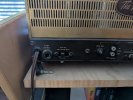
I replaced the accessory outlet with a DPDT slide switch. No drilling or cutting required.
PXL_20250127_131702598.jpg
 
Last edited:
The SA300/SA300B did not come with a factory installed power switch.
I replaced the accessory outlet with a DPDT slide switch. No drilling or cutting required.
View attachment 3411522
I was laying in bed the other night thinking the very same thing.

"What if the power switch what burned contacts, and not enough current was passing through it"
You know, just enough to light the 6.3 volt filaments, but not enough for the big power items.
It would account for that come-and-go nature of the symptoms.

The 1976-78 Pioneers (smaller of the SX series 450, 550, 650 & 750) had the power switch ganged to the speaker switch.
They are notorious for failing intermittently, and no replacement is available.
The only fix I can offer customers is to jump-wire the switch on, fix a in-line rocker on the power cord with enough lead to loop to the front for easy access.
 
Pretty unlikely its the power switch if the other tubes glow. Problems with the power switch would cause problems with every tube, and the 6v secondary is dealing with a lot more current than the rectifier winding is.
 
Back
Top Bottom