• The move to the new server is done. There are some software and database maintenance updates in process. This has us passing the hat around to help out. We appreciate any donations. Seriously, even a dollar helps. The payment page may be found here - https://www.audiokarma.org/support.html

SAE 5000; the secret weapon?

Willeve146

AK Subscriber
Subscriber
Picked up a SAE 5000 Impulse Noise Reduction System unit off of eBAy recently. Payed $50 plus shipping. Tired of fighting the static pops, especially on older vinyl. Turns out this thing is amazing. I will admit I'm not not the kind of enthusiast that insists on minimal signal path from source to speaker; I do not have a reference system. I do however want what sounds best to me and I have to say this unit has given all my older vinyl (some of which I've been carting around since 74') a whole new lease on life. Screw the Zerostat gun this unit just makes life easy and good sounding. Does any one else have experience (good or bad) with these units? It seams like a steel for the price vs. what it is dose for removing those pops and clicks.:thmbsp:
 
Register to hide this ad
They're your records, but I wouldn't dream of using a blanker as a substitute for cleaning. I have a lot of clean but scratchy thrift stuff I like to play in real time, so a blanker - not a computer program - is an interesting appliance at my home.

I have an SAE 5000, same as you. (Got mine for $5, but I had to rewire it to 120V.) I haven't fallen in love with it; when it triggers, it mutes too long, chops a noticeable hole in the music. It could be malfunctioning, but as far as I can tell it's behaving the same way in both channels so probably not. Someday I'll measure the mute duration and see if it makes sense with respect to the schematic I found on the web.

Dave
 
I have owned a SAE 5000A for about twenty-five years and I often use it when I play records with scratches or grit that a record cleaning machine will not eliminate. My record cleaning machine is pretty good at removing dirt however; it will not remove the scratches.

The SAE 5000A is a nice tool to have, but; there is no free lunch. While it will eliminate impulse noise it does not do so without some audible side effects. When playing a record without scratches or grit, I switch it out of the circuit. Also, when I do use it, I carefully adjust the sensitivity control to get the best balance between eliminating impulse noise and audible side effects. I feel it is well worth having and would recommend one to anyone who plays records. :yes:
 
Pops & ticks don't really bother me very much - audible mistracking/records that have been chewed up from mistracking bothers me.

The analog impulse noise reduction schemes were very brute force.

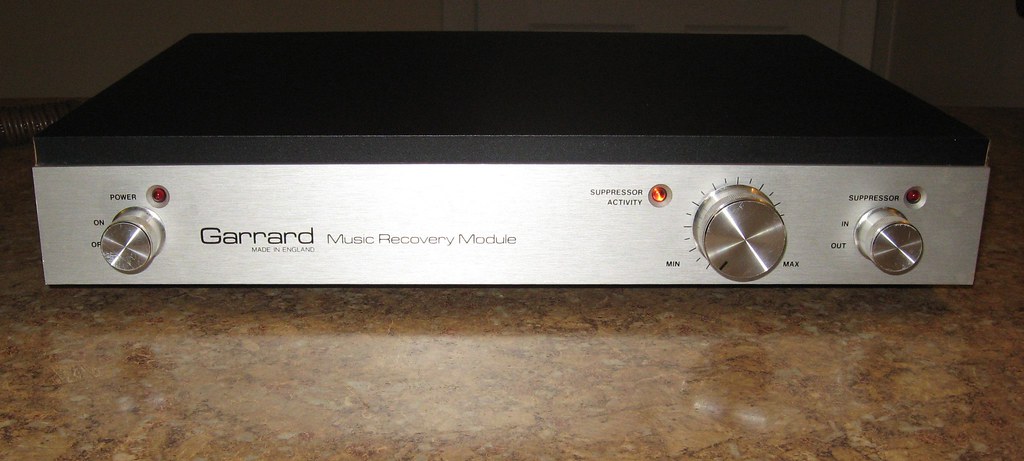
Amusingly, thanks to the largess of a local hifi enthusiast, I have one of the other players from the same era - a Garrard MRM :-)

I've only tried the phono preamp (reputed to be rather good); never tried it to suppress pulsatile noise.

Garrard MRM 1 by mhardy6647, on Flickr
 
Should give the Burwen Research (later badged by KLH) TNE-7000A pop & tick processor... I find it far less intrusive than the SAE 5000.

Brute force isn't quite how I'd define this class of processors, esp. the Burwen. I see it as a fairly brilliant analog audio circuit design, actually. Not trivial to detect and act only on transients in the analog domain while avoiding cutting other signal in ways that the ear finds objectionable. To a large extent, they managed to do that with this piece. It's not perfect but if you have a noisy record that isn't able to be cleared up thru cleaning, this box will make it much more listenable for sure.

John
 
I just picked up an SAE 5000A after wanting one since the original 5000 first came out in 1976. I've heard that it is far superior to its predecessor (SAE 5000) about removing noise without the same level of deleterious effects to fidelity. At any rate, being a curious, technical type, I was looking for a service manual or factory test procedure for the device. I have found schematics (mostly for the 5000), but would prefer a bit more technical documentation. If anyone has info on this they wouldn't mind sharing, I would appreciate it!
 
You presumably found the manual here, yes?
http://www.hifiengine.com/manual_library/sae/5000a.shtml

EDIT: Unsuffixed SAE 5000 "white paper" (self-described) at:
http://lcweb2.loc.gov/master/mbrs/recording_preservation/manuals/The SAE 5000.pdf

Interesting looking article on the topic in Feb 1979 Popular Science - article starts on pg 30 (not that I can figure out how to get a link to the start of the article); this link will get you in the neighborhood, though!
https://books.google.com/books?id=k... suppressors feb 1979 popular science&f=false
 
Last edited:
Picked up a SAE 5000 Impulse Noise Reduction System unit off of eBAy recently. Payed $50 plus shipping. Tired of fighting the static pops, especially on older vinyl. Turns out this thing is amazing. I will admit I'm not not the kind of enthusiast that insists on minimal signal path from source to speaker; I do not have a reference system. I do however want what sounds best to me and I have to say this unit has given all my older vinyl (some of which I've been carting around since 74') a whole new lease on life. Screw the Zerostat gun this unit just makes life easy and good sounding. Does any one else have experience (good or bad) with these units? It seams like a steel for the price vs. what it is dose for removing those pops and clicks.:thmbsp:
I have a couple of the heathkit AD-1304 active audio precessors which I use a lot with some records, tapes and FM broadcasts. I like them.
 
Never liked the idea of these type of devices. All your doing here is hiding an underlying problem that could be damaging the stylus. Clean LP's and healthy stylus do not make for noisy play. That's my experience. YMMV.
 
I have a 5000A and it's effective against those really huge clicks that come from visible scratches across the grooves, but not so much against low level crackle.

The Garrard and Burwen processors are the opposite; effective on low level crackle, not so much on really big clicks.

These are all 40+ year old tech, however, and in most cases you'll get better noise removal with fewer processing side effects by digitizing the LP and running it through the noise and click removal tools in Audacity.
 
Last edited:
Picked up a SAE 5000 Impulse Noise Reduction System unit off of eBAy recently. Payed $50 plus shipping. Tired of fighting the static pops, especially on older vinyl. Turns out this thing is amazing. I will admit I'm not not the kind of enthusiast that insists on minimal signal path from source to speaker; I do not have a reference system. I do however want what sounds best to me and I have to say this unit has given all my older vinyl (some of which I've been carting around since 74') a whole new lease on life. Screw the Zerostat gun this unit just makes life easy and good sounding. Does any one else have experience (good or bad) with these units? It seams like a steel for the price vs. what it is dose for removing those pops and clicks.:thmbsp:
Got a 5000A and it works great. Well worth incorporating into a system. If you expand your inquiry beyond this forum you will find most believe the component works and downsides are minimal. That’s where I come out.
 
I built a Silicon Chip (Aussie electronics magazine) LP Doctor, an excellent MM phono preamp with an added click detector which delays clicks and pops and blanks them. Trust me, you don’t notice anything missing from the sound, except for clicks – the click suppressor can be bypassed, so it’s easy to compare sound quality with and without. So the members who think you’ll miss anything or reduce resolution are needlessly obsessing about something they won’t miss – it happens so quickly, that the brain just doesn’t register that anything is missing!

Admittedly the LP Doctor is a design from the early-2000’s, so may be better than some of the older click suppressors – having built some phono preamps which are rarely matched by commercial designs for noise, the LP Doctor holds up well as an excellent, quiet MM phono stage, with the added bonus of click suppression. Sadly the Mitsubishi delay chip it used is now obsolete and very hard to find, so it was a one-off that can no longer be built.

Bear in mind that all of my records are exceptionally clean (I own a vacuum RCM), well-stored in clean, new liners, and with sealable plastic external covers inside a purpose-built record cupboard with rubber dust-sealing doors and have been permanently destaticised (using SoundGuard, Permostat, Static Cleaner or AM Record Cleaner), and all have been very well treated (by me, anyway – some were bought used). So they are mostly near-mint quality, but they still somehow manage to pick up a few clicks and pops. The LP Doctor usually catches all of those, so I consider it a good buy and build to improve the sound from my vinyl records.

 
I've owned one since the late 70's. It still works as designed. All of my old LPs are well cared for and I've used a discleaner, ZeroStat and other methods to keep them as clean as possible. Even LPs in good condition have an occasional pop or click that the INRS will intercept. I'm curious if interest in these devices will pick up with the resurgence of vinyl. There seems to be a lot of these available out on the bay! I'm in the process of resurrecting my Sansui based stereo rack and I'm still keeping the 5000a mounted in there somewhere.
 
I have read that the Burwen is better for LPs and the SAE 500a works better for 78's.

Interesting to hear the review of the LP Doctor, I came across it online (only the intro), so was curious. Would it be possible that there is a modern equivalent of the Mitsubishi delay chip?

Doesn't the Parks Puffin digital phono stage have click removal?
 
I have a SEA 5000A just sitting around for a while. I got the manual 'out' (opened the pdf) and tried to suss out the connections. It seems that I need a preamp and set it to tape monitor to get the effect. I was going to try and test this out 'on the cheap' by connecting to my Klipsch the One Phono, but that doesn't have a 'tape monitor' function, and I'll need to crack out a preamp and amp from somewhere. I'm loathe to use my current main system which has relatively inaccessible connections. I'll see which one of my integrateds I can use, and a pair of non-powered speakers.
 
Picked up a SAE 5000 Impulse Noise Reduction System unit off of eBAy recently. Payed $50 plus shipping. Tired of fighting the static pops, especially on older vinyl. Turns out this thing is amazing. I will admit I'm not not the kind of enthusiast that insists on minimal signal path from source to speaker; I do not have a reference system. I do however want what sounds best to me and I have to say this unit has given all my older vinyl (some of which I've been carting around since 74') a whole new lease on life. Screw the Zerostat gun this unit just makes life easy and good sounding. Does any one else have experience (good or bad) with these units? It seams like a steel for the price vs. what it is dose for removing those pops and clicks.:thmbsp:

I appreciate you to comment on this unit.

Personally i have no problem with (or ocurrence of) "pops", i think it's all down to a good cleaning. But then, I live in a humid climate.

Now, i do have checked the schematics of the SAE 5000 (and the burwen unit) long long ago and it uses a huge delay line which should give a lot of signal degradation; that's what I don't like about those units. But i have never *heard* one to confirm.
 
I appreciate you to comment on this unit.

Personally i have no problem with (or ocurrence of) "pops", i think it's all down to a good cleaning. But then, I live in a humid climate.

Now, i do have checked the schematics of the SAE 5000 (and the burwen unit) long long ago and it uses a huge delay line which should give a lot of signal degradation; that's what I don't like about those units. But i have never *heard* one to confirm.
they work great but you can not get too aggressive with the sensitivity as it will cause audio dropouts. there is a fine line to using one "properly" and to use it effectively, you will never be able to remove all pops and clicks without repurcussions.
 
I've had my 5000A since 1981. I used it a lot back when we bought a record, recorded it to tape and seldom played the record again. It did a great job of removing the clicks/pops so they didn't get put in the tape. I always liked it. I recently pulled it out of storage and found it has some issues with the right channel. Hopefully a recap and good cleaning will resurrect it.
 
Back
Top Bottom