• The move to the new server is done. There are some software and database maintenance updates in process. This has us passing the hat around to help out. We appreciate any donations. Seriously, even a dollar helps. The payment page may be found here - https://www.audiokarma.org/support.html

Samsun 4000 suddenly snap crackle one channel, cleaned and still persists

tonymaine

New Member
Darn spellcheck in the title and Forum won’t let me change title. My SANSUI 4000 has been working well for a couple years. I had cleaned all the pots and switches after finding out a yard sale and everything was fine. This week I started getting a snap and crackle out of only the right channel at all volumes on all inputs Regardless of speaker or speaker wires. I opened her up cleaned all the pots and switches including the hidden ones for the level and muting in the rear. I don’t see anything loose or burst caps. It still continues and seems to get worse as the unit stays on longer. When just firing up the unit the pops and crackles will be intermittent. But after running for a while with no inputs just powering on the unit with the speaker hooked up the snaps and crackles become much more consistent to where it is almost a common noise. I will start by saying that except for opening up and cleaning pots my interior capabilities in these units has been limited. I have been very lucky that finding and cleaning all the units has worked out for me but I would really like to save this one but really have no idea what else I am looking at on the inside. Any suggestions for the novice hands-on person like me would be appreciated. I do know how to solder from recapping speaker crossovers, but that is my limit so far.
 
Last edited:
Register to hide this ad
Probably a result of a small transistor getting noisy, not an uncommon problem.
The question is are you ready to "up your game" or take it to a pro?
 
I really have nothing to lose by trying to fix this on my own. It is not my only receiver although my only sansui. Willing to try on my own. Heck I paid $5 for it and got my use even if I screw it up.
 
The unit is worthy of a little time and attention.

Jim is correct, and there are several potential NLB (noisy little bastard) transistors in the unit. The 2SC871s populating many of the boards are notorious noise-makers. They can be successfully replaced with KSC1845Fs for literally pennies apiece.

There are also 2SC458s in the protection unit, and they are known for leakage. That's a circuit where we really don't need any leakage. A couple of 2SC2240 (or two more KSC1845Fs) can replace those.

Another pair of 2SC458s are in the driver amp, and those should be replaced with 2SC2240s or KSD1616As due to the power requirement.

It would be best if both the tuner and IF/MPX boards were left alone.
 
Time to start learning and looking over other threads on how people are fixing the gear.
Transistor replacement is fairly straight forward - just make sure that you install them correctly.
Each has three leads - Emitter, Base and Collector (aka EBC). You don't want to mix them up and replacement transistors can have them in different positions.
Also, while you're in there look closely at the circuit boards for solder cracks.
 
Hey, Jim - Should we tell him about the "special" solder in that vintage Sansui? Having been in a few of those, I've found that the alloys used may have been unusual, and needed a bit more heat to liquify and extract. Extra flux (before desoldering) seemed to help, and washes off easily after repairs are completed.

I had a 3000A that I thought may be a candidtate for the acetylene torch before discovering the hot/flux regimen.
 
Have the 2000A and 3000A. Sansui of this vintage is very solidly built. Nice look to them too, especially they have the wood cabinet. Worthy of repair. De-soldering can be a challenge with this vintage Sansui, they tended to mash the component leads flat against the board so care and figuring out a good technique is needed to avoid damaging the solder pads.

Best bet is go after the transistors Watthour mentioned. Some "low noise" vintage transistors did not tend to stay that way.
 
Did not mean to imply that I would trash this. I figured if I screw up the replacement I would post to find a good home. Back to my issue. I can read a schematic ( from my one EE class in college) but wanted to see if you folks could recommend any primer video as there is a bunch to get through in here. Or based on pictures too.
 
If your desire is to refresh/hone your skills, it may be beneficial to get a piece of electronic scrap and practice the desoldering. It seems that late 1990's and later equipment often has "special" solder as well, and any TV, radio, or other scrap device from that period could be good practice with no risk.
 
The 4000 is an easy unit to recap, I did one....

Swap the amp boards to see if it follows, if it doesn't you've probably got a preamp problem.

Before you start the rebuild build a dim bulb tester and use it every time you change anything.
 
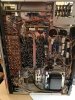
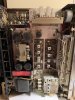
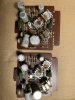
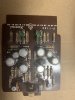
Ok. Swapped the boards. (Delayed a day while I built my dim bulb tester!) It is still on the left channel only regardless of which driver is in that slot. It is lots of crackle not quite like a bad pot type sound for compare and still constant on all volumes/inputs, left on for 10 minutes butno big pop like it was before. Could I have shaken something loose? Here are photos of the left and right.
Any suggestion on how to further diagnose?

Also, What’s up with the brown on the little heat sinks?
 

Attachments

  • C2AEF81B-A9B7-4347-BCDF-C92F35A25FE6.jpeg
    C2AEF81B-A9B7-4347-BCDF-C92F35A25FE6.jpeg
    136.5 KB · Views: 13
Last edited:
Also, after stepping (down) to one of my backup receivers, an HK 330c, I really appreciate what I have (temporarily) lost in the sound of my 4000.
 
If swapping the amp cards did not swap the issue would point toward the preamp. A number of problem transistors could get used on the board with the tone controls. Have greatly quieted the background of a couple of old receivers the NPN types used there had gotten "hissy". I think the schematic had the 2SC871 populating that board they are one known for developing noise issues.
 
Back
Top Bottom