• The move to the new server is done. There are some software and database maintenance updates in process. This has us passing the hat around to help out. We appreciate any donations. Seriously, even a dollar helps. The payment page may be found here - https://www.audiokarma.org/support.html

Sandbox TT isolation pictures, please.

Spectrum77

Super Member
Following BroonsBane's TT isolation thread, please post some pictures of your sandboxes (not Kitty's, please) as I would like to try building one.
Currently using a platform suspended by chains from the ceiling, which works well, until The Beer Monster takes hold and bumps it.
Many thanks.
 
Register to hide this ad
I've seen one which was an open-top box filled with sand, and a plate of glass(smaller than the area of the open top) sat on the sand, and the TT sat on the glass plate. The whole box itself had spikes for legs. I've been wanting to do this myself too, but without the glass. Probably just a big MDF box filled up with sand, then sealed, painted, and given isolation legs. Two weeks ago there was enough sand on the floor of the average Toronto streetcar that with all my scrap MDF I could have made an isolation box for free.
 
This isn't mine but it contains some nice pics of a sandbox.

http://www.wardsweb.org/audio/isolation_table.html

I've built sandboxes but haven't taken pics. I've built some out of solid oak with mitered corners and an oil finish. Since I wasn't going to see the top, I just used some 3/4" MDF for the top. If you were going to see the top, then I would use something that would take a nice finish. I've used play sand in my sandboxes so far but glass blasting beads is also a good choice.
 
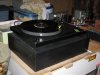
Here's a pic of my Kenwood KD-500 mounted on a Bright Star Audio Big Rock sandbox. It's filled with about 50 pounds of clean white sand (sold as playsand at Home Depot). Yeah, I know, it's not DIY, but I got a really good price on it, and it works well.
 

Attachments

  • KD500 and sandbox.JPG
    KD500 and sandbox.JPG
    25.5 KB · Views: 376
OK- thanks jcmjrt, that nailed it in one. Tedrick- is the TT sitting on MDF, or another kind of material? I was also wondering whether there would be any benefit of using .5" thickness of granite in place of glass- or would that be overkill? Thanks for the quick responses.
 
Tedrick- is the TT sitting on MDF, or another kind of material? I was also wondering whether there would be any benefit of using .5" thickness of granite in place of glass- or would that be overkill? Thanks for the quick responses.
There's a thin (1/4-3/8") piece of MDF over the sand. I thought about granite, too, but haven't tried it.
 
Hey Tedrick...that looks sweet. I just got a KD-550 yesterday. What kind of arm/cart do you have on yours? Any trouble with pitch stability?
 
Thanks! My Kenny has an Infinity Black Widow arm with a Grado Reference Platinum cartridge. I think it's a great combination.

I had some speed stability issues when I first got the 'table; the motor would not hold a steady speed, and the platter would speed up and slow down randomly. But a little shot of DeOxit into the pitch adjustment controls took care of that. She's rock-steady now.
 
OK- thanks jcmjrt, that nailed it in one. Tedrick- is the TT sitting on MDF, or another kind of material? I was also wondering whether there would be any benefit of using .5" thickness of granite in place of glass- or would that be overkill? Thanks for the quick responses.

It is not a good idea to use a heavy slab on top of the sand. It's weight will reduce the viscosity of the sand and cancel out the desired effect.

I once built a sandbox - not as finely finished as the exceptional design shown in the thread, just built for effect - and used it without any top plate (mdf or glass or whatever) and placed the TT, a Dual 1009 in it's factory wooden plinth on top of the sand. Very effective.

Had to dispose of it shortly after I built it, as my mom didn't want to have loose sand in the house.

Glass balls is one option, but in Greece, as we have plenty of sand from the beaches, I used washed and sieved sand. The very thin sand is useless and the thicker grains are also less effective.

I may build a new one in the summer, combining a granite absorbing base with a sandbox on top of that.
 
Very fine sand is useless. How so? I was thinking that a good sub base may be rock dust -- the ground rock, ? could be granite, that they use as the underlayment for brick or stone walkways. I've seen it in bags at a hardware store i think or it can be bought in bulk too.
 
The instructions that came with the Big Rock suggested using play sand, which is usually classified as a clean, well sorted, fine-grained sand. If you do a DIY sandbox and don't seal the joints very well, fine sand might eventually leak through; otherwise I can think of no reason not to use it. If I could still get my hands on zircon sand, I'd use that, as its density is 2 times that of regular silica sand.
 
Very fine sand is useless. How so?
Let's take the extreme case of ultra fine, powder like, sand.

Pour it into a base, level it, and what you have is almost solid, totally uncompressible layer of material. It works as a mass absorber. Not useless but not what sand is all about.

The other extreme is using small stones. They don't settle well with each other and the whole thing isn't very stable. You get again the effect of solid material, until a stone colapses into a cavity and deforms the base.

Very fine sand will not perform as a solid material but the grains settle pretty well and again that reduces the effect desired.

Actually, the correct solution is using two different particle sizes of sand. Fine sand (not too fine) and a very small percentage of finer sand. The finer sand fills gaps and acts as a "lubricant" withing the cavities of the larger grains. The idea of the sanbox is to act as a liquid of solids, in other words exhibit viscosity, which allows small movement of particles inside the mass that in effect absorb the incoming vibration before reaching the other end (top part).
 
SaSi- very informative. I'm in Japan, and quite often I cannot obtain specific products; in this case I have never seen anything like 'play sand' but can envisage the two different size grains. So, has anyone heard of random-sized sand, such as sieved beach sand being used? Would it compact too much, defeating the intended effect of the liquid nature of the sand?
 
Does thee fact the top plate the table sits on touchs the sides of the box cause an issue? Seems that would transfer vibrations from the box sides to the top plate. Wouldn't having a gap all around the top plate be a better solution?
 
Here is phase 2 of my sand box construction. Phase 1 was building it. It is 3/4" MDF bottom with 3/4 X 5" Oak. My plan is/was to get a granite counter top company to fabricate an 18"X18" slab from a sink cut out of Black Galaxy and sit it on home depot play sand in the box. I have a tile supplier giving me an 18"X18" black galaxy granite tile @ 1/2" thick for free so I will start with that. I just painted it flat black today. I will sand it with some 220 or higher sand paper to knock down the grain a bit and may be hit it with one more coat of black and put some matte or satin poly on it to match my speakers, which are black oak.
 
Last edited:
Does thee fact the top plate the table sits on touchs the sides of the box cause an issue? Seems that would transfer vibrations from the box sides to the top plate. Wouldn't having a gap all around the top plate be a better solution?

There should be a small gap between the top and sides. That is shown on the link...the .25" gap
 
IMHO, the best performance sandbox won't have a top cover. If you won't accept having your TT laying in the sand, then 4 circular legs (brass or steel prefferably) can form a "civilized" base on top of the sand.

Why leave the top free? Because the free face of the sand in the air allows it to vibrate freely and release more energy in the air, rather on the TT.

Why brass feet rather than glass or plywood? Because it's an interface of materials and you WANT each such interface to act as a mass absorbtion system. Plywood and settled sand have rather similar densities. Brass and steel are much denser.

I would invite anyone currently using a sandbox to just remove the top cover for listening to the TT.

PS. Last night (it's early noon here now), I recalled another mod for the improvement of the sandbox. Assuming the sandbox can contain 3-4" of sand, you can have the first layer (first 3") contain a mixture of sand and rubber pellets. Pellets have to be small (3mm, i.e. 1/8") and soft. The top layer (at least 1") must be pure sand. The bottom layer must be leveled and settled before the top layer is added. And, the thicker the mdf or plywood forming the sides, the better - less vibration comming from the sides.

The small rubber pellets allow the vibrations comming in the sand mass to be absorbed faster and locally, rather than travel towards the top and being gradually attenuated.

20 years ago, such material studies and sandbox designs were very fashionable. I even found an article in an IEEE issue, while I was searching for loudspeaker design methods. Not much of that has survived into the internet, I'm afraid.

 
Back
Top Bottom