• The move to the new server is done. There are some software and database maintenance updates in process. This has us passing the hat around to help out. We appreciate any donations. Seriously, even a dollar helps. The payment page may be found here - https://www.audiokarma.org/support.html

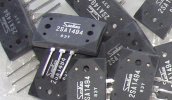
Sanken fake power transistors

stereo71

AK Subscriber
Subscriber
This has been a problem for a long time now, but can anyone suggest how to identify the fakes by appearance? Current example is 2SA1494; I have some which I believe are genuine (purchased from a legit seller years ago) that weigh close to the 18.4 grams specified in the Sanken datasheet, and some others that weigh less (about 14 grams) that also "look legit" but may not be, that came recently from a different USA surplus seller I've used in the past, which I'm skeptical of. Just measuring them with a Peak tester, and diode test with a trusted Fluke multimeter, the readings are very close. I can post some pics a bit later...

What I'm looking for is any evidence that Sanken may have made some lighter ones late in their production runs, or if all should be in the 18g. range. If their weight was always consistent, then lighter ones can't be real. Or can they?
 
Register to hide this ad
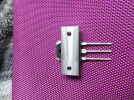
IMG_2394.jpeg

This one I think is real, I've had it for over 10 years...it weighs 18.3 grams

IMG_2395.jpeg

Recent purchase, weighs 14 grams. Note the Sanken logos are slightly different, and the number fonts don't match,
especially the 1 and 2.
Different plant production could vary, I suppose, even for genuine parts.
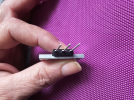
IMG_2393.jpeg

Backs look very similar, the one on the right has the 53 Y code,
which I think is genuine. They both test about the same, with low current testing.
 
I too have a dozen or more of the 1494/3858 "Sankens" bought 5 or more years ago, cheap. I did not know about the 18.2 grams proper weight till recently. My entire bunch is bogus as they weigh between 12.4-13.6 grams each. What recently increased my suspicions was my completely refurbed Technics V8, which had these 1494s installed, failing after 1 hour of moderate to vigorous use at 4 ohm. Two of my three fuses were blown and several outputs tested shorted. The machine had been repaired and tested by trusted professionals.
Why would Sanken reduce the weight of their top line outputs by almost a third without mentioning it?
I also recently discovered a pack of ten 1187/2838 Sankens bought at the same time for much higher prices. The all weigh exactly 18.3 grams each.
If anyone knows if these outputs with their higher frequency are compatible with the Technics V8 it would be much appreciated. Thanks in advance.
 
I know what you mean...the amp that went up in smoke (not literally) probably ate some upstream drivers and maybe emitter resistors. Don't have it in hand yet. But I'd just as soon convert it to some A1492 and C3856 from Digikey and know it's gonna work. Drill and tap, be done with the mystery. It didn't originally have 200v 17a outputs anyway...
Still I'm curious of all these big Sankens should be 18 gram parts, to be considered genuine. And once the counterfeiters figure out how to up the weight, even that won't be a guarantee!
 
Yes, the MT-200 are history...sadly enough. If you look at the Sanken datasheets, the A1494 and A1492 are the same construction, same curves....only difference is the max voltage and amperage. Unless you need the 200v 17a capability of the 1494, of course. And we can still get the 1492, they're in the current offering. Have to make them fit the heatsinks of course...which shouldn't be a problem. Better than junking an amp! If we decide to do that, will start a new thread.
 
Stereo71, I work in the electronics industry and have some thoughts to share. Take this with a grain of salt, as only someone at Sanken would be able to confirm. Parts like these can be packaged in many different facilities, and there's always a possibility that one packaging house uses a different molding compound than another, which COULD account for a difference in weight.

If they measure similarly on a tester, you have nothing to lose by putting them into a unit and seeing how they perform.


- Jeff
 
I have some genuine ones here purchased from bdent some years ago so I just checked for you.
2x 2SA1494: 18.53g, 18.58g
2x 2SC3858: 18.57g, 18.57g

What I'm looking for is any evidence that Sanken may have made some lighter ones late in their production runs
Not a chance at 14g. I'd almost guarantee yours are fake, the writing looks different to the real ones too.

More importantly, keep in mind that mass nor visual inspection are any guarantees of real product - counterfeiters are clever and it's not too hard to change the mass of a part once you know people are checking for it. The only guarantee (or near-guarantee) is buying from a reputable large supplier like digikey/mouser, or one that takes pride in only selling genuine product such as bdent. I've also purchased genuine Sanken parts from chip1stop in Japan.

For future reference, I've read about modern counterfeit transistors that are meeting the Vceo and Ic specs (along with hFE) - so they won't even fail in circuit - however other parameters like fT, capacitance and noise figures will be miles off the real thing.

Hope that helps.
 
@zaibatsu
Thanks, well said, and that's what I figured...only the 18+ gram ones, of original units, are going to be genuine. That being said, it's getting hard to know what you get these days. And the more time that goes by, the likelihood of finding real ones gets slimmer. So unless we that have some know they're the real deal, no point in chasing them. In order to actually test any suspect units, we would need a test bed amp, or purpose-built platform, that could get them into their higher amperage operation, while measuring noise and distortion, etc. My simple tools at hand, a Peak tester and a quality diode-mode multimeter, aren't going to reveal the fakes. And if any of us are working on client's gear, we need to be sure we're not guessing about the parts we're putting into their amps. I may have a test mule to use; if I get the A1494 and complimentary C units to work in it, will be a good test!

Will start a new thread if that works out...
 
Went through the same thing buying Sankens off eBay - even from sellers who insisted they were good units pulled from working equipment. The font was different than the genuine ones and the weight was ~13.2g vs. ~18.4g for the real ones. Luckily the sellers all accepted returns once I identified the differences.

Some very nice AK members came through and offered me spares of theirs which I now have on hand for whenever I finally figure out my A1000 ...

https://audiokarma.org/forums/index...ge-in-signal-path.862129/page-7#post-15711620
 
Sorry mods for bringing up an old thread. I had an unfortunate accident and i blew my Sankens on my Technics SU-V8X on one channel. They measure 18.53grams. Place in Australia selling them cheaply and they measure 18grams. I assume, they are the same code of the ones in my v8x 83y, but ive seen a few fakes with that code, is the weight the main thing to look at. Certainly cant tell with the lettering
sankenz.jpg
 
My supplier shows stock here in Japan. NOS, about $45 for a set (2 pairs each) of 1494/3858 then postage to where-ever.
 
That case type I bet it's real, but I also would rather buy a drill and tap set and just pop in a new production TO-247.
I milled out straps to do one entire M-80. No drilling or tapping of the heatsink required.

Using TO-3P subs

OEM 2SA1169 ( SANKEN MT-200 )
200V
15A
150W
20 mhz

Sub 2SA2151 ( SANKEN TO-3P )
200V
15A
160W
20 mhz

1688579017490.png1688579138653.png
 
Last edited:
Yes, sad state of affairs in finding Genuine MT-200 package Sankens these days. The earlier fakes were always lighter than the spec shown in the Sanken datasheet. But, if the fake manufacturers have adjusted to putting out heavier product to meet this expectation that buyers look for, then the game gets harder to play.
The only real way to be sure, is hack them open and inspect the die size.
Since genuine Sanken current product can meet the spec of the OE, almost exactly, in a smaller package...that's the only sure way to go.
 
Back
Top Bottom