• The move to the new server is done. There are some software and database maintenance updates in process. This has us passing the hat around to help out. We appreciate any donations. Seriously, even a dollar helps. The payment page may be found here - https://www.audiokarma.org/support.html

Sansui 2000, transistors question

I've cleaned the pots as well as I can. I don't have any Faderlube handy, will have to get some next time I order stuff from Amazon. At the moment the receiver is working well, sounds pretty nice, but I still feel it could be better. I think I'm going to relegate this unit to the workshop/art studio area where a little white noise isn't that big of a deal and call it good for now.

If nothing else, this has been a good learning process. Thanks to those that have offered their help.
 
In a pinch I have used CRC 2-26 Electronics lube vs. Faderlube or DeOxit GOLD on ROTARY Switches, and push switches. You can always flush it out with DeOxit D-5 later and apply Faderlube or Gold. The DeOxit D-5 not only cleans but it leaves little to NO Lubrication behind. The CRC can be had at Home Depot in the electrical Dept.
 
larryderouin; Try and remove as much of the solder as possible with solder wick and resolder with good quality 60/40 or 63/37 tin/lead rosin core solder. DO NOT USE Lead-Free rosin core or plumbing(acid core) solder. Larry[/QUOTE said:
Larry, is this (do not use lead-free rosin core solder) a general principle by you or just on Sansui products or ???
 
Larry, is this (do not use lead-free rosin core solder) a general principle by you or just on Sansui products or ???

You don't ever want to use acid core ever on electronics. It can eat away the traces over time.

And the problem with Lead free (I believe) is twofold;

1) It has a higher melting temperature which can kill some more heat sensitive components.

2) Lead Free doesn't mix well with ordinary Rosin Core Solder


Yes, I'm quite aware that acid core is not for electronics.


The lead-free (Kester Lead free is SN96.3% / AG 3.7%) is supposed to mix with rosin core, i.e., be used for repairs, provided one removes most of the original solder. Isn't it supposed to form an alloy? An ugly one at that, with a very dull finish.


Your heat point is well taken, particularly with silver solder. But if the component is particularly heat sensitive, clipping on an alligator clip or a hemostats as a heat sink is good practice regardless of the solder being used.

EDIT: Went back to 60/40 - much smoother than the lead free, though with the lead-free there was no health concern with handling and fumes.
 
Last edited:
Hãy tìm tụ C004, 1000Mf, 50V dò ngược về gốc dây dương (+) tại F-1195 tiếp mát qua tụ cho chân mày, chỉ cần 1 tụ 2200mF 50 V, vấn đề về ồn sẽ được giải quyết.
 
Last edited:
Để làm triệt tiếng ồn trong máy sansui 2000, 2000a, 2000X các bạn xử lý như sau:
Các kỹ sư Nhật đã mắc sai lầm cơ bản, khi tôi mua 2000a đã phát hiện ra sai lầm này. Hãy tìm tụ C004, 1000Mf, 50V, dò ngược về gốc dây dương (+) tại F-1195 nối chân mày với mát máy (-) qua tụ, chỉ cần 1 tụ 2200mF 50 V, mọi vấn đề về ồn sẽ được giải quyết.
 
Translation:
"To make noise in the machine thoroughly sansui 2000, 2000a, 2000X you dealt with as follows:
The Japanese engineers have basic mistakes, when I buy 2000a have discovered this mistake. Look for capacitors C004, 1000Mf, 50V, original probe wire back to positive (+) F-1195 in connection with the cool air-brow (-) through convergence, just 1 2200mF 50 V capacitors, all problems will be noisy Desc."
 
HUH!?!!!?!?!?!?! I wonder if he's saying C004 is too small for the job and to increase it to 2200uf???
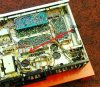
Sansui power supply.jpg

Sansui 200a top .jpg
 
Translation of the 1st of his posts.
Look for capacitors C004, 1000Mf, back to the original probe wire 50V positive (+) at the F-1195 continued through the capacitor to cool brow, just 1 2200mF 50 V capacitors, noise problems will be solved.

As C004 is NOT on the 1195 board, I would take this to mean he's probably changing it for a 2200uf 50V.
 
2000x-a.jpg
Hãy tìm tụ C004, 1000Mf, trở lại dây thăm dò ban đầu 50V dương (+) tại F-1195 tiếp tục thông qua các tụ điện để làm mát chân mày, chỉ cần 1 2200mF 50 V tụ điện, vấn đề tiếng ồn sẽ được giải quyết.
 
Last edited:
Không phải tụ C004 nhỏ, các kỹ sư Nhật đã đặt sai vị trí: Đáng ra, C004 phải đặt ngay sau đi ốt D005,D006 nhưng họ lại kéo dài ra xa cỡ 20Cm để đặt C004 ( sai lầm cơ bản về lọc nguồn) do không còn chỗ. Do đặt C004 như vậy dòng xoay chiều đã không thoát được hết, kể cả dùng tụ 10.000 mf cũng không được. Giải pháp: đấu thêm một tụ vào đầu ra của đi ốt D005+D006 mối xuống mát máy. Thế là xong, tụ cần từ 1000-2200mf.
Not small capacitors C004, Japanese engineers were misplaced: Worth, C004 must place soon diodes D005, D006, but they extend away from size 20cm to set C004 (basic mistakes filter source) so no room. Due to such C004 placed AC did not escape all, including 10,000 mf capacitor is not. Solution: adding a capacitor to match the output of D005 + D006 wholesale LED cool down the machine. It's done, capacitors need from 1000-2200mf.

C004 không nhỏ, họ đã đặt sai vị trí.

C004 is not small, they were placed in the wrong location.

thiemdx; If you speak english it may be easier to figure out what you are getting at. I've never had problems replacing The diodes on the 1195(A VERSION) or the 1195-1 (X Version) board, nor the capacitors, and have never ended up with hum. I use 1n4007 diodes and stock values of caps in all versions of the board. On the "X" Sansui added C015 to the 1195-1 board from the1195 "A" version, and the board became very crowded. But it's workable to add new diodes and caps.
 
Have all 3 versions of the 2000. All have been overhauled, new diodes, caps, resistors. The 1195 boards on the "A" and "X" versions were completely stripped and rebuilt with the exception of the transisitor on the boards. No problems at all.
 
Sansui 2000, repair questions

I found 7 of the transistors. They have been replaced. According to the service manual, there should be 2 of these on the equalizer amp board (f-1037). Looking at the board, no bright orange little square things. Look at the diagram again. Find exactly where they are supposed to be. They are not 2sc458, they are instead 2sc281 so I didn't replace them. Did a little test after replacing and the noise is still there, but to my ears the sound is better, more detail and depth but that could just be wishful thinking. Which brings me to my questions.

FWIW the 2SC458s in my 2000a (I know, it's not the EXACT same unit) were not "bright orange little square things" but black or dark grey.

I had to replace them ALL to get the unit quiet. If someone says that the 281s had similar issues, I'd get rid of them.
 
You might want to reach out to ConradH
I seem.to remember him taking a special interest in this one. I know he has an Internet thread on improving it. It's certainly worth a shot.
 
2000ax1.jpg
C004 không phải là nhỏ, chúng được đặt ở vị trí sai.
C004 = C004 + C004'.
 
Last edited:
2000
ScreenHunter_26 Dec. 28 13.00.jpg
2000A

ScreenHunter_27 Dec. 28 13.03.jpg

2000x
ScreenHunter_28 Dec. 28 13.05.jpg

In none of the 3 boards is C004 physically connected to the board EXCEPT thru the wiring. I physically checked all 3 of my units and none of them have C004 or any markings for C004 on them. I still don't understand what you are trying to explain.
 
Back
Top Bottom