• The move to the new server is done. There are some software and database maintenance updates in process. This has us passing the hat around to help out. We appreciate any donations. Seriously, even a dollar helps. The payment page may be found here - https://www.audiokarma.org/support.html

Sansui 5000a - 1040 vs 1063 vs 6013

Rob_Feature

Rob Feature
Over the past few years, I've become a Sansui fan and I pick them up whenever I see them. Have 3 of them in the house currently. Today I counted myself lucky when I came across a really nice condition 5000a at the thrift, so I bought it home.

Then I was a little bummed when I started to read about the problem with the 1040 boards catching fire. I read that the later models had a replacement board that was labeled as the 1063.

So, I cracked the unit open...only to find 2 boards marked F-6013. At first I was confused...but I think these ARE the replacements for the bad 1040 boards. Is that correct? Just looking for clarification.

I think it goes like this:
- The 1040 boards were original to the 5000 and 5000a, plus early models of the 5000x
- They then started using the 1063 boards to remedy the problems of the earlier board
- Then, as a total guess, I'm thinking the 6013 boards were like the replacement/recall boards that were offered to existing units with 1040 boards.

My unit had a sticker on the chassis that was from "Sound Labs, Inc" in Chicago. My guess is that they serviced this unit and probably installed the 6013 boards when the recall was issued.

Does that all seem about right?
 
Register to hide this ad
Not sure where the reference to F-1063 came from, I've not seen that before. There was F-1040, followed on by F-1040-1 (a minor revision) and then F-6013 as the final update to solve stability problems.

F-1040 and the -1 revision can be modified to achieve stable operation, so there isn't a huge reason to go searching for 6013 boards, unless the existing boards are scorched. Bottom line, I'd not be too worried about having the older boards, as long as they get the mods applied.
 
Not sure where the reference to F-1063 came from, I've not seen that before.
Ya know, it's weird. I saw it in a post here on audiokarma, then in a couple other posts elsewhere. The odd thing is, I had a feeling it was a mis-type because the numbers were so similar to the 6013. So, maybe it was a mis-type that was copied in different places? Or maybe Sansui collectors are more dyslexic than average :)

Either way, the fact that you don't really know what that is...tells me its probably an error that I just saw a couple different places. Thanks!
 
Ok. Incidentally, in speed reading your original post I somehow missed that you had the 6013 boards already installed in this 5000A. So, you are good to go in any case.

An interesting aside to this is that Sansui appears to have issued board numbers (with the prefix F in amps, tuners and receivers, G was used in cassette decks and S in turntables) sequentially in the order they were designed, near as I can determine.

Revisions generally had a dash with a number (-1 for example) and sometimes a major revision or redesign to address a design failure was given an entirely new number; as in the case of the 6013.

What I can't figure out is why they chose 6013. I can see using a high number that wouldn't fall within the range of numbers already in use or about to be, but why not an even number like 6000, instead of something random like 6013? I figure we may never know the rationale for that.
 
What I can't figure out is why they chose 6013.


True, it's now likely anybody's guess as to why, but it could be said, in this particular case, that the new revised circuit was done in another division of the factory, one that used another numbering system, or perhaps they drafted this circuit to in a book that began at 6000 and it was the 13th drawing...:dunno:
Any other 6000 series boards around at this time??

Also when I did work to my 5000X, the first thing I noticed was these boards being a lighter shade to the rest in the unit, probably meaningless but interesting anyway.

:)
 
The 6013 boards were definitely different in appearance from.the 1041, owing to the fact that PCB fabrication was already undergoing changes and improvement at the time they were done. All the original boards in the 5000/A and probably X as well were early phenolic PCBs, many with no green mask on the foil side as was common just a couple of years later in the early 70's.

I inagine there were many batches of 6013 boards made over some period of time as Sansui - to their credit- had many 5000/A/X repaired at their own cost to change these boards well beyond the original warranty period. Authorized service centers were provided new boards and labor coverage for this purpose to modify any customer units brought in for repair of a blown channel. So the 6013 boards may even have changed a bit in their appearance (not in layout or fucntion) from the earliest to latest batches made.

There are no other design update replacement PCBs that were used in the 1970-72 era that I know of, and almost all regular production PCBs had a number in the 1000-1999 range until about the mid 70's. Just for reference, the driver board in the 8080DB/9090DB/QRX-9001 is F-2436, so that gives you an idea of where the board numbering was at circa 1976.

I don't know what year the F numbers finally crossed the threshold into the 2000 range but probably 1975 or late 74 would be my guess. The G (cassette deck) and S (turntable) board numbers are another issue entirely, and I've not really looked closely at that. It is clear that Sansui was in their most prolific phase of manufacture from the mid 70's - in terms of number of different models offered - and so the number of unique boards increased a lot from 1974 onward until they started pulling back and noticeably shrinking the product line about 1984.

I'd note here that F numbered boards were also used in EQ's, reverb amps, and some other accessory items.
 
Last edited:
The 6013 boards were definitely different in appearance from.the 1041, owing to the fact that PCB fabrication was already undergoing changes and improvement at the time they were done. All the original boards in the 5000/A and probably X as well were early phenolic PCBs, many with no green mask on the foil side as was common just a couple of years later in the early 70's.

I inagine there were many batches of 6013 boards made over some period of time as Sansui - to their credit- had many 5000/A/X repaired at their own cost to change these boards well beyond the original warranty period. Authorized service centers were provided new boards and labor coverage for this purpose to modify any customer units brought in for repair of a blown channel. So the 6013 boards may even have changed a bit in their appearance (not in layout or fucntion) from the earliest to latest batches made.

There are no other design update replacement PCBs that were used in the 1970-72 era that I know of, and almost all regular production PCBs had a number in the 1000-1999 range until about the mid 70's. Just for reference, the driver board in the 8080DB/9090DB/QRX-9001 is F-2436, so that gives you an idea of where the board numbering was at circa 1976.

I don't know what year the F numbers finally crossed the threshold into the 2000 range but probably 1975 or late 74 would be my guess. The G (cassette deck) and S (turntable) board numbers are another issue entirely, and I've not really looked closely at that. It is clear that Sansui was in their most prolific phase of manufacture from the mid 70's - in terms of number of different models offered - and so the number of unique boards increased a lot from 1974 onward until they started pulling back and noticeably shrinking the product line about 1984.

I'd note here that F numbered boards were also used in EQ's, reverb amps, and some other accessory items.
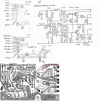
I have a 5000 with the 6013 boards in it and have recapped them and put in new transistors with heatsinks and such and am wanting to verify the wiring between the 807,808, 809,810 transistors and the 6013 boards and am getting confused on the schematics and their differences.

Ok I am getting ready to hook these driver boards back up and needing to confirm where all these wires go since I did not get this in working order. The top red (one red is from the fuse and the other goes to collector) blue (base) and black (Emitter) all go to TR808 and the lower red (Collector & Capacitors) blue (Base) and black (Emitter) go to tr810. Same principle left channel

1741141990790.png
 

Attachments

  • 1741141934453.png
    1741141934453.png
    304.7 KB · Views: 16
Back
Top Bottom