• The move to the new server is done. There are some software and database maintenance updates in process. This has us passing the hat around to help out. We appreciate any donations. Seriously, even a dollar helps. The payment page may be found here - https://www.audiokarma.org/support.html

Sansui 6060 - different heatsinks

getter365

H.H. SCOTT stereomaster
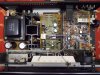
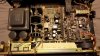
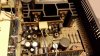
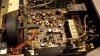
Good afternoon, does anyone know if Sansui used two different output stage constructions in the 6060 receiver? In my internet travels I have noticed two different heatsinks on what I believe are photos of the 6060 receiver.
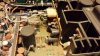
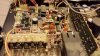
Which one is a better design - the one where the transistors are mounted at the bottom of the U-channel type heatsink or the one where the transistors are mounted on the side wall of the heatsink that has an air duct in the middle of it? I would think the latter.
I wonder if they discovered that one was inadequate and made an improvement. Or was it a cost-cutting measure.
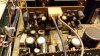
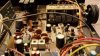
Also, these are not my photos but they are, allegedly, the model 6060.IMG_3654_resize.jpg DSCN1834.jpg
 
Register to hide this ad
The left pictured power supply/protector board looks significantly different, (extra vertical PCB on the right), as does the PCB supporting the main smoothing capacitors - several quite major differences. The left hand picture shows a unit that has definitely been 'worked on' - whereas the right hand unit looks pretty much 'stock' as far as I can see.

The left hand unit could simply be 'later production' - and just recapped.

NB: as I view them left and right pictures 'swap' depending if you are logged on or not.

A look at the serial numbers of these two units would help.
 
Last edited:
The left pictured power supply/protector board looks significantly different, (extra vertical PCB on the right), as does the PCB supporting the main smoothing capacitors - several quite major differences. The left hand picture shows a unit that has definitely been 'worked on' - whereas the right hand unit looks pretty much 'stock' as far as I can see.

The left hand unit could simply be 'later production' - and just recapped.

A look at the serial numbers of these two units would help.

Hi Hyperion, Yes. very good observation. One of these has had the power supply caps changed and perhaps some other parts. But they still could be two 6060 receivers with some design differences.
Or one these could be a 5050 model, but I feel they are both 6060. I certainly find way more photos of the unit with the transistors mounted on the side of the heatsink, as opposed to the layout where they are mounted at the bottom of the U-channel shaped heatsink.
I am hoping some owners post pix of the inside view of their 6060.
I have a 7070 and those have the heatsinks protruding out the back and that is the only version I have seen. I have a 6060 on the way so I will pop the hood when it gets here and see which one mine has.
 
Yes, Sansui made a major production change in the 6060. They completely changed the power supply board. The service manual shows the configuration in the picture at the top of the page. I'm working on a later production 6060 and can't find a schematic for it.

- Pete
 
Yes, Sansui made a major production change in the 6060. They completely changed the power supply board. The service manual shows the configuration in the picture at the top of the page. I'm working on a later production 6060 and can't find a schematic for it.

- Pete

Thank you LBPete for your insights. Would be interesting to know why the change was made (cost cutting or design improvement).
Well that answers my question as to the different layouts of the 6060 that I have seen.

I have read a number of your posts on Sansui receivers. Very informative to the people you were helping.

I hope you can find the schematic to the version you are working on.

getter365
 
Pete, I have a 690 (black panel version) of a 6060 awaiting power supply work, it lights up but no juice to tuner or driver stage. It is the later version with the chimney heatsinks. Looks like Oct 1976 production. If you happen across proper schematics, please advise via this thread. I will do some looking and if I locate them will do the same in turn.

Kevin
 
There is a 5050 schematic posted on this site that reflects the newer design. I haven't had a chance to compare it to the 6060 so off hand I don't know how much the 5050 and 6060 differ.

This production change was definitely an improved design. The heat sink assembly is much more robust and modern design. As a rule, Sansui's production changes were almost always to improve the design. I just wish they documented them better.

- Pete
 
Agreed. When I saw the picture of the early revision, I was rather surprised, as an amp in this power class from Sansui generally had a nicer heat sink than the simple U extrusion shown. The late version is more like what I've come to expect from them. The real question is whether the early version was failure prone and resulted in warranty claims (ala the 5000/A/X driver board issue) or if they upgraded it as a pre-emptive measure. Generally, running changes are reactive.

Kevin
 
My 1st guess is they used the same U-channel heat-sink (and supporting circuits) design for both the 5050 and the 6060 when these were released in 1976. After all, these two receivers are practically twins. This is why the service manual includes both the 6060 and the 5050. I suspect they had to improve the 6060 design because of its higher power dissipation being too much for the U-channel to handle. My service manual shows the U-channel heat sink design only. There has to be another service manual/schematic for the newer version 6060 out there. If you have the older heat sink you can always keep it runny cool with a small, quiet cooling fan. NO doubt, this will meet or exceed the chimney style capability with only convection.

2nd guess: Or it could have been done to be able to release both models at the same time, with the redesign already in process. I suspect there are not many 6060 models with the U channel built as compared to the newer version. It probably was a short-lived version. Or the more obvious, they all went kaput and there are not that many around as a result.

My 3rd guess is that maybe Sansui could no longer source the originally specified output transistors or their price went up. Then they had to use different BJTs which required a larger heatsink and other changes too.

I will stop guessing now.

Thank you LBPete and Sansuiman for your input. Good stuff.
 
A couple of good theories, though it appears to me the 5050 also got the revised heatsink despite being lower power output. I know both models recevied the revised power suply board F-2701 at some point in production and while not certain that both changes were simultaneous, this board change seems to coincide with the heatsink change. This may support the idea that the revision was dictated by an OPT change as the rail voltages may have changed as well to accomodate that. Anybody seen a unit with a newer heatsink but the old power supply board, or vice versa?

For that matter, does anyone have a serial number for an early version so we can get a rough idea of the cutover date in production? As stated my 690 is 10/76 but I have no frame of reference for when the revisions were incorporated.

Kevin
 
Hi Sansuiman. Makes sense. Saves on the cost of materials and labor to have both units use the same heat sink and similar power supply setup. Cheaper to buy 10,000 heat sinks of the "chimney" type than 5000 of one and 5000 of the other due to price breaks. My 6060 actually just arrived today, but being at work I have not seen it yet. Once I get to pop the hood I'll post a few snaps.

I am happy because in my business it is all about redundancy. If one 'sui craps out on me (my 7070 or my new old 6060), I have the other beauty (this assuming they have similar sonic qualities) to listen to while I attempt to fix the one that is down. At my listening levels, either receiver should be suitable. I shouldn't get ahead of myself because I haven't tested the new one yet. The person I bought it from said everything works and it sounds great. Hmmm, we shall see.

Yes, it would be great to know when the revisions took place (and to have a service manual for the later version).
 
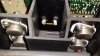
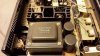
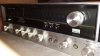
Here are some pictures I took of my new addition - the Sansui 6060. 20160126_175105.jpg 20160126_175415.jpg
 

Attachments

  • 20160126_175132.jpg
    20160126_175132.jpg
    79.8 KB · Views: 34
  • 20160126_175152.jpg
    20160126_175152.jpg
    89 KB · Views: 33
  • 20160126_175202.jpg
    20160126_175202.jpg
    86.1 KB · Views: 29
  • 20160126_175308.jpg
    20160126_175308.jpg
    84.9 KB · Views: 29
  • 20160126_175322.jpg
    20160126_175322.jpg
    87.9 KB · Views: 29
  • 20160126_175508.jpg
    20160126_175508.jpg
    84.1 KB · Views: 30
  • 20160126_175623.jpg
    20160126_175623.jpg
    91.8 KB · Views: 31
  • 20160126_175527.jpg
    20160126_175527.jpg
    63.7 KB · Views: 28
What's the serial number on your newly acquired 6060? We can determine the build date from that. If it is earlier than 10/76 then we know more about the rollout timeframe of the changes. I don't know when first production of the 6060 occured but my 690 is October 1976 and has the later design, as does your 6060 pictured. I'll be curious to know when yours was produced especiaoly if it was before mine.

Kevin
 
What's the serial number on your newly acquired 6060? We can determine the build date from that. If it is earlier than 10/76 then we know more about the rollout timeframe of the changes. I don't know when first production of the 6060 occured but my 690 is October 1976 and has the later design, as does your 6060 pictured. I'll be curious to know when yours was produced especiaoly if it was before mine.

Kevin

Hi Sansuiman,
Mine is serial # 858031925.
I don't know what these numbers translate to but it sounds like you do. Hope this helps some. I got to test drive it tonight. She is in good electrical condition and sounds as she should. Just have some dial lights that need replacing and the pointer light but no rush on those.
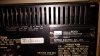
20160126_222817.jpg
 
Ok, yours is a much later build, March 1978. Serial number is formatted xxYMMzzzz where:

xx=line/plant ID
Y=year (only one digit, the specific decade is generally self evident)
MM=month in typical 01-12 format
zzzz=the sequential build number. It is unclear to me where the reset point was on this number(monthly, yearly, or otherwise) or if it just ran from 0001 to 9999 for the specific plant/line referenced by the first two digits, irrespective of the month and year. Wish their was some clarification on this.

I didn't realize these were still in production that late. Has to be pretty close to the cutover point where this series of receivers was discontinued and the first G series was introduced to take their place, as I think those dropped in late 1978. In any case, makes sense that yours has the revised board and heatsink given the build date. I'm hoping someone here will post one with the revised design built prior to 10/76 just because I'm curious how early in production Sansui made these changes. I doubt we will ever know exactly why unless a tech bulletin is unearthed outlining the change

Sansui did publish these sometimes, as for the 5000/A/X models regarding modification and ultimately replacement of driver boards, I have copies of these TSB's and it is clear they did this because of stability problems, even doing out of warranty replacement of the faulty boards at no charge for some time to maintain their reputation. This was back when their gear had rock solid build quality (circa 1970) and they were still building market share in the US market so perception was very important, and they were a well run outift that valued doing things right.

Anyway, good to hear yours is in good operating condition. These really are nice "little" (relative to their larger siblings) units that pack a punch without shouting "look, I'm a real bad mother" like the 9090 (DB) does with it's massively imposing presence and power.

Kevin
 
Hi Sansuiman,

Thank you for the serial number field breakdown. Yes, we do need some serial numbers of the earlier layout to find out when the revision was made. If anyone else owns a 6060 (earlier version with U-shaped heat sink or later version with more robust "chimney" style heat sink), let us know your serial numbers so we can determine when the revision was made.
I agree with your last paragraph too. Though I totally respect the 9090 and all of Sansui's efforts to build a powerhouse, I really don't need anything that powerful in any of may stereo systems, and I have quite a few. Also, I found the sound of the 6060 to be just as full and pleasant as my 7070 when listening to FM stereo (I didn't get a chance to try other input sources, but I am pretty sure, they will be equally as nice). I hope the phono preamp of the 6060 has great sound too. Have you used it? How does it sound?
I will be looking into how to change the display lights (the ones to the right of the display are out) and the tuning pointer light too. Then she will look real nice. The FM stereo light is alive and well.
I am hoping to get another 40 years out of these receivers. That is not a pipe dream either. If these are sound designs, there is no reason they won't last that long (especially if I do some preventative maintenance), plus my listening is spread across around 5 different systems so no one system gets too much use - just works out that way.
 
I didn't realize they built 6060s this late either. I guess the smaller models of the G series rolled out later.

To clarify a couple of issues with the serial number. The first two digits indicate the production line. Like many manufacturers, Sansui had multiple lines running at any time. The last four numbers are a sequential count of units built on that line during that month's production. It was common for Sansui to produce several different models on the same line in the same month so it's not necessarily a count of how many of a particular model were built that month.

- Pete
 
Back
Top Bottom