


Zeus12
Active Member
Greetings fellow audiophiles!
After reading all the great reviews about this little gem I decided to jump on the opportunity when I saw one.
What a beautiful sounding receiver!! It also has probably the best FM tuner I have heard so far.
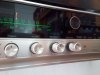
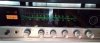


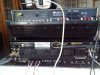
I have done my usual procedure of cleaning the buttons, knobs, pots with "Deoxit", clean the undersides of the boards with acetone and treat the front with "Tarni Shield" to get that old shine back. The front is in mint condition, couldn´t find the smallest scratch, and overall it looks to be 100% original except for the 2 left output transistors, the NEC 2SD180s-- which were the originals -- there are 2 RCA 2N3055 (8218)s.
Specs for the 2N3055 https://alltransistors.com/transistor.php?transistor=2776
Specs for the 2SD180 https://alltransistors.com/transistor.php?transistor=18656
From what I understand the most important factors to consider when substituting output transistors is to try to match the "Veb", "Vce", "Vcb" and "hfe". From looking at the specs it looks like the RCA was better and this change must have been done some time ago since the 2N3055 is out of production. It is listed as a substitute for the 2SD180 in the "2nd book of Transistors Equivalents and Substitutes" by B.B. Babani (Babani Press, 1974). I cannot hear any difference between the two channels and unless somebody advises me to change them, I will leave them alone.

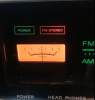
Amazing how good it can sound after almost 50 years. I know a recap would be beneficial and it will be on the pending list down the road. For the time being, I have visually inspected all components and they look to be OK. No bulging caps, burnt resistors, or something out of place. There are some solder joints on the AM/FM boards that look like they need to be touched up but I´m afraid it might mess up the FM reception. I don´t want to mess anything up since the FM reception is AMAZING. One thing I noticed on the tuner meter is that it never goes over 3 (3.5) while the Sansui 5050 which is in the living room does almost touch 5 on some strong local stations. Reception is crystal clear, big soundstage and loved to play around with that MPX Separation knob on the back. Definitely makes a difference in the sound.
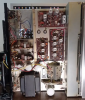
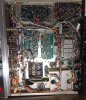
Very strange there was no mention of Bias or DC Offset in the manual. I know this is a cap-coupled design so there is no DC Offset but there is a "center voltage". By the way, I couldn't adjust the "center voltage" to get it to read 27V at 8C since my DDM always showed 1 (BOTH CHANNELS). Pin 8D, instead of showing 54V also showed 1. I clipped the "black probe" to AM ground and red probe touching the corresponding pin on the driver boards. Bias did show on pin 8E and left it at 11.5 mV for both channels. I followed this nice video on how to do it: guide:
Now regarding the sound I have to say that this is a keeper and from my limited Sansui comparisons I could say that this is the liveliest, most musical and powerful sounding I have heard so far. It has a BIG room filling sound that just makes the whole house seem like a little disco. The bottom end is deep, fairly articulate, thick but not gooey with plenty of "dig". The mids are well defined and strong. The highs are VERY EXTENDED and to my ears sound TOO high. On some recordings, a little bit of edginess and a very slight sibilance. I normally turn down the treble just a notch. Don´t get me wrong, they are detailed, airy and crisp but to MY EARS, it sounds just a tad too much. I prefer more of a rolled off sound, ala Avery Fisher but that would be a personal preference I guess.
Comparison with the AU-5500, for example, the highs are definetelly more neutral and not as pronounced. The AU-5500 is from 1975 and it also has something SPECIAL about it that I love to listen to. It is the most neutral and balanced of all the Sansuis I have heard so far. The lows and highs are nowhere near the 800 but the warmth, neutrality and balance make up for it. You can keep raising the volume and that balance (lows, mids and highs) is maintained until the house starts shaking. They are both Sansuis and as the saying goes, "I HAVE NEVER HEARD A SANSUI I DIDN´T LIKE".
Used Pioneer CS-66G speakers --great 3-way sealed speakers from roughly same time period, Topping D10 DAC and "The Dali CD - In Admiration of Music" Audiophile CD and "George Michael - Older" CD as source for listening comparisons. Track Nu. 1 - Jesus to a Child - is the "litmus test". George sounds like he is 8 feet tall on the 800. Very good soundstage and also, another important and great feature about the 800, is how good it sounds at really low volume. No need to use the loudness switch.
So another SATISFIED customer on this little beauty from 1968. I wasn´t even born when this thing came off the Tokyo assembly line and it´s sounding so sweet and smooth that boggles the mind how that could be possible. Did I mention that it also looks soooooo vintage.
Cheers!!!
After reading all the great reviews about this little gem I decided to jump on the opportunity when I saw one.
What a beautiful sounding receiver!! It also has probably the best FM tuner I have heard so far.
I have done my usual procedure of cleaning the buttons, knobs, pots with "Deoxit", clean the undersides of the boards with acetone and treat the front with "Tarni Shield" to get that old shine back. The front is in mint condition, couldn´t find the smallest scratch, and overall it looks to be 100% original except for the 2 left output transistors, the NEC 2SD180s-- which were the originals -- there are 2 RCA 2N3055 (8218)s.
Specs for the 2N3055 https://alltransistors.com/transistor.php?transistor=2776
Specs for the 2SD180 https://alltransistors.com/transistor.php?transistor=18656
From what I understand the most important factors to consider when substituting output transistors is to try to match the "Veb", "Vce", "Vcb" and "hfe". From looking at the specs it looks like the RCA was better and this change must have been done some time ago since the 2N3055 is out of production. It is listed as a substitute for the 2SD180 in the "2nd book of Transistors Equivalents and Substitutes" by B.B. Babani (Babani Press, 1974). I cannot hear any difference between the two channels and unless somebody advises me to change them, I will leave them alone.
Amazing how good it can sound after almost 50 years. I know a recap would be beneficial and it will be on the pending list down the road. For the time being, I have visually inspected all components and they look to be OK. No bulging caps, burnt resistors, or something out of place. There are some solder joints on the AM/FM boards that look like they need to be touched up but I´m afraid it might mess up the FM reception. I don´t want to mess anything up since the FM reception is AMAZING. One thing I noticed on the tuner meter is that it never goes over 3 (3.5) while the Sansui 5050 which is in the living room does almost touch 5 on some strong local stations. Reception is crystal clear, big soundstage and loved to play around with that MPX Separation knob on the back. Definitely makes a difference in the sound.
Very strange there was no mention of Bias or DC Offset in the manual. I know this is a cap-coupled design so there is no DC Offset but there is a "center voltage". By the way, I couldn't adjust the "center voltage" to get it to read 27V at 8C since my DDM always showed 1 (BOTH CHANNELS). Pin 8D, instead of showing 54V also showed 1. I clipped the "black probe" to AM ground and red probe touching the corresponding pin on the driver boards. Bias did show on pin 8E and left it at 11.5 mV for both channels. I followed this nice video on how to do it: guide:
Now regarding the sound I have to say that this is a keeper and from my limited Sansui comparisons I could say that this is the liveliest, most musical and powerful sounding I have heard so far. It has a BIG room filling sound that just makes the whole house seem like a little disco. The bottom end is deep, fairly articulate, thick but not gooey with plenty of "dig". The mids are well defined and strong. The highs are VERY EXTENDED and to my ears sound TOO high. On some recordings, a little bit of edginess and a very slight sibilance. I normally turn down the treble just a notch. Don´t get me wrong, they are detailed, airy and crisp but to MY EARS, it sounds just a tad too much. I prefer more of a rolled off sound, ala Avery Fisher but that would be a personal preference I guess.
Comparison with the AU-5500, for example, the highs are definetelly more neutral and not as pronounced. The AU-5500 is from 1975 and it also has something SPECIAL about it that I love to listen to. It is the most neutral and balanced of all the Sansuis I have heard so far. The lows and highs are nowhere near the 800 but the warmth, neutrality and balance make up for it. You can keep raising the volume and that balance (lows, mids and highs) is maintained until the house starts shaking. They are both Sansuis and as the saying goes, "I HAVE NEVER HEARD A SANSUI I DIDN´T LIKE".
Used Pioneer CS-66G speakers --great 3-way sealed speakers from roughly same time period, Topping D10 DAC and "The Dali CD - In Admiration of Music" Audiophile CD and "George Michael - Older" CD as source for listening comparisons. Track Nu. 1 - Jesus to a Child - is the "litmus test". George sounds like he is 8 feet tall on the 800. Very good soundstage and also, another important and great feature about the 800, is how good it sounds at really low volume. No need to use the loudness switch.
So another SATISFIED customer on this little beauty from 1968. I wasn´t even born when this thing came off the Tokyo assembly line and it´s sounding so sweet and smooth that boggles the mind how that could be possible. Did I mention that it also looks soooooo vintage.
Cheers!!!


