• The move to the new server is done. There are some software and database maintenance updates in process. This has us passing the hat around to help out. We appreciate any donations. Seriously, even a dollar helps. The payment page may be found here - https://www.audiokarma.org/support.html

Sansui 8080 bypass caps reduced bass response

Brad1234

Active Member
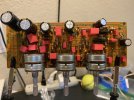
I have fully restored my Sansui 8080 and tried it without adding the bypass caps. The sound was loud, clear and powerful but it was very ear-fatiguing and causing my ears to ring (louder than normal), so I thought I would try adding the bypass caps to maybe filter out some of the high frequencies causing my ear fatigue. It worked and it sounds much clearer with no ear-fatigue but the bass response is not as punchy as without the bypass caps. Is this normal?

I used Panasonic 2.2uF/250V polyester film caps like recommended. Would polypropylenes sound better? I also used Nichicon KZ 10k uF for my main filter caps, are these as good (or better/worse) as the more basic caps with higher ripple current? Just trying to figure out if I need to change my main filter caps or bypass caps to get better overall sound. Thanks in advance for any advice. I am constantly learning in this hobby.
 

Attachments

  • IMG_4558.jpeg
    IMG_4558.jpeg
    85.7 KB · Views: 54
  • IMG_4574.jpeg
    IMG_4574.jpeg
    148.9 KB · Views: 59
  • IMG_4533.jpeg
    IMG_4533.jpeg
    124.7 KB · Views: 63
  • IMG_4441.jpeg
    IMG_4441.jpeg
    134.6 KB · Views: 56
  • IMG_4449.jpeg
    IMG_4449.jpeg
    145.2 KB · Views: 55
Register to hide this ad
Suggest removing bypass caps as well as rolling different nichicon muse bipolar caps instead of wima films in the treble section of the tone board. I personally like films there as you have installed as I think they add more detail, others feel electrolytic caps sound more like the original design.
 
Last edited:
Suggest removing bypass caps as well as rolling different nichicon muse bipolar caps instead of wima films in the treble section of the tone board. I personally like films there as you have installed as I think they add more detail, others feel electrolytic caps sound more like the original design.
I did try the Nichicon Muse BP caps in the tone board for the (4) 10uF low leakage caps and the sound was harsh and fatiguing. I swapped those 4 electrolytics with polyester films that miraculously fit perfectly on the board. The other films are replacing the mylar caps with the smaller value ones polypropylenes. The new film caps cleaned up the sound incredibly, the clarity is amazing.

I dont know why the sound is causing ear fatigue so I assume something is off with the filter caps I chose or it needs a proper size/type bypass cap? All of the electrolytics, most of the transistors and diodes have all been replaced.
 
I used those same main caps (10,000uf) without bypass for both of my 8080db's and quite satisfied with the sound, as well as WIMA films for values of 2.2uf and below where electro's had been used originally. What did you use for caps C01 and C02 on the driver card, and C27 and C28 on the tone board?
Would be easy enough to change one side only and compare results.
Also will note that my G9000 with film caps is very detailed (next generation design) at the expense of being dare I say edgy if one gets carried away with the tone controls. Both run through HPM 100's or Yamaha NS590's while the other 8080db runs through Klipsch Forte's with Crites mods.
On another note are you still using the original BA-312's on the tone board?
I am using Wima polyester film caps for C01-02 on driver and C27-28 on tone board. I didnt change the BA 312 integrated circuits on the tone board, is that something to do to improve sound? Not read that anywhere before.

So you also used the nichicon KZ filter caps with no bypass caps with good results? I was just worried the audio grade fancy caps may let too much thru instead of filtering like they are supposed to do? I will try unsoldering a leg on those bypass caps and give it a run for a while. Maybe the new films on the tone board need a break in to smooth out? I am running mine on my JBL L112's and some restored OLAs, the L112's are my reference speakers, they are very detailed, good for judging new amp rebuilds.
 
The BA-312 was just a query, your jbl's will be similar to the hpm's and I also have run both 8080db's on jbl-100's. Yes to KZ caps with no bypass caps. Many feel a break in period is needed to improve things, was never sure what was breaking in, our ears to the sound or the sound to the caps :)
Have you measured AC ripple across the new caps with the bypass caps removed?
I am suspicious about that BA-312 chip now because this 8080 has had a shrill, fatiguing, noisy sound since I restored it, and I bought it not working so dont know how it sounded before restore, other than brief period I played it after fixing it and it just sounded muffled and muddy from old caps. I replaced all of the smaller value caps on tone board hoping to get rid of the noise and it is still there. The bypass cap takes out some noise but also cuts the bass response bad. Took the bypass caps off and it has full bass again, but shrill highs. I havent measured the AC ripple yet, is there an explanation how to do that I should look up or easy description how to do it?
 
I've been watching this thread and I must say I am very puzzled by the symptoms you are getting, and how you partially alleviate it (removing the Main PSU bypass capacitors). Exaggerated treble, and wimpy bass are usually symptoms of under biassing. :idea:

I think I might have observed what I think could be a mild case of what you describe, as I have no other explanation to offer. Noticed after changing only the main PSU capacitors in one of my own amplifiers. The capacitors were/are Nichicon KG Gold Tune, there was no interaction noticed with the bypass capacitors. The cure was just to leave it powered on playing music, it took a few days of on and off use before it 'recovered' and was back to its 'normal self' - actually in this case 'better than its normal self' due to the new capacitors. :king:

Since then, I have noticed several amplifier reconditions that have improved over a day or two to a few days, after that no more change. I can only assume that this is the capacitors settling down, some capacitors it seems, are quicker than others. :idea:

Edit - add.
Maybe the amplifier is self oscillating? - this would very likely mess up the bias, and mess up goodness knows what else, it might even explain the high sensitivity to bypass capacitor removal. :dunno:
 
Last edited:
I've been watching this thread and I must say I am very puzzled by the symptoms you are getting, and how you partially alleviate it (removing the Main PSU bypass capacitors). Exaggerated treble, and wimpy bass are usually symptoms of under biassing. :idea:

I think I might have observed what I think could be a mild case of what you describe, as I have no other explanation to offer. Noticed after changing only the main PSU capacitors in one of my own amplifiers. The capacitors were/are Nichicon KG Gold, there was no interaction noticed with the bypass capacitors. The cure was just to leave it powered on playing music, it took a few days of on and off use before it 'recovered' and was back to its 'normal self' - actually in this case 'better than its normal self' due to the new capacitors. :king:

Since then, I have noticed several amplifier reconditions that have improved over a day or two to a few days, after that no more changes. I can only assume that this is the capacitors settling down, some capacitors it seems, are quicker than others. :idea:

Edit - add.
Maybe the amplifier is self oscillating? - this would very likely mess up the bias, and mess up goodness knows what else, it might even explain the high sensitivity to bypass capacitor removal. :dunno:
Thanks for the feedback Hyperion, I have about 8 hrs of play time on the receiver after the recap, and have checked/readjusted the DC bias a few times with little change to it. I checked it again yesterday after installing the bypass caps and it was just up 1mA to 31 mA, so the bias appears to be holding steady. The offset is also steady around 0 mV. Is there a way to test to see if the receiver is self-oscillating?

I can try setting it up in another room and running it for about 5-8 hrs a day and see if it improves. I also am going to build new BA-312 chips to put in it and see if that helps with distortion and noise in the sound. Those 50 yr old chips could use replacing anyways I assume. Let me know if you have any other suggestions or advice for me on 8080/9090 restoring. I have another 9090 I will be working on and it also has a similar high treble sound, though not as bad as the 8080.
 
Need some gear to test for oscillation. I use a frequency generator capable of square wave output, 8 ohm dummy loads and a multi channel scope. Will also get my harmonic distortion analyzer involved to check thd. Anyways short version square wave output to device under test, 8 ohm dummy loads on outputs, scope leads to each channel and ground, set input voltage to 750mv on aux input and monitor waveforms starting at 1000hz and say 1 volt peak to peak output on the amp. Monitor the scope display for nice crisp break lines on the waveform with no bouncing either on the trailing or forward edges. The repeat at 5000hz, 10000hz and 20000hz. As you get higher you may start to see a little jitter but if the traces start to really look like slinky springs you have an oscillation issue.
If none seen you can increase output and re test
-Lee
 
Last edited:
Need some gear to test for oscillation. I use a frequency generator capable of square wave output, 8 ohm dummy loads and a multi channel scope. Will also get my harmonic distortion analyzer involved to check thd. Anyways short version square wave output to device under test, 8 ohm dummy loads on outputs, scope leads to each channel and ground, set input voltage to 750mv on aux input and monitor waveforms starting at 1000hz and say 1 volt peak to peak output on the amp. Monitor the scope display for nice crisp break lines on the waveform with no bouncing either on the trailing or forward edges. The repeat at 5000 ohms, 10000 ohms and 20000 ohms. As you get higher you may start to see a little jitter but if the traces start to really look like slinky springs you have an oscillation issue.
If none seen you can increase output and re test
-Lee
This is exactly the kind of stuff I want to learn how to do, I just got a Rigol DS1054Z Oscilliscope but still trying to learn to use it. I still need to get a decent signal generator and harmonic distortion analyzer to be able to practice this type of troubleshooting. Did u mean 5k, 10k, 20k in hz or ohms?

Also, if there was oscillation in the signal, what would be the fix? Im going to copy all of these steps down to test for it when I get the right equipment.
 
kilohertz, distortion analyzers are spendy btw
Ah shucks, will have to save up for it or look for one on the used market I guess. A distortion analyzer seems like a critical piece of equipment for trouble shooting sound issues on old equipment.
 
A distortion analyzer seems like a critical piece of equipment for trouble shooting sound issues on old equipment.
Actually an oscilloscope is more useful IMO, a distortion analyser will allow you to measure how much distortion you have, but a 'scope will help you find out where it is happening - with the use of a signal generator that is. But the 'scope & Sig Gen double act is only as good as its operator. ;)
 
IMO, the most useful part of a THD analyzer isn't the number it puts out, but the residual jack, where you can hook a scope and see what the distortion actually looks like. Good to see the effect of biasing, or lack thereof.

IMO again, the BA312 parts aren't exactly state of the art and there's little to do about it unless you scratch build a replacement. No experience with that, but I remember them as being quite noisy.
 
Sparkos has these updated replacements for ba312.

 
Actually an oscilloscope is more useful IMO, a distortion analyser will allow you to measure how much distortion you have, but a 'scope will help you find out where it is happening - with the use of a signal generator that is. But the 'scope & Sig Gen double act is only as good as its operator. ;)
Yes, learning to use the scope/signal generator correctly makes all of the difference. Anyone have any recommendations on tutorials or guidance manuals for using a scope for audio repair and troubleshooting?
 
Those Sparkos replacements look like a huge improvement. The Sansui 881 also used 'em and would benefit.
 
Thread is going sideways, however need to fire up the way back machine for the most excellent BA-312 thread from a few years back that showcases the Sansui group think collective :)


And here are the $3 to assemble replacement boards (excuse the one ugly resistor as ups had lost an order on me at the time I assembled them and took the photo). Absolutely quiet and trouble free have now installed twelve of them in AU-9900A/8080/8080db etc.

1692732735863.png

Now back to the main discussion, way back machine dis-engaged.
 
Back
Top Bottom