• The move to the new server is done. There are some software and database maintenance updates in process. This has us passing the hat around to help out. We appreciate any donations. Seriously, even a dollar helps. The payment page may be found here - https://www.audiokarma.org/support.html

Sansui Alpha - debunking NRA series

fojica

Active Member
Ok, so let's say that I'm still in the Christmas giving mood, so this would be a second "gift" :)

To start with a bit of history as this seems unclear for some people, Sansui Alpha's were actually born in 1982, with B-2301 power amplifier. Indeed, not named "Alpha" back then, but "X-Balanced".
Strictly from a marketing perspective, their amps were named "X-Balanced" in 1982-1985 interval, then in 1986 that was changed to "Alpha". Technically being the same "heart" as before, so kind of "the same Mary wearing a different hat".

As a parallel joke, later on from 1990 onward "Mary" started to change a bit here and there, but still pretty much on the "make-up" side instead on the "heart"...but indeed, "Mary" got prettier, to some extent.
And if we follow "Mary" through the '90's until 1995, then we get to meet the AU-α*07MR series. And later in 1997 "Mary" was changed a bit again and we would meet AU-α*07NRA series.

Leaving the joke aside, what follows is just a summary of the comparison between MR and NRA series, exposing the "visible" change that was done in the NRA series. There could be obviously more changes, but it's not possible to track them visually.
Speaking strictly on a technical note, that would be a very short summary: NRA series has a modified VAS. In fact, this was already mentioned by me before https://audiokarma.org/forums/index.php?threads/alpha-907-limited.896129/page-4#post-14901984 and https://audiokarma.org/forums/index...i-x-balanced-amps.856879/page-3#post-14096821 , but only briefly.
This time is also not intended as a pure technical analyze, so I will try to keep it at a "general" level.
Also I have no intention to recover the service manual of the NRA series, so please don't ask that.

There is no public schematic of the NRA series that I'm aware of (not even a conceptual one), so this could be the first public schematic, even if not a complete one.
I underlined only the certain change that occurred in the NRA series compared to MR, so except for the red boxes I'll say pretty sure that for AU-α607NRA the rest of the schematic for the power-amp section matches the one of AU-α607MR.
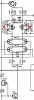
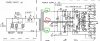
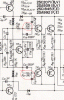
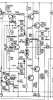
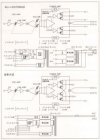
Words would be more or less meaningless, as it was probably the case before with the earlier postings, so this time we have a simplified schematic to visualize and understand better:
mr_vs_nra.jpg

For non-tech people looking at it,
CCS = Constant Current Source (in fact those are 2 Wilson current mirrors in both MR and NRA)
and
VBE-M = Vbe Multiplier (or bias spreader), aka the transistor setting the bias current for output devices

The change itself is framed in the red boxes, it's easy to spot.

Ok, now we that we have clarified also the acronyms used, we can get to the "why" point :D
I don't intend to speculate just for the sake of speculation, so I'll say frankly that I don't know why they did this change and what was the end-goal.
What is obvious, however, is that for some reason they wanted to increase the current in the VAS stage, and instead of using bigger devices (and slower), they "doubled" the usually ones used, being 2SC2705 and 2SA1145. Also resistors driving the VAS were increased from 1.2k in MR to 1.8k in NRA, clearly confirming the increased VAS current in the NRA compared to MR.
By the looks of it, I tend to say that they kept the same VAS devices. However, I can't prove that the "old ones" are still used here, so I don't claim that this is 100% certain.

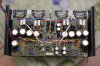
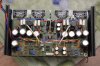
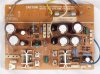
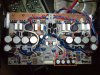
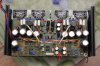
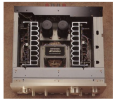
Further we have two images from AU-α607NRA and AU-α907NRA power-amp modules.

AU-α607NRA:
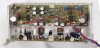
607nra.jpg
and
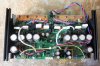
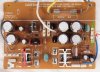
AU-α907NRA
907nra.jpg

In the marked areas we can see the same number of devices + associated caps, so I would say that this change was consistent through the NRA range. What is further different though only for the 907NRA are the output devices and their number, now being only 4 per amp module instead of 8 as before (including MR series). For AU-α607 series were always used only 8 output devices (that's the minimal number of output devices required anyway), so there is most probably no change.
Due to the investigation done by Erden (eradoncic) back in 2004 here, I suspect that what we see here in case of 907NRA are 2SC2922/2SA1216 output devices. But it's just my guess.

If anybody want to contribute or correct me, feel free to do so

Regards
 
Register to hide this ad
Admittedly I forgot to mention another visually tracked change, one having most probably a much lower impact than the VAS modification.
I'll also admit that I have no idea about Sansui's reasoning for this change.
Was interesting though to find out that this one looks like being done first before NRA, on AU-07 Anniversary in 1996, then it was also kept for NRA series - namely there aren't anymore 0.47uF film bypass caps on LTP's SV-03 diodes as were on MR.
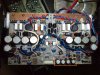
Pictures below confirm this, just check orange boxes area. My thanks to @Hyperion for posting the picture with the MR module, that helped to confirm this one :thumbsup:

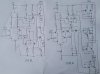
Visual change draw on the MR series schematic:
mr_ltp.jpg

AU-α907MR
907mr.jpg

AU-07 Anniversary
au07.jpg

AU-α907NRA
907nra.jpg

If any other changes will be found, they will be added to this thread

For some sound-wise reviews on Sansui Alpha series (including NRA) you can check this > link < (you may need to have an account).

Regards
 
Last edited:
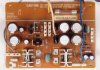
Browsing through some Sansui pictures today, just found something interesting: as much as PSU (Power Supply Unit) is concerned, it seems they have been pretty consistent in time; for example, all 607 series from 1991 to 1999 have remarkably identical PSU modules (where pictures are available), and the same can be said about 907 series, DR-KX-XR-MR series having at least the same PSU schematic (service manuals being available).
The main difference between 607-707 series and 907 series is that in case of 907 there is a floating ground PSU, which wasn't the case for lower series 607 and 707 (there is a center tap).
In case somebody is wondering, having a floating ground PSU helps by keeping the charging currents out of "normal" currents flows in the amplifier, or said otherwise there would be a "cleaner" ground if floating.
Although I have no clear evidence for 907NRA, there is no reason yet to expect any change in PSU also in NRA generation between 607-707 and 907 series.

Some visual examples
907DR-KX-XR-MR series PSU schematic [area in question]:
907_psu_sch.jpg

607MR series PSU schematic [area in question]:
607mr_sch.jpg

And related PSU boards, in chronological order (all of them can be seen in bigger size on amp8 site)

1991 AU-α607 MOS Premium
607mosprm_psu.jpg

1997 AU-α607NRA
607nra_psu.jpg

1999 AU-α607 MOS Limited
607moslim_psu.jpg

Guess this will be it...for a while at least :)

Merry Christmas to everyone !
 
Last edited:
Another interesting detail that is easy to spot in the pictures posted before, if paying enough attention: AU-07 (like B-2105 MV) has the SV-03 diodes (that keep the bias for DD block) replaced with 1K Riken resistors. Check the red arrows.
But, for the later NRA series they reverted back to the usual SV-03 diodes. So the only "exceptions" in the whole range of X-Balanced or Alpha series through the years that have resistors instead of diodes for biasing the DD block are AU-07 and B-2105 MV.
No idea why they did this.
And, in fact, B-2015 MV is using amp modules boards with the same ID as AU-07, 7216 (bottom left) - this can be clearly seen in the publicly available service manual for B-2015.

AU-07 Anniversary
au07.jpg

AU-α907NRA
907nra.jpg

Over and out :)

Regards
 
This is not from the alpha series, but I don't know which topic to put it in, so here is the closest to the topic. More than once, on devices of the G series and AU series of newer serial numbers, towards the end of production, I have seen resistances of 390 ohms between VAS and the pre-driver that were replaced with jumpers. I have been preparing for a long time to make measurements with and without resistance, so time does not allow me. Have any of you seen a device with jumpers instead of resistance and what is your opinion about it, everything else in the topology is the same.
 

Attachments

  • 390ohma.GIF
    390ohma.GIF
    111.4 KB · Views: 46
Indeed, this has no connection with Alpha NRA series.
Anyway, I know what you mean. You refer to the R || C group between VAS and pre-drivers, 390R || 1nF (the caps are also visible in your attachment). It's important that there are not only 390R resistors - those are bypassed with 1nF caps, which are a form of compensation.
It was done like this also in older X-Balanced/Alpha models like B-2301, AU-D11 II, AU-G90X and AU-G99X. Later that R || C group was replaced with 100R 'simple' resistors (there are not any parallel caps anymore).
Sansui were not the only ones who used this form of compensation - Dual CV1460 (made by Denon actually) is another example.
CV1460 relevant section - see 270pF C49 and C51.
cv1460.jpg

However, let's try to stick to NRA series here or at least something Alpha topology related - otherwise it will be a mess in the end.
Maybe it's better for you to open a separate topic dedicated to that form of compensation - I'm not sure how it's technically named.

Regards
 
@fojica thanks for taking the time to draft this thread - super informative.

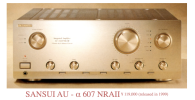
Can you comment on the changes between the 1997 *07NRA series and the 1999 AU-α607NRAii? Real and or marketed benefits of the separate "speaker drive"/"pre-driver" transformers and any other differences?

Audio Database AU-α607NRAii -
"In order to eliminate the interference between the power windings in the transformer, an EI core transformer dedicated for the speaker drive is mounted on the final stage in a left and right independent power supply system, and a toroidal transformer is mounted on the power supply of the pre-drive stage so that the power supply to the final stage is independent.
In addition, a ripple filter circuit is adopted for the power supply of the predrive stage to provide a more stable power supply.
The toroidal transformer is completely shielded by pure copper material, Teflon sheet and special rubber, and it is mounted floating on the back of the front panel."

Screen Shot 2023-06-25 at 8.03.52 AM.png
NRAii in.png


Screen Shot 2023-06-25 at 8.17.21 AM.pngScreen Shot 2023-06-25 at 8.17.27 AM.png
 
Last edited:
@JimEGR - thank you for your kind words.

I will begin by saying that I have no documentation about Alpha NRA-II series.
The phrase quoted by you it's just about the physics of the transformers - in any transformer there are inevitably some parasitic capacitances developed between the windings. How those are dealt with and in which way, that's a totally different story. But the fact remains.
What's also obvious is that the biggest current spikes in any amplifier are developed in the secondary winding(s) which supply the power output stage(s) - again, just a matter of physics. Due to aforementioned parasitic capcitances between the windings, those current spikes could be 'reflected' in other windings in the transformer, including possibly the primary winding. This is probably why they had chosen to add that ripple filter for the 'drive' transformer - anything that would be 'reflected back' from power secondary winding(s) to the primary winding of the 'power trafo - EI type' would be then attenuated (as much as possible) in order to not reach the primary winding of the 'drive trafo - toroidal type' - and, from there, to not reach secondary winding(s) of the toroidal trafo, which may impact the 'drive' side of the power supply.
So, yes, from my perspective what they did on NRA-II series with the trafo's layout seems absolutely logical and is also beneficial.

For 'any other differences' - sorry, as I said, I have no technical documentation or details about NRA-II series, so I can't say what those differences are compared to 1997 first NRA series, beyond the obvious transformer layout changes. And I really don't see any point to speculate just for the sake of speculating what might be or what might not. When I know, I know. When I don't know....well, I don't :)

Regards
 
Thank you for the reply. I have a 607 NRAii on the way, and I'd be glad to dissect it and post some photos for you to document if you are interested.

The 607 NRAii is a fascinating historical piece, as the second to last Alpha produced - 607 MOS Limited the last Alpha. And it does not look like many of either were produced - only 24 NRAii and 25 MOS Limited in the database. Early 1999 release for the 607NRAii and late 1999 release for the 607 MOS Limited.
 
Last edited:
I have a 607 NRAii on the way, and I'd be glad to dissect it and post some photos for you to document if you are interested
You're welcome. If you're willing to post some photos from the inside of the amp, sure, we can try to figure out more details. For me it looks to be the only 'sure' way to obtain more technical details regarding rare Sansui amps.
AU-α607MOS Limited power amp boards have the same ID 7332 as AU-α607NRA (photos can be seen on amp8) and I think the boards are identical (copper traces perspective). However, there are some slight differences in the schematics, as not all components from NRA are also present on MOS Limited - this is obvious if someone looks at the boards.
So I don't expect NRA-II to be significantly different from previous NRA, except from trafos layout.

Regards
 
To be more specific regarding 1997 NRA and 1999 MOS Limited - as I said previously, the power amp boards used on both amps are identical - ID 7332 drive part + ID 7333 power part.
The main difference in NRA series was the doubling or 'parallel'-ing the VAS, as explained in the first post of this thread.
But 1999 MOS Limited is unlike-NRA, meaning that there is no 'parallel' VAS anymore and it resembles in fact the VAS section of previous DR-KX-MR/MRX series, prior to NRA. So that model kind of negated the VAS change done in first NRA series. No idea why and I won't go into useless speculations about the reason(s) for which Sansui did this - it's just the way they did it, plain and simple.
It will be interesting to see if NRA-II design kept the 'parallel' VAS of the first 1997 NRA series, or it was dropped as well as in 1999 MOS Limited. And for this purpose your pictures of NRA-II may worth their weight in gold :)

Regards
 
@Hyperion - John, for first NRA series it's really simple.
If you take a MR schematic and just 'replace' the red-marked blocks in first post, then you get NRA topology. And if instead of 1.2k resistors in DD collectors to the V+/V- rails (like R22 and R23 for 907MR) you put 1.8k ones, then you get almost 100% NRA changes. There may be some slightly altered caps values (as between DR-KX-MR), but pretty much that's it for 'what's different in NRA'.
I don't have time to hand-draw a complete schematic with the NRA VAS change, sorry. But a little imagination will solve it easily.
Hope this helps you. :thumbsup:
 
I don't have time to hand-draw a complete schematic with the NRA VAS change, sorry.
No, don't do that, it's only curiosity on my part, not an actual 'need' ;)

Regarding the changes - interesting, seemingly desperate for more drive in the VAS stage, doubling up on transistors.
 
more drive in the VAS stage
That's correct, it looks to me like an attempt for 'more class-A' in VAS. Probably the goal was a higher gain and maybe to alter somehow harmonics distribution in that 0.00x% low anyway THD. I can't find any other logic to do that.

You can read more about how 907NRA sounds on Stereonet:

"Sansui AU-α 907 NRA More polish present than the other Alphas, so clean in the mid-range it sparkles, so clean in the top end it shines. Has a mild bass boost effect that is not present on the other Alphas.

The NRA has a slightly smoothed feel to it, call it polished if you wish, so it very slightly cleans off the jagged edges of rough tones. It's a subtle effect but it is there, this makes it feel just that bit less forceful than its older brothers.

It also has the ability to convey hard-worked female vocals like no other Sansui before it. On many songs this will not be noticeable as the Sansui vocal standard is very good already, however, if you are an opera lover I suspect you will notice fairly easily (but if you are a listener to commercial radio you may notice almost never) this 'effect' only kicks in when the girls really kick their voices boxes into high gear but when it does it is worth having. This is the first of the big differences, so a difference of 5%, or maybe a little more, better at vocals than its brothers."
 
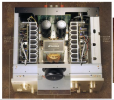
Having seen for a couple of months now some photos with internals of 607 NRA-II series (many thanks to @JimEGR ), it's probably a good moment to conclude my NRA series thread.
In brief, the main differences between NRA (first/initial series) and NRA-II are:
1 - power supply side -> EI-type power trafo, apparently with separate secondaries (like in 907) but non-bridged and feeding each of them a channel (likely a dual-mono topology) + toroidal trafo for drive section & other modules, in NRA-II. Different supply wiring also for Hot and Cold amps section, compared to first NRA series and older ones. Refer to below diagram.
2 - VAS stage, which was "reverted back" to the usual VAS with only 1 transistor instead of 2 parallel-ed transistors, like in the first NRA series

So, from a high-level perspective, power-amp section in 607 NRA-II is identical with 607-MR.

There could be other differences (likely minor), but with no visual proof and no schematic, any of such will remain as "possible / maybe".
As it is highly unlikely for any other relevant details to appear concerning NRA series, from my point of view this concludes the technical "investigation" into Sansui NRA series.

Regards
 

Attachments

  • nra2.jpg
    nra2.jpg
    171.8 KB · Views: 40
Thank you for your kind words, John. :)
As you know for sure, it was my curiosity and desire to "see" and understand the evolution of X-Balanced/Alpha series amps in time.
While there are still some unknowns left, I pretty much have now a good idea of what was changed through the years, from B-2301/B-2201 to 607NRA-II/607 MOS Limited. As said previously, this wouldn't have been possible without some important details shared by other members, to whom I want to say "thank you" once again. I can't say that I fully understand Sansui reasoning for the changes or what their goal was at some point, and in the same time I consider that in some areas there was more of an involution than an evolution (probably economically induced to some degree, a.k.a. cost reductions), but that's just my view. And, as always, I may be wrong. I won't go into details about evolution/involution, as this is another subject aside from NRA series and it would take anyway (many) more pages than this thread.
Wish everyone here to enjoy their X-Balanced/Alpha amps, no matter if being NRA or not :thumbsup:

Regards
 
@JimEGR - thank you for your kind words :)
Are there any other Sansui you are interested in analyzing?
Well....no particular model on my radar for now, I dissected pretty much anything Alpha that I could see :) Let's just say that I have some leftovers with AU-X111 MOS Vintage and B-2102 MOS Vintage. Not much, but as you know for sure, the devil is in the details.:biggrin: So, who knows, maybe one day more details concerning any of them would show up, to form a more complete overall picture.

Regards
 
Back
Top Bottom