• The move to the new server is done. There are some software and database maintenance updates in process. This has us passing the hat around to help out. We appreciate any donations. Seriously, even a dollar helps. The payment page may be found here - https://www.audiokarma.org/support.html

SANSUI AU - α 507R, only outputs one channel

tea station

New Member
Very new to Hifi, please excuse my lack of knowledge.

I live in Japan, and recently purchased a used SANSUI AU - α 507R. It worked well at first, but recently it has started to intermittently output sound from only one channel (typically right, but ocassionally only left). Ocassionally, it will output from both channels, but after a few minutes one channel will cut out.
I have tried swapping the LR input cables to verify that the issue is not the turntable, but the input seems to be fine.

Steps taken to try to fix the problem:
  • Applied Deoxit to all the controls I could easily access (including source control, volume, and balance, among others)
  • Applied Deoxit to the input ports
  • Replaced the relay
  • Tried to clean off some firty flux from the easily accessible PCBs
Immediately after replacing the relay, it did output sound from both channels, but the problems returned a few days later.
Sometimes after unplugging the input and plugging it back in, a loud buzz will play, then the channel will return, but it will usually cut out again within 3-10 minutes.

Any help would be greatly appreciated.

*Additionally, in the case that I can't find a solution, I'd love to hear any suggestions for Sansui amps released in Japan toward the end of Sansui's run (mid-late 90s?) that (hopefully) might not yet have capcitor issues, as used Sansui amps are relatively easy to find here online.

Thank you!
 
Register to hide this ad
This could be a lot of things, oxidised switch contacts, or connectors, but also possible to be dry joint(s) or faulty semiconductors. I have never seen the schematic for one of these, but the unit looks very nice with a classic Sansui look about it.

If you are a novice to electronics, this isn't going to be an easy fault to find, and suggestions for other Sansui amplifiers to buy may just place you in the same position but with a different fault. After ~30 years often a lot of TLC needs to be applied to such units, and experts in vintage HiFi are getting more difficult to find.
 
Thanks for your response Hyperion.

It does seem like trying to repair this might be out of my depth.
A few follow-up questions if I may:
  • I know the α 507R isn't a particularly well-known or popular model. Do you think it would be worth the effort/price to try to have it fixed?
  • If not, would you recommend just buying a new amp rather than a vintage one? Or would it be worth it to seek out a refurbished more popular Sansui model?
Thank you!
 
Do you think it would be worth the effort/price to try to have it fixed?
That depends how good the tech is, and how much he would charge, it is a nice looking amplifier it would be a shame to own it and have it in a non-working condition. You could ask the tech to just fix the fault, then you could see if you like it enough to have it fully reconditioned.

would you recommend just buying a new amp rather than a vintage one?
For what you paid for the '507, I am guessing you wouldn't be able to buy anything 'new' up to the spec of the '507 for the same money. Obviously you can't buy a 'new' Sansui, I am hoping you will stick with Sansui, I have been hooked for over 40 years, I bought new when you still could, and wouldn't buy anything else.

Or would it be worth it to seek out a refurbished more popular Sansui model?
This is a definite possibility, but people who can't do the work themselves usually buy an unrestored example of their favourite Sansui and have that reconditioned. (After first making sure they choose one of the more desirable/easy to repair models).
 
Thanks for your reply.

I asked around a few shops here about repairing it. One gave me a quote of about $350 USD, but one said they wouldn't be able to fix it.
  • What do you think would be a reasonable price to have it restored? It seems like most shops here will recap the amp, along with trying to fix the problem.
  • Are there any other Sansui amps you would recommend as being easy to have repaired?
Thank you!
 
What do you think would be a reasonable price to have it restored? It seems like most shops here will recap the amp, along with trying to fix the problem.
Well, a re-cap should make it sound better, but re-capping should not/never be considered as being a fault finding technique. It's hard for me to know how much people would charge in Japan for such work, but I'll guess about $500 +parts (about $100?), if done properly. The more I think about the fault you have described the more I think it is a cracked or dry solder joint somewhere. It is such a shame that even in Japan, people won't work on such equipment, or outrageously over charge for various reasons.

Perhaps you could list what is available to you now, in your price range and spec' then I might be able to suggest models from that list?
 
You are based in the last known treasure trove for used vintage Sansui gear.

The nice feature with the AU-a507R is the remote aspects (if you have it). There are not many Sansui integrates that have a remote.
The AU-a507R is not a very common model.
I would dare say the AU-a607 is very abundant in Japan and is a better quality amp that I would look into.
I myself have the AU-D607X Decade.
 
@tea station
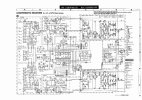
Service manual is available, if you have account or know somebody who has one: https://www.hifiengine.com/manual_library/sansui/au-a507r.shtml
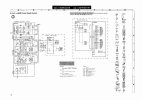
Unfortunately is too big to be attached, but at least you can see the schematic attached below.

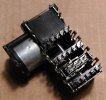
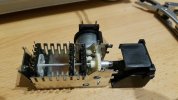
There is a motorized rotary input switch in your amp. Without knowing the exact type, all I can say is that those used by Pioneer and Onkyo amps are notorious for going oxidized over the years and making exactly those kind of symptoms - either lower volume on one channel versus the other, or cutting it entirely.
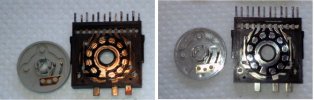
In case of those used by Pioneer and Onkyo amps, the only long-term solution is to get them out from the board, dismantle and clean carefully, then put them back. Any deoxit spray or similar will not reach the contacts are as they are "covered" internally. Being there, done that. You can also see how the contacts look before and after the cleaning.
Again - this depends on the exact type of rotary switch used. If the one in the Sansui looks like what you see in the below pictures, then from my point of view cleaning is an absolute must. Be very careful with those gears, they go brittle as the years pass-by. And even if the input rotary switch is a different model, I would still clean it as the first step - just to eliminate that potential problem from the list.
Regards

input switch_01.jpginput switch_02.jpginput switch_03.jpgp1.jpgp2.jpg
 
Back
Top Bottom