• The move to the new server is done. There are some software and database maintenance updates in process. This has us passing the hat around to help out. We appreciate any donations. Seriously, even a dollar helps. The payment page may be found here - https://www.audiokarma.org/support.html

Sansui AU-111

jobrewer1983

AK Subscriber
Subscriber
Hi All,

A few months back I traded a fellow AKer an amp and preamp for a nicely restored AU-111.

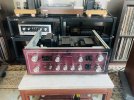
Ill get some pix of it up. In the deal he also gave me a NOS face plate from 1969. The box was turning to dust but the faceplate was intact and looks great. No marring where the screws go through it and non where the locking nuts mount either. I have yet to mount it as the original face plate has a cool faded look that i kind of like and do not want to swap.

The SQ on the unit is fantastic, its just a little wonky of an amp...

Have a few questions:

1. The volume pot seems to be a bit off, when its at zero there is no sound but if i turn the music up i get a little sound from one side, but if I turn it up a little more it balances out. From all my research this is totally normal for that amp. From what I have read on google the early unites did not have the best pots. So my question is should I replace the pot, or just well enough be as its working and not causing any issues.

2. All the pots feel loose - Meaning there is no drag or resistance on them. They work with no static at all but all feel cheap.

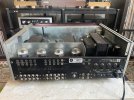
3. The RCA Jacks - The RCA Input jacks on the back of the amp are slightly oversized - Not sure if they can be replaced or not, but I am finding that they are damaging my interconnects. Is there anyone on the site that has changed them, and if so what did you use?

4. I zapped the living crap out of myself - The can caps I do not think are isolated, I was poking around in it with the hood off and I had my hand on the chassis and accidently touched one of the cans and wow wee did it get me, scared the living crap out of myself. Need to figure out if i can isolate that can some how, or is this normal for this amp?

Ill get pictures up shortly, but not sure I want to keep this unit, may just post it to BT at some point. The shop that did the work is said to be really good, and all the work they did on it looks super clean. Just trying to figure out a few things with it prior to just letting it go.

Any info would be great.
 
Register to hide this ad
The pots are loose feeling because some one cleaned the grease out of the shaft while trying to clean the resistive element.

The uneven volume pot problem is because your music sources have much more level than the original 1960's sources.

This forces you to use the very lowest resistances of the inexpensive volume potentiometer.

Hope that helps.
 
^ pretty much what @Buck Rogers said regarding the pots. Als, when working on tube amps, always observe proper safety protocol, never have both hands on/in the equipment at the same time, and assume anything you touch will have high voltage in it.

Yea I usually keep a hand in the pocket, but i was not actually working on the unit. Just had the hood off. It was on a small table and i was leaning over it with my hand on the chassis. Touched the can caps to see if they were hot due to being near the power transformer and some tubes. Wanted to feel how warm they got. Did not realize they were not isolated and learned that lesson real quick.
 
If this has a voltage doubler power supply and the upper cap doesn't have a cover, it will zap you. Negative is at half the plate voltage, which is why in original form those caps at least were insulated.
 
The schematic I find does show a voltage doubler power supply with two 200 uF/300V electrolytic caps "stacked" to handle the 420V plate voltage supply. That being the case, the "top" capacitor's case/common is operating at about 1/2 the plate supply voltage and must be insulated to avoid just such a hazard. The case of this cap is likely mounted on an insulating wafer or some other way so the case of the cap is not grounded to the chassis, but it's still "live" with that B+ voltage.

If this is the case and someone re-capped the amp with caps that have an un-insulated case, a cover must be installed on the "top" cap to eliminate the physical shock hazard! A photo of your set up might be helpful.
 
something else I've discovered is that even though the cap may not have the negative directly tied to the can, there will be enough leakage between the negative electrode and the case to make touching it unpleasant. Did that on my big Bogen amps, the "upper" cap was at +350vdc.
 
The schematic I find does show a voltage doubler power supply with two 200 uF/300V electrolytic caps "stacked" to handle the 420V plate voltage supply. That being the case, the "top" capacitor's case/common is operating at about 1/2 the plate supply voltage and must be insulated to avoid just such a hazard. The case of this cap is likely mounted on an insulating wafer or some other way so the case of the cap is not grounded to the chassis, but it's still "live" with that B+ voltage.

If this is the case and someone re-capped the amp with caps that have an un-insulated case, a cover must be installed on the "top" cap to eliminate the physical shock hazard! A photo of your set up might be helpful.

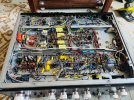
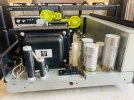
IMG_1720.jpegIMG_1724.jpegIMG_1721.jpegIMG_1734.jpegIMG_1735.jpeg

Just pix I had on my phone but I can take more when I’m home
 
yeah at least one of those cans should be insulated for a doubler config. I can't tell which one, but fair bet it will be a single-section cap, and the outside of the can will be wired to a + terminal on another cap. A diode will also land at that junction. There would also need to be insulation between the can and the clamp.


Overall doesn't look horrible to service, heck of a lot less of a mess than say a Sansui 1000a. Agree it looks like a pretty nice job overall. If all it "needs" is some heat shrink over a cap, not a big deal.
 
@gadget73,

The 111 isn't what I'd call easy to work on, but is a damn sight easier than the 1000A, or the AU-70, both of which are pretty nasty due to space constraints. Keeping in mind the 111 sits on a larger chassis, and of course has no tuner stage to add to the component density.

The AU-70 is on a standard sized chassis (identical to most small to medium output receivers Sansui made) so everything is much tighter in terms of access. It also runs at the highest voltage of any of the above, owing to it's utilizing 7189A outputs. I do not relish poking around that one.
 
my notion of "horrible" is probably somewhat worse than what other folks would label it. Consider the first tube thing I ever re-capped was a 1939 Philco radio with the Mystery Control and a heap of rotten rubber wire. The second was a TV set, then I did several Euro radios. All of that is what I'd consider horrible. This may not be the easiest thing to deal with, but its not layers deep, so not the end of the world.

I will say I haven't felt motivated to do a TV or Euro radio in a long time. At some point it goes from an interesting challenge to a royal PITA, and for me once it stops being fun, I'm not interested anymore.
 
@gadget73, oof. You definitely got started on tube resto's the hard way. The worst job I've done to date is recapping the tone generator in a Hammond model D organ. Mostly on account of the time involved. Access wasn't so bad (though the amount of disassembly required to get into the tone generator itself was no fun). I've been working on a 1953 Sansui Q-3535 power amp, and it isn't terrible, but I've been taking it slowly in fits and starts. I probably should just bite the bullet and choose a weekend to finish it up.
 
There appears to be some kind of polymer or polymeric gasket between the cans of those four caps and the clamps holding them to the chassis. This would likely serve to insulate the common/can from the chassis on the "upper" doubler cap, which ever that one is (probably one of the two back caps) and avoiding a short in the high voltage DC supply. Take your DMM meter and (carefully!) check DC voltage between the cans of the caps and the chassis and you'll find the "live" one. That one should be insulated. I've seen it done with large diameter heat shrink tubing or a re-purposed cardboard cover from another insulated can cap that was replaced.

That is indeed nice looking work on the restore, but that can should not have been left un-insulated, as you can no doubt testify!
 
There appears to be some kind of polymer or polymeric gasket between the cans of those four caps and the clamps holding them to the chassis. This would likely serve to insulate the common/can from the chassis on the "upper" doubler cap, which ever that one is (probably one of the two back caps) and avoiding a short in the high voltage DC supply. Take your DMM meter and (carefully!) check DC voltage between the cans of the caps and the chassis and you'll find the "live" one. That one should be insulated. I've seen it done with large diameter heat shrink tubing or a re-purposed cardboard cover from another insulated can cap that was replaced.

That is indeed nice looking work on the restore, but that can should not have been left un-insulated, as you can no doubt testify!

I know what one is live as it zapped the living crap of me, I may measure the DC on it to see what I got hit with. Ill have to dig the amp out this week, its put up right now as I dislike the RCA input jacks on it, they seem to be larger than standard RCA jacks.

The SQ on the amp is fantastic, one of the better sounding units I have, just huge and hard to put in the rack.
 
@jobrewer1983, I replaced all the RCA jacks on my 111, they are the "old style" that have more of a taper to them then those made after about 1973. Consequently, they don't accommodate modern RCA plugs very well. So far as I'm aware, all AU-111 were fitted with the old.stoyr jacks, as production of the 111 ended before the newer style jacks were ever developed. If you have older style patch cords with the "tulip" style shield on the plugs, they can be made to work. But newer plugs with a full 360° shield ring are near impossible to get properly seated.
 
RCA jacks were developed in the 30s and haven't changed size since then. Seems like someone at Sansui didn't get the memo about their actual dimensions. I believe the 1000 has those same jacks.
 
@gadget73, I've encountered the same problem RCA jacks on other brands of gear from the 60's and very early 70's. Have had little exposure to gear earlier than that, excepting my SP-220/Q-3535 combo from 1953. Further, I don't think Sansui made those jack panels in house, they were supplied by an outside vendor, and assembled onto finished products by Sansui and others. It may well be that it was a uniquely Japanese issue, can't say that I've ever found any domestic (US) made gear that have the oddly sized RCA jack issue.
 
Last edited:
Back
Top Bottom