• The move to the new server is done. There are some software and database maintenance updates in process. This has us passing the hat around to help out. We appreciate any donations. Seriously, even a dollar helps. The payment page may be found here - https://www.audiokarma.org/support.html

Sansui AU-666 speaker selector off but audio coming through left channel

ter5je

New Member
Hi, first post here, new at this so apologies if I get something wrong.

I have an AU-666 in good working order, been using it for about 10 months with a pair of JBL 4101s. Yesterday while I was playing music, something happened to the sound, where the sound stopped coming through the right speaker. I stopped and checked the speakers, switching them between left and right and moving them over from B to A, to see if it was a speaker or wiring issue with the speakers, but what I found is that it’s back at the amplifier.

When hooked up to A, sound will come through the right speaker on all speaker selector settings: Off, A, B, A+B. While the left will only work when on A and A+B. When the speakers are hooked up to B, there is sound on both speakers when speaker selector is on A+B, only the right speaker on B, and A and Off are nothing.

I’m at a loss. I had a look at the connector switch. It’s clean and no signs of frayed wires that I can see. Can anyone provide any ideas about what might be wrong? Thanks in advance!

(Edit: Accuracy)
 
Last edited:
Register to hide this ad
Sounds like a problem with one or more contacts on the rotary switch for the speaker system selection. If this just happened suddenly, did the switch action feel off (difficult to turn, crunchy, other anomalous chsracteristic)? These switches tend to be pretty reliable unless messed up during service and repair work, out of many dozens of pieces of gear I've used over decades, I've never had a rotary switch just fail spontaneously without there being some previous damage to it.

I suppose it's also possible an internal short on a circuit board or wiring terminal could conceivably cause this issue, but that strikes me as a real stretch; more so than a bad switch.
 
Thanks so much for your help!

There hasn’t been any grinding or scratching noises when using the switch. It’s generally been working fine, smooth to turn and so on. I do remember a couple of weeks ago having speakers in both A and B and when going from B to A, the left speaker wouldn’t engage on A. I’d just go all the way to off and back to A, and it would work. It only happened a 2-3 times.

I have no idea if anything is amiss with the internal workings of the switch.

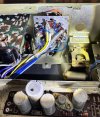
I added a photo of the switch, if it helps. Really appreciate the help.
 

Attachments

  • IMG_4478.jpeg
    IMG_4478.jpeg
    162.2 KB · Views: 16
I can't tell much from the picture, unfortunately. As there looks to be more than one section (wafer) I'm wondering if the moving contact rotor for the right channel has "rounded out" in the center and is no longer being turned by the shaft (which is flatted on two sides, and inserts through a slot in the center of the moving contact rotor), thereby leaving it in one position at all times, while the left channel contact continues to rotate through its different positions as the knobs gets turned.

Try looking at the internal part of the switch while turning the knob, and see if you can tell if the moving contact on both sections is actually moving while doing so. If one isn't, then that's the cause. Problem is that a repair would be tough. The center portion of the rotor is plastic, and if it split or rounded out, I'm not sure there is much than can be done to repair it, short of just trying to epoxy it back together and to the shaft, which would make any future non-destructive disassembly of the switch impossible.
 
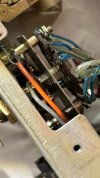
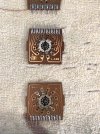
Thanks again for all your help. I took a look inside the switch, turning through each speaker option. The rotor on the outside, the one seen in my poorly taken photo didn’t seem to have a problem, but there was something moving on the inside rotor. It seemed loose and a with a pair of tweezers was able to take it out. It was loose - disconnected from something. It looks like the contact part on the rotor. I’ve attached a photo of it. Now only the right speaker works on its correct selection settings.

I have no idea if it’s possible to attach again? took a photo of roughly where the piece came from, I hope helps explain.
 

Attachments

  • IMG_4482.jpeg
    IMG_4482.jpeg
    134.3 KB · Views: 18
  • IMG_4481.jpeg
    IMG_4481.jpeg
    88 KB · Views: 17
If I’m not mistaken the slider is broken…
Here is a wafer from an other switch , it’s the metallic slider that slides through the contacts .
IMG_5250.jpeg
If I’m not mistaken , the rest of the slider should be in the switch still???
I don’t think it is going to be easy finding a switch on eBay or anywhere else ….
IF it’s what I’m seeing, then you need to disassemble the switch , get the part that is still in , put it together with the one it’s fallen off , measure the thickness of the metal , get a metal sheet at the same thickness
( not aluminium) , put together the broken part , draw the shape of the part on the metal sheet , use Dremel to replicate a new one…
Not an easy task but I don’t see any other way .
Take a lot of photos/notes when you start disassembling…..
 
It may be possible to reattach that metal contact piece to the plastic disc it came off of (the retainer points on the plastic disc have failed), but will be a difficult operation entailing complete removal and disassembly of the switch and then having to use an epoxy to adhere it to the plastic (assuming that piece isn't damaged beyond being able to do so), all while maintaining it's alignment so that it is positioned correctly on reassembly.

I'd consider it an advanced operation, not something to be taken lightly by someone without pre-existing skills in this type repair work. I'm not sure what your comfort level/capability is, so don't know how to recommended proceeding.
 
This is a bit like watch repair. I suspected a piece had broken off and was interfering with the circuit path. How many speakers do you want to attach to your amp? A temporary work around would be to attach the feed wire from F-1334 to the wires leading to the terminals so that they are "always on." You can attach either or both sets, disconnecting the speakers at the back as you need. If you want to disassemble that switch, download the schematic for the AU-666 and see the logic of the signal path. The signal path of other switches in that Sansui line is similar, I just don't know if they would physically fit.
 
Thanks so much for all the feedback Sui-Yogi and Sansuiman. I’m basically at the stage you described Sansuiman. I’ve got the selector disassembled. The plastic disc is still in one piece, as you said the retainer points failed.

I managed to put it together without using any epoxy and got it to play, but once I move the selective the metal things obviously don’t stay on so well.

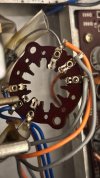
It looks like I need to reattach the metal things while the plastic disk is in the selector, rather than being able to do it outside. This is beyond anything I’ve done before, so if you have any tips or advice on how to approach it that would be a huge help.

Added some photos to hopefully help show what I am trying to describe.
 

Attachments

  • IMG_4486.jpeg
    IMG_4486.jpeg
    141.7 KB · Views: 14
  • IMG_4487.jpeg
    IMG_4487.jpeg
    80.7 KB · Views: 14
Yes, the metal pieces have to be reattached with the plastic disc in-situ. Obviously the positioning of the 3 metal contact sections is critical, as is alignment of the slot in the disc to the shaft on reassembly, or the switch will be "out of sync" relative to the physical position of the switch.

As to reattaching the contacts to the disc, both the plastic and the contact will have to be completely clear of any grease, oils or other surface contaminants. If there is any portion of the plastic retainer points left sticking up from the disc, it should be possible to put the contacts back in place and sparingly use a two part epoxy to adhere them to the disc, letting it cure fully before reassembly.

I don't know what sort of longevity you might expect from such a repair due to mechanical stresses placed on the switch during rotation, but the only other solution is to find a compatible switch assembly form the same or similar model of amp. That may take a while, and likely won't be cheap when it does turn up. By my best guess, AU-666 and 888 are the likely suitable parts donor models.

AU-555A uses individual toggle switches for speaker controls, so that one is out. AU-999 may also be a possibility, but verification by comparing schematics for the switches being considered will have to be done to ascertain compatibility. Differences in physical fitment (shaft type and length) also need consideration when looking for substitute parts sources.
 
Last edited:
Thanks Monicker1, it’s good to know there’s a potential work-around. Most days I only run 1 set of speakers through this amp. I’ll take a look at the service manual and see if it is something I can potentially handle.

I reckon I have little chance of lining up everything perfect on the disk, the retainer points are pretty much gone. Someone with more skills than me may be able to handle it, I’ll check around my area first, before I have a go. Will keep my eye out for a replacement part too, seeing as even if it can be fixed it will probably fail again soon . Thanks for all the fantastic advice Sansuiman, really appreciate it!
 
One other possibility worth consideration if finding a replacement switch isn't possible would be to get a bog standard rotary switch with the correct number of positions (or one that is adjustable to have the needed number) and use it to selectively power relay coils, using 2 pole relays to switch the L+ and R+ outputs, using a separate relay for each speaker system. A small circuit board with the relays, some rewiring, and maybe a small add-in power supply (if the existing PSU lacks adequate headroom for powering two added relay coils) would do the job nicely, while retaining full functionality of switching speaker systems and maintaining a stock look outwardly.

In fact, I employed a similar mod on a Pioneer receiver many years ago that had a missing rotary speaker selector switch, and while I could find the matching knob, at the time an OE switch was quite elusive anywhere (including eBay). Turned out very nicely, and saved a unit that otherwise would've been hacked up to try and salvage it, or just parted out. This would be better than hardwiring a speaker output to be always live.
 
That sounds like a good option to explore, as not much came up in my search for a like-for-like replacement on eBay and the like. Thanks heaps for the advice!
 
Back
Top Bottom