• The move to the new server is done. There are some software and database maintenance updates in process. This has us passing the hat around to help out. We appreciate any donations. Seriously, even a dollar helps. The payment page may be found here - https://www.audiokarma.org/support.html

Sansui AU-70 Tubes Replacement and Alternatives

I have recorded the hum before I pulled out the "suspected" tubes:

https://1drv.ms/u/s!AqmHA7OHJwtnhrgljQy-Dd85hdJBNg

Any idea?

That's not hum, that is oscillation. If you hear a noise like this you need to turn off the amplifier immediately or it can be damaged.

It can be as simple as dirty controls, bad cables, a loose wire, a bad component, dirty switches, etc. Good idea to let a tech look at it! I still think it is not the tubes.
 
yeah thats an ugly noise. Something is very unhappy there. If this is all original Japan-built from the 1960s, you're probably well overdue for some component replacements anyway. The caps they used were not amazing 50 years ago and they don't get better with time.
 
Noted. I will find a repair specialist (there are a few quite reputable ones here) to take it over.

In relation to this, there is a seller of a vintage Marantz integrated SS amp bought in 1973, who claims that his unit is never serviced, never mod, everything is in stock form, and the amp is still working flawlessly. When I asked if I would need to recap it if I buy it from him, he said, "If it ain't broken why fix it?" —Is this possible?
 
Noted. I will find a repair specialist (there are a few quite reputable ones here) to take it over.

In relation to this, there is a seller of a vintage Marantz integrated SS amp bought in 1973, who claims that his unit is never serviced, never mod, everything is in stock form, and the amp is still working flawlessly. When I asked if I would need to recap it if I buy it from him, he said, "If it ain't broken why fix it?" —Is this possible?

It is completely possible it works fine, especially if it was not used much. That said, electrolytic capacitors that old are on borrowed time, and it is inadvisable to rely on such old parts.

Another way of thought though is personally I would way rather buy a "virgin" amplifier like that than something which has been serviced by an amateur or unknown tech. Better to be in control of what has changed and what stays the same.
 
I had one of those amps...and they are complex to the point of being scary. Also, the film caps employed in that amp are also a risk; they failed by leaking DC. And there are a lot of them in that amp. Also, as just an FYI, those output transformers are with cathode FB windings. This complicates the circuit. It is useful, but lifting the hood to look inside is going to be scary. Good luck with the quest for a skilled technician.

Douglas
 
I had one of those amps...and they are complex to the point of being scary. Also, the film caps employed in that amp are also a risk; they failed by leaking DC. And there are a lot of them in that amp. Also, as just an FYI, those output transformers are with cathode FB windings. This complicates the circuit. It is useful, but lifting the hood to look inside is going to be scary. Good luck with the quest for a skilled technician.

Douglas
Yeah I won't touch anything inside, will get a good tech to go over it, I think best to change everything that's degradable, since it has never been serviced before.
 
A side question: I bought this AU-70 at around usd600. Can I find any newer tube amp, at used price that's between $600-800, with a sound quality that's on par with the AU-70? Or, another way to ask this question: at 55 years old, can the AU-70 rival modern tube amps at this (used) price range?
 
A side question: I bought this AU-70 at around usd600. Can I find any newer tube amp, at used price that's between $600-800, with a sound quality that's on par with the AU-70? Or, another way to ask this question: at 55 years old, can the AU-70 rival modern tube amps at this (used) price range?

It depends on how good of a deal you get, and your local market. I would say you could do better but also much worse depending on how motivated the seller is. Also, the AU-70 has collector's value because vintage Sansui is popular, so you can easily sell it. This is an advantage not all newer gear will possess.
 
An update:

I brought back the AU-70 to the seller and test at his place, and, there was not a single problem, smooth music flows, not a bit of noise, and, he was using generic cables. o_O

I was perplexed, not knowing why it produces that awful noise at my place. The original owner suggests I check the interconnect cables and use some contact cleaner.

Back home, I did as said. To my big relief, it sounded good now! So no need to bring it to fix. :beerchug:

One thing I observe: those RCA connectors on AU-70 are a bit shorter than modern ones, I can't use the better RCA cable that I bought, and I have to find an older cheap cable that can fit better–and it works. I'm thinking of changing them to newer ones - is it worth doing this? This AU-70 is still in its original state, except the 4 main capacitors was replaced some years ago by the owner himself, and of course the tubes.
 
At least change the four coupling capacitors which are between the output tube grids and the driver tubes, if they are original. If those are left in place it is only a matter of time until one leaks and causes a tube melt down.

As for the connectors, I would suggest against changing them, because it can end up doing more harm than good, and it alerts the next owner that they are buying a "modified" amplifier, which can actually harm value.
 
At least change the four coupling capacitors which are between the output tube grids and the driver tubes, if they are original. If those are left in place it is only a matter of time until one leaks and causes a tube melt down.

As for the connectors, I would suggest against changing them, because it can end up doing more harm than good, and it alerts the next owner that they are buying a "modified" amplifier, which can actually harm value.

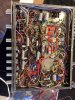
Do you refer to the two blue ones and the two silver ones? (photo from the web...)

RELvVVU.jpg
 
I found this with many photos, maybe you can point me to the relevant one:

https://audiokarma.org/forums/index...-tu-70-my-first-sansui-tube-adventure.691556/

In that amp, they were already changed - In yours if these four are still the grey Suzuki capacitors, better change them ASAP! Changing those four capacitors is the minimum work I would do to this amplifier before using it. Really for best performance ALL the grey capacitors should be changed, but any one of those four can create big problems.

See the red rectangle in the photo below, where these four caps have been changed and are different from all the others:

sansuitube1.jpg
 
Back
Top Bottom