• The move to the new server is done. There are some software and database maintenance updates in process. This has us passing the hat around to help out. We appreciate any donations. Seriously, even a dollar helps. The payment page may be found here - https://www.audiokarma.org/support.html

Sansui AU-717 rebuild

I took voltage readings of all the transistors for the left channel on board 2720. Each transistor has a voltage that is off highlighted in bold. The correct reading is in brackets.

TR1 E -32vDC (0.7v)
TR3 E 33vDC (0.72v), C -32vDC
TR5 E -32vDC (0.72v), C -32vDC
TR7 E 33vDC (0.7v), C 33vDC
TR9 E 33vDC, C -32vDC (-1.0v)
TR11 E 33vDC (0.2v), C 32vDC
TR13 E 32vDC (-1.0v), C -32vDC

I also removed the preamp switch board 2670 and re-flowed the solder but no change.
 
Last edited:
1. Double check D01 - should be two 1N4148 in series (C->A->C->A)
2. TR7 E 33vDC (0.7v), C 33vDC --> C should be at 0.7V
3. Compare B reading at TR3 and TR7 -> Compare with right channel (TR4 and TR7)

Do you have any power connectors disconnected? (Example EQ board power left unconnected or loose). This amplifier needs all power connectors installed for proper ground. Double check this.
 
I finally have it sorted out. I took voltage measurements on the tone and equalizer boards and the C or E leg that should read less than 1 volt on each transistor were reading way too high. I went back to the 2720 tone board and started re-soldering the connections probably for the third time. Then I found a strand that was touching another connection which was probably the culprit. After I cleaned up the two connections I checked the voltage on TR01 E and it now reads 0.7VDC. I hooked up two speakers with a CD player and both channels are now working. This week I will order the TTC004B transistors so I can run it in and set the bias.

I have a pair of rack handles that could use some paint. What brand and colour spray can is a good match these days?
 
I went back to the 2720 tone board and started re-soldering the connections probably for the third time. Then I found a strand that was touching another connection which was probably the culprit. After I cleaned up the two connections I checked the voltage on TR01 E and it now reads 0.7VDC. I hooked up two speakers with a CD player and both channels are now working. This week I will order the TTC004B transistors so I can run it in and set the bias.

If you don't want to go through all of that in the future, do what I do.

After every part I solder I clean the flux off, then I use my meter to check for shorts between every solder joint near my work to ensure there are no shorts.
This takes only a little time, but saves plenty of time if I have to start looking for something I did wrong.

Glad you found the problem.
 
Glad you found it - Sound advice from @kwayde, I do this with all restorations/repairs. Solder, clean area with IPA and then inspect work with a magnifying glass. If something does not look right, test with meter for solder bridges or poor connection due to lifted pads.

Anyway - glad you found the issue and its working now. On to the next board....

I have had good luck with Krylon Satin Black paint.
 
Should TR 1-4 on the power board 2663 have thermal pads installed? When I removed the transistors there were no pads.
 

Attachments

  • 20250509_194335.jpg
    20250509_194335.jpg
    175 KB · Views: 23
Thank you. I removed the pads.

I will look into powder coating .

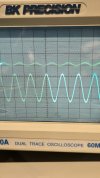
I put a 1Khz signal throught the aux input and the sign wave on the left channel is much smaller than the right. If I hooked up the amp the sound is cutting in and out on the left. Can someone give me a hand to trace the issue? Let me know what information you need.
 
Last edited:
One step forward two steps back.

This morning I pulled the driver board to add some thermal grease to the brackets. Then I thought it would be a good idea to add isolation pads to TR1-4 on T-2663 which I ended up removing and now my left channel has crackling and the volume comes in and out.
 

Attachments

  • 20250601_201648.jpg
    20250601_201648.jpg
    78.4 KB · Views: 19
  • 20250601_201700.jpg
    20250601_201700.jpg
    95.8 KB · Views: 19
So when I put a 1Khz signal in the Aux input I get the attached on the scope. The top sine wave is the left channel. Any suggestions on how to trace this?
 

Attachments

  • 20250601_142114.jpg
    20250601_142114.jpg
    78.6 KB · Views: 5
I decided to replace all the left channel (odd number) transistors on the 2720 tone board and everything is working again. It is all bundled up and burning in. Very happy with the results.
 
The AU-717 has been working great until recently. When I turn the unit on the right channel is muffled and within the first minute it would clear itself up and sound great.

I have a power amp so I flipped the switch at the back to separate the preamp from amplifier section. The right channel issue is present when I used the preamp of the AU-717. I do not have a preamp so I cannot test the amplifier section.

Assuming the preamp is the issue should I be investigating the 2720 tone board?
 
The right channel is now very faint. There is no short when running it with a DBT and the relay does connect.

I took some meter readings and so far nothing seems out of place

F-2721
pin 1 0V
pin 2 0V
pin 3 0V
pin 4 6.2V
pin 5 58.2V
pin 6 -58.2V

F-2722
pin 7 0V
pin 8 0V
pin 9 0V
pin 10 6.2V
pin 11 58.2V
pin 12 -58.1V

F-2663
pin 13 26.1V
pin 14 43.6V
pin 15 43.6V
pin 16 43.6V
pin 17 43.6V
pin 18 25.7V
pin 24 34.4v
pin 26 -33.4v

F-2720
TR02 c-32.7V, e0.7V
TR04 c0.7V, e33.7V
TR06 c-33.1V, e0.7V
TR08 c0.7V, e33.6V
TR10 c-0.9V, e-33.2V
TR12 c34.4V, e0.1V
TR14 c-33.2V, e-0.3V
 
Last edited:
Possible to scope out the signal path based on service manual? Some transistors can start to fail without affecting voltage readings.
 
Tonight I decided to pulled the F-2720 tone board and replaced the right channel (positive) transistors and now it is working again. I checked the transistor with a Atlas DCA55component tester and non of them showed as faulty so I am not sure which where the problem units.
 
Back
Top Bottom