• The move to the new server is done. There are some software and database maintenance updates in process. This has us passing the hat around to help out. We appreciate any donations. Seriously, even a dollar helps. The payment page may be found here - https://www.audiokarma.org/support.html

Sansui au-919 & ventilation

The Sansui au-919 is rack mountable & there are many pictures online where other gear is stacked on top of an AU-919, such as the TU-919. But my (very reputable) tech warns against placing gear on top of the au-919. He argues that the heat sinks of an AU-919 are somewhat too small for the machine, and that there should be about 4cm free space on top to allow for air circulation.

My amp is now completely restored and recapped, so the warmth it generates now is how it's designed. It becomes quite warm to the touch but not hot. My plan is to place an MA7 on top of the AU-919, on its feet, but now I'm not sure anymore.

What are the views here?
 
Register to hide this ad
Put a thermometer on top over the heat sinks and keep us informed.
Don't do anything else yet.
After running for a few hours at moderate levels the temperature right above the heat sinks has stabilised at around 36 celsius.

This is correct behaviour for an AU-919, you should provide at least a 4cm gap at the top for ventilation, but also make sure that air flow into the bottom of the case is similarly unrestricted.
The original feet are 12mm high... I'm really not sure if I want to go all the way and place wooden blocks underneath it. Happy to hear suggestions from the community about ventilation underneath the amp.
 
After running for a few hours at moderate levels the temperature right above the heat sinks has stabilised at around 36 celsius.

The original feet are 12mm high... I'm really not sure if I want to go all the way and place wooden blocks underneath it. Happy to hear suggestions from the community about ventilation underneath the amp.

I'm sure Hyperion would agree that there's no need to raise the AU-919 higher than its feet provide for. Rather, not to place it on a soft surface such as a carpet and not on top of another unit that runs more than a very few (preferably nil) degrees above ambient temperature.

My 919 has survived over 40 years standing directly on a shelf in a cabinet having an open front and cut-away back to encourage air through-flow. Currently it has 60 mm clear space above, but has spent most of its life with around 45 mm.
 
For anyone who is interested: I bought a DHT22 temperature sensor, and taped it directly above the heatsinks of the AU-919. There is 4 cm free space above the amp:

upload_2022-12-22_22-55-37.png

The sensor is connected to a raspberry pi. It measures the temperature every 5 minutes and writes the data to a Google Sheets file. These readings can then be put in a diagram. The following are two of such day readings. You can see exactly at what time I turn on or off the amp.

upload_2022-12-22_23-0-32.png
upload_2022-12-22_23-3-46.png

The temperature stabilizes at around 39 celsius. At this temperature the amp feels quite warm to the touch but definitely not too hot to touch.

The next experiment is to set some kind of warning threshold, if temperature exceeds 42 celsius or something.
Another experiment that I'd like to do is remove the 4 cm space and simply put the other machine on top (an MA7 on its feet). I am quite curious if there is a change in temperature to be seen in the readings.
 
Last edited:
The temperature stabilizes at around 39 Celsius. At this temperature the amp feels quite warm to the touch but definitely not too hot to touch.

Yes, excellent work!

I'd also be interested to know how the temperature varies with load, if you feel inclined. Measuring at between, say, 9 o'clock and 12 o'clock on the volume control might be enough to show the trend.
 
That's a good idea. I was thinking of doing something similar to monitor/log amp bias over time, while an amp is in use.

Probably more work than it's worth, but it would be interesting to see.
 
Putting anything on top of an amp that ventilates on the top is a bad idea, period, IMO.

I am very happy for @Multimode that his 919 has done well with less than 2.5 inches of space above it, but I would want more. The output transitors are unobtanium, so why risk stressing them more than necessary?
 
The output transistors are very capable of handling heat, and don't usually degrade from this cause over time unless the heat is very high indeed.

Our man @Multimode has the small comfort of knowing that I reconditioned his AU-919 :king:, and remounted the output transistors with the right amount of heatsink compound, and with the correct fixing screw tightness. Other measures to improve airflow were taken during the restore, mostly due to more modern (smaller) electrolytic capacitors, (improving airflow), and raising hot components up on ceramic beads to improve temperature stability and shed heat faster. I happen to know he doesn't connect multiple speakers to the AU-919, and doesn't often turn the volume up to high levels - so I think he is fine with his AU-919 ventilation how it is. ;)
 
Last edited:
With the new (higher performance) driver transistors, mine now can sometimes get to 120 f over the heat sinks. But that's if I have it on for a few hours. It doesn't make it to 120 f very often though.
 
… the right amount of heatsink compound, and with the correct fixing screw tightness.
Could you explain a little about how you apply the right amount of compound, and the correct screw tightness?

When I’ve done my rebuilds I usually cut up an old credit card and use it to spread a thin, even layer of Dow thermal paste. I cover the underside of the transistor, as well as one side of the mica (the side that will be touching the heat sink). Then I install the screws and tighten them a little at a time, alternating back and forth until they feel ‘right’. By this time a small amount thermal paste has squeezed out from under the transistor and under the mica.
 
Last edited:
Could you explain a little about how you apply the right amount of compound, and the correct screw tightness?
I don't do anything much different from you. However for the last 15 or so years of my career I was upgrading or repairing computer servers, after dismantling and re-assembling several thousand of these (including their CPU's +heatsink compound), you get a good feel for what is right screw tightness-wise. As you correctly say, you need to see a small bead of compound squeezing out from underneath the output transistor, if you have the right amount of compound there won't be much.
 
Last edited:
I took my temperature measuring project to the next level by adding a small display. It is a waveshare epaper screen, connected to the same raspberry pi mini computer. As soon as the temperature reaches 25 degrees the screen is turned on. It displays the temperature in Celsius and the timestamp of the last measurement. Every 10 minutes the info is refreshed. When the temperature drops below 25 degrees the screen is turned off again.

upload_2023-1-13_14-28-53.png

This was a fun technical project, which involved some programming in Python and Linux. If anyone is interested in further technical details please feel free to send me a direct message.
 
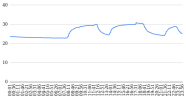
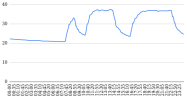
A few weeks ago it got quite warm here in The Netherlands. As a consequence the temperature of the amplifier easily reached 40C. I wasn't too happy about that, so I decided to get a fan. It is the "noiseblocker blacksilent pro pk-1", which is pretty much silent. I placed it directly above the heatsinks. You can see the fan, next to it (small) the thermometer, and in the bottom left the screen that displays the temperature:

1688329180106.png

The difference is really big. The amp remains cool to the touch after hours of playing. This is also confirmed by my temperature readings. The fan seems to cool about 10C.

Yesterday (1st July 2023), with fan

1688328331500.png
One month ago (24 May 2023), without fan

1688328681052.png
 
Last edited:
Back
Top Bottom