• The move to the new server is done. There are some software and database maintenance updates in process. This has us passing the hat around to help out. We appreciate any donations. Seriously, even a dollar helps. The payment page may be found here - https://www.audiokarma.org/support.html

Sansui AU-999 DC problems?

Sp33ls

AK Subscriber
Subscriber
Hey all!

First of all, thanks for all the assistance. There's so many great resources here on these forums for this little amplifier. I've replaced all the electrolytics, and the usual problem transistors. I've even swapped some of the larger value resistors with new, Vishay metal film.

I've applied a few of the recommended mods to the amp -- with Kev's pre-amp mod being one of them, of course.

I recently applied Trnsfmr's bass mod.

However, I'm not sure if I misplaced the polarity of a capacitor or something... I'm observing this phenomenom where when powering on and off the amplifier, the speaker cones slowly move out and in.

That being said, if I did stick a cap in backwards, wouldn't it have popped by now?

I've uploaded a video here with the DC measurements attached to the speaker. You can see it turn on, I move the volume knob (which forces the cones to move), and I power it off.

Interesting to note: once the amp is on for over half a minute, the volume knob does not have this effect, and the amp sings beautifully. Also, this effect occurs when I use the AU-999 as a pre-amp, and have the speakers connected to a separate power amp.

This leads me to believe that there's something going on in the pre-amp section.

I have not tried to re-bias the amp since doing the bass mod, but I thought this was a bit odd. Any thoughts?
 

Attachments

  • IMG_20181105_102202.jpg
    IMG_20181105_102202.jpg
    125.4 KB · Views: 46
  • IMG_20181105_102310.jpg
    IMG_20181105_102310.jpg
    134.5 KB · Views: 44
Register to hide this ad
check and make sure the protect circuit is working properly. The relay shouldn't engage until after 5 seconds or so. If it engages immediately, check for issues in the protect section. If the protect is operating fine, check for DC volts using your meter at the input of the power amp stage, as you turn the volume. If you see DC above 0.010 volts, look for shorted small value caps (1uf, 2.2 uf, 3.3uf, 4.7 uf in the tone amp or controlamp sections. It could also be shorted connection on the circuit board after cap replacement. Another logical place to look for DC is on the tabs of the volume control. there are 2 wafers in parallel. 1 outside leg on each wafer is connected to ground. The center leg is the adjustable volume, and the 3rd leg is full volume coming from tone circuits. You may also have a fourth leg used for the loudness function. none of the legs on the volume control should have any DC on them above 10 mv. If you have more, look for shorted small caps that you replaced, or shorted connections.

Lastly, does this happen on both channels or just one?
 
Thanks for the quick reply, I'll have to take a look at those later.

It happens on both channels, and without measuring, it seems to be to the same effect.
 
Better to install Bi-polars there.

No loudness or relay on the 999 Tom.

Good point. Maybe I'll just go ahead and make an order from Mouser (I have to place another order anyhow), and replace all of these with bi-polars.
 
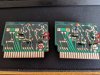
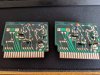
I think the red ringed bits really need to be tidied up, and maybe sleeving added for some - sorry to be a nit picker. :(
AU999pica.jpg
AU999picb.jpg
 
It is quite normal for the speakers to move as the DC drifts when the amp is powering down, same when it powers up but not quite as bad.

I always turn the speaker selector off when powering up or power down an AU999, and pretty much any amplifier that does not have a speaker/protection relay.

You need to tidy up that work with those caps on the back of the board, use some plastic sleeving.

If you want to observe the difference and eliminate the preamp boards as a suspect, just pull those boards from the amp and turn it on with those boards out, I am pretty sure it wont make any difference.
 
Also support using some sleeving on those cap legs.

Sansui originally did this on any point-to-point component legs for resistors and caps, so you want to follow how they did things.
 
Hey!

cool to see that mod getting done! Yea I was just going to chime in on the protection circuit on these models. It is garbage. It will save your speakers by shorting the outputs of the amp. I cut all 3 wires that go to the protection and cap them with heatshrink. The DC drift on power up with these amps is perfectly normal because it has no relay to engage the speakers AFTER the DC has settled. As kevzep says, just turn off the speaker selector switch for the first 10 seconds or so.
 
Hey!

cool to see that mod getting done! Yea I was just going to chime in on the protection circuit on these models. It is garbage. It will save your speakers by shorting the outputs of the amp. I cut all 3 wires that go to the protection and cap them with heatshrink. The DC drift on power up with these amps is perfectly normal because it has no relay to engage the speakers AFTER the DC has settled. As kevzep says, just turn off the speaker selector switch for the first 10 seconds or so.
Nice to see you here!! I used to email Jim quite a lot, we had many email discussions over the years...He was a great man.
Good to see you carrying on the business!!

yeah the crowbar circuit, there is a chance in the event of a catastrophic failure that you could end up with the full DC rail voltage on your speakers, so I think Sansui used this common protection circuit as I guess they figured it was easier to replace a couple of transistors than fry your speakers.....
 
Thank you for the kind words about my pops.

I feel that in most situations these days you're better off saving your ~$1000 restored amp than maybe saving some speakers. Also shorting the outputs will often take a lot more with it than just the outputs. The 999 could use a slightly beefier rectifier, I have seen quite a few of them blown in my day. In other words, output --> drivers and rectifier too. In most cases at least. Back then I suppose that speakers were probably about half the value of your system, I feel if you're using restored vintage gear these days that is pretty unlikely. Also, how do you safely test one of these prot. circuits short of hooking up a adjustable power supply (with short protection) to its inputs and cranking the voltage up? Definitely can't test it in circuit since they don't do anything till the voltage gets over/under ~3V or more. Also if it activated it would destroy your amp...

p.s. It occurs to me that this is sort of like driving off a cliff to avoid a car wreck.
 
Last edited:
Does removing the protection circuit add any benefits?
Apart from not potentially taking out the output transistors, no not at all, no audible difference removing it.

I leave them in the AU999's I work on, I think its foolish to not have your speakers protected from DC.
But if the customer wants it removed I remove them.
 
Hi trnsfrmr_jr - I'll echo Kevzep: Nice to see you here ! Awesome that you suffixed "junior" as your username - I too was fortunate to correspond and learn alot from your dad - he was a real asset to our community and is missed.

Glad you agree that the rectifier should go, especially when you uprate your supply caps, otherwise you are leaving a Time bomb in there. "See you around"
 
Glad you agree that the rectifier should go, especially when you uprate your supply caps, otherwise you are leaving a Time bomb in there. "See you around"

Until the day I actually take out one of those rectifiers on the load bank, I'm leaving the originals in there.....I have done about 5 or 6 AU999's only one has a uprated rectifier, they all have 10,000µf caps .....
I was playing my "test track" which can send any amplifier running for the hills, at beyond full power, it has some very hard and nasty transients to boot, slightly clipping for about 2 hrs, and no problems.....
Do the work, test these things, there could be any number of reasons why a rectifier has failed, mostly I find someone has fitted a larger rated mains fuse or rail fuse which then puts huge stress on the bridge rec and can cause them to fail, this was the case with my AU999 when I got it, it had a 20amp fuse in it!!
 
Apart from not potentially taking out the output transistors, no not at all, no audible difference removing it.

Got it! Yeah, I'll leave it in for now. After several raving reviews, I'm picking up a pair of Buchardt S400s (which are more expensive than the Sansui).

Also, I think I might be selling the AU-999 after I go through and replace the caps with bipolars (or maybe mylars like trsnfmr_jr mentioned to me) and add the sleeves to the capacitor leads, as well as some final touches. It sounds really good... rivals amps that cost much, much more than it (even after the cost of new components). I also love the vintage style and heavy knobs.

That being said... a passive pre-amp into the PS Audio Stellar S300 just sounds superior overall. I managed to snag one, basically brand-new, from a friend for around $900. It's technically Class D, but it must be well-engineered because I don't hear anything wrong with it.

It's just so hard to let go after working on it. I've considered just giving it to a family member like my parents as a Christmas gift or something... just to keep track of it.. ;)

Hi trnsfrmr_jr - I'll echo Kevzep: Nice to see you here !
^This is awesome. I'm glad my post could be a part of your welcoming here. :)
 
It's just so hard to let go after working on it. I've considered just giving it to a family member like my parents as a Christmas gift or something... just to keep track of it..
I sold my heavily modified AU999 to a good friend of mine and he loves it....
It would have been difficult to sell it to a stranger
 
I sold my heavily modified AU999 to a good friend of mine and he loves it....
It would have been difficult to sell it to a stranger
Do you miss it? I'm guessing you might find more satisfaction in knowing that a friend is getting good use out of it.
 
Back
Top Bottom