Looks fine to me - I am very pleased for you!Here are the results of the variac testing of the secondary windings @Hyperion .


Looks fine to me - I am very pleased for you!Here are the results of the variac testing of the secondary windings @Hyperion .

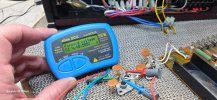
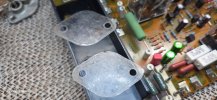

Yes, I think so, if the short were C-E, but probably not if B-E for example.Any outputs shorting to ground would also cause a DBT fail, even with the driver amps isolated, right?

Many thanks, very helpful.@Hyperion is correct, a C-E short will fail the DBT even with the driver amps isolated.
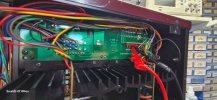
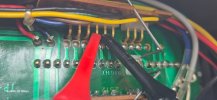
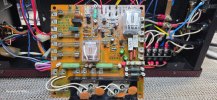
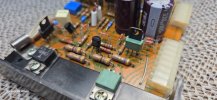
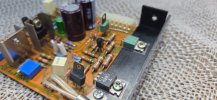
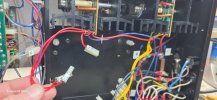
You can quick-check the output transistors for C-E shorts without removing the heatsink assemblies by probing the transistor case (C) together with the orange wire on the output board (E) shown in your last photo above. Because the transistors are in parallel you only need to test one to test all three, so test one of the NPN's on the front side of the heatsink and one PNP on the back, for each heatsink.
To properly isolate the load from the unregulated supply when testing with a DBT, disconnect terminals 7 and 8 (output stage) and 29 and 30 (driver stage) on F-2511.
Just saw your last post re: shorted outputs. Old uniwatt pre-driver transistors a common cause for shorted outputs.
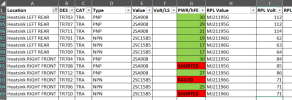
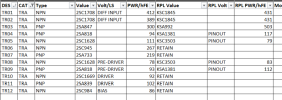
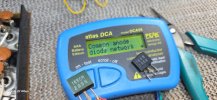
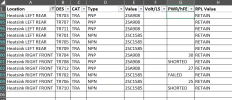
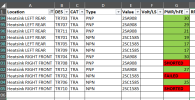
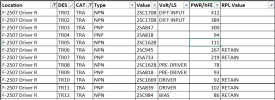
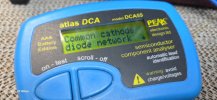
The shorted ones, literally shorted all 3 (CBE) leads. The failed one registered as a diode so one side was open.Just wondering what your failed criteria is in the above chart? If it helps I have 1 spare 2SA908 and 1 spare 2SC1585.
R34, R35 and /or R36, R37 on driver board usually show signs of overheating with shorted output transistors.