• The move to the new server is done. There are some software and database maintenance updates in process. This has us passing the hat around to help out. We appreciate any donations. Seriously, even a dollar helps. The payment page may be found here - https://www.audiokarma.org/support.html

Sansui Blues - 5000A and AU-919

jdg123

Active Member
OK guys, I'm just a parts changer. I'm a very careful parts changer. I read up all I can, make extensive lists, maps if you will, to the completion of recapping and up dating of transistors and I go in with the idea that I'll do no harm. Most times I hit the mark and I get a working receiver. Twice now with Sansui, I've not been so lucky.


I want advice from people with more experience. I have two very nice units that were not functioning when I started and do not function even after my attempts: a Sansui AU-919 and a Sansui 5000A. IS it worth sending them to one of you experts to bring them back to life or should I sell them for parts.


The outside option is to dig deep and try some suggestions for diagnosing the issues. I don't mind trying but I have no training in circuit design. I have DMMs and know how to use them but that is not like having a notion of what to do with the readings :-)


So, everyone, please advise…


Background on the pieces: AU-919 has had F-2839 driver board both recapped and refitted with this forums recommended transistors, all the other boards are just recapped. All black flag caps replaced. Symptom: dim bulb tester never goes dim. 5000A: complete recap (I just put in Nichicon audio grades at or about the same as was present before). Driver boards are the new style 6013. There I put in for TR801: MPSA18LRAG, TR802: KSC1845 TR804: 2sc4883a and TR805: 2sa1859a and 5W resistors in for the 2W. Symptom: 30VDC on each speaker terminal (dim bulb tester worked/dimmed).
 
Register to hide this ad
Both units, but especially the AU-919 is so nice when it's working well, that just because it fails the dim bulb test, it makes me wince to think of it being taken apart as a parts unit. And the same feeling for the 5000A although in truth (for me personally) not so much.

Both very likely simple faults, well worth taking it to an AK'er with the know how.
 
5000A: complete recap (I just put in Nichicon audio grades at or about the same as was present before). Driver boards are the new style 6013. There I put in for TR801: MPSA18LRAG, TR802: KSC1845 TR804: 2sc4883a and TR805: 2sa1859a and 5W resistors in for the 2W. Symptom: 30VDC on each speaker terminal (dim bulb tester worked/dimmed).

Hey Jdg,
I won't comment on the 919, have to see that one. But, what you say about the 5000A is almost an impossibility. The 5000A is a cap coupled amp, meaning the output is the negative side of the two 2200uf caps on the outputs. There can be no DC there if the cap is working. The amplifier output goes through those caps.

Did you replace the output caps? I just rebuilt a 5000X and put 15,000uf @ 80v on the outputs. I would use no less than 10,000uf. Makes for better low end.

I would guess, either the cap is in backwards, or it's the old, very leaky 2200uf cap.

???
 
Well, the 919 was busted when you started, and remained busted after you changed a limited set of parts. Don't be hard on yourself, you just didn't get lucky and the fault remains. It fails the dim bulb because it draws too much current. That means there's either a problem in the power supply, or something downstream, like a power stage, is drawing too much current. It's a matter of making DMM measurements to try and track down what's probably a bad diode or transistor. There are other possibilities, but that's where I'd start.
 
Hi guys, thanks for the responses.


Hyperion: yes, I think it may be worth the go to try to get them in the hands of a skilled diagnostician. I'll try a separate thread for that. I'm in over my head here.


Trnsfmr: I agree that it seems impossible but there it is. I have to admit that anything is possible but I have yet to put a cap in backwards after 4 years of work. All caps have been replaced…


ConradH: With the AU-919, because it is drawing such current I am afraid that if I fire it up and plod through what for me as a novice would be hours of testing, it is going to burn something up! I have only run it for 20 seconds at a time to be sure it was not going to into proper safety cycle (dim bulb test).


I forgot to mention that I have, and always do, replace the output transistors…with the best that can be found. I do the drivers and the input differential pairs too.


If I could pay someone with the skills a couple hundred and throw in a couple hundred for shipping round trip it seems I could then turn them around for a couple hundred profit. It is kind of a long shot though. Motivation is to keep them from the scrap heap. I'd be just as happy to get a few hundred out of them (thats what I have in) and let someone do that same thing (keep them making music) at their leisure. I'll float that in another thread, if that seems copacetic...
 
Hi guys, thanks for the responses.

Trnsfmr: I agree that it seems impossible but there it is. I have to admit that anything is possible but I have yet to put a cap in backwards after 4 years of work. All caps have been replaced…
.

Well, no offense, but do you want us to help or not? :bye:
I would suggest putting an 8 ohm load on the outputs of the 5000A and turning it on again. Use speakers if you want. An unterminated capacitor with 40v on one side will have voltage on the unterminated side with a suitably high impedance meter. No way will there be enough DC current from a cap coupled amp to blow speakers though, as it is incapable of flowing DC current.

I would guess there might be nothing wrong with your 5000A.

My recently rebuilt 5000X just happens to be on my bench, so I disconnected one of the speakers and hooked my cheap Harbor Freight meter up to the output, and turned it on. Guess what? It slowly came up to 42 volts.

You probably need to adjust the "offset" on your amp, which is quite different for cap coupled amps. Adjust for 1/2 of the rail voltage on the + side of the output cap, which on the 5000 series is around 40-43 volts. You should probably be reading 40+ volts on the outputs with no load. There's a better, more complicated way to do it, but that will suffice.

Give it a try. :whip:

Let's get your 5000A going, and then maybe you will want to try something with the 919. :D
 
:bowdown:OK, you got through to me. I have been obsessing about what I could have done wrong. I reviewed all my before and after pics. I tested all my grounds. gave the thing a whole body and cavity search for any loose parts and connections and so came to the conclusion I had done nothing wrong. It should work. I'm at this point thinking I'm just too dumb to know that that voltage is normal (this is my first cap coupled amp). I went to this thread in the hopes that someone had said as much...:banana:

'Put some speakers to it...:beerchug:

I'll put some images up when I have the thing reconstructed and operating. Many, many thank yous!!!!!
 

Attachments

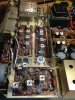
  • IMG_1590.JPG
    IMG_1590.JPG
    78 KB · Views: 68
Good job mate!!! I tell you what, that's a nice looking 5000A inside. My 5000X is nice but yours is almost perfect. I have a 5000A also, playing at a business I am involved in and it was a beater. In fact the whole chassis was bent so bad it wouldn't sit level, and we had to bend it back with some 2 X 4's. It had been left in a basement for 20 years and was also quite corroded, but it works great. Sansuis are survivors.

Let us know how it goes.
 
Back with an update: been just listening to the unit kinda hoping for some cap break in to release the midrange...it is still constricted. Maybe it is just the cap coupling topology, I don't know, I have never heard a unit this old before :-)

I Love the tuner though! It's perhaps the best I have heard.

I have noticed a staticky buzz when there is no music playing. It does not increase as I turn up the volume so I'm thinking it is PSU noise. I am therefore looking at the F1137 board with suspicion. I have recapped but that may be insufficient. Yet I am quite unsure of what the component values are for the diodes and Zeners as well as the vintage transistors! The transistors are listed as 2sd72 and 2sd223. I'm guessing the Zeners are 1W 27 and 13 volt? The diodes might be replaced with some standard 1NXXXX?

What do you think?:dunno:
 

Attachments

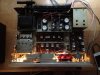
  • 5000A overhead naked.jpg
    5000A overhead naked.jpg
    95.5 KB · Views: 23
Hmm, I don't equate cap coupling with poor and constricted midrange. Some of the best examples, like the Marantz 2230, are cap coupled and widely acclaimed. I have a 5000A also, but it's in storage at the moment. It's stock. I enjoyed it when I last had it hooked up. Keep us updated!
 
Constricted might be too strong a word. Still, this Sansui sounds different than any other amp I've owned, a number approaching 40.
 
I know what you are talking about. Can I ask a couple questions?

What size and type caps did you use on the outputs?
What kind of caps did you use in the signal path, ie. coupling between stages, etc?
 
Sorry for the delay in response...

For PSU I did 3300uF/100V and output caps are 2200uF/100V. I stayed with original or very close values for all the other caps.

I checked just about every ground I could reach and all are good. Checking bias on the amp seems weird, looking over multiple posts on "setting" the bias. I, like some other fellows got no reading at all when trying to check Bias as outlined in the service manual.

I know you (Trnsfmr) recommended a simple measure of about 42V from output cap positive to ground (if I take your meaning correctly) but I am not sure what VR to adjust! I have the new boards (F-6013) and would guess to use the inboard VR (VR802) but I'm a bit of a scaredycat ;-!

I think (I'm guessing that's all) putting in new transistors on that F-6013 board for TR804 and TR805 has the gain hopped up! I used Sanken 2sc4883/2sa1859. I can barely touch the volume knob before the volume is way too loud on some smallish bookshelf 90dB/W, 6 Ohm speakers. OR it's a dirty PSU...
 
There are two adjustments on each output board. One adjusts bias current, and the other offset (the 42v adjustment). There are two fuses accessible on the back panel, this is the HV feed to each output. After playing loud for a while and well warmed up, you put your ammeter across the fuse terminals and remove the fuse. Then you will be measuring bias current at no signal. you set the bias to whatever the spec is. I think 12 ma, but it varies a bit depending on the model. If you don't know which trimpot does it, turn one, then the other and you will see. I don't have a f-6013 board here to look at.

Once you have set the bias, the other trimpot will do the offset, which you can set to the 42v figure (or half the rail voltage), measuring at the + input to the output cap. You can measure the rail voltage at the same fuse where you set bias. I hope this helps.

As to your concerns about how your 5000A sounds, I would like to make a recommendation about the output caps. They tremendously affect the sound quality. We have restored a bunch of these cap coupled amps and have found through experimentation that a much bigger cap is better, at least 10,000uf. We have also found that caps made for switching power supply use, normally called "snap in" caps have the ideal parameters for a cap coupled amp. They are designed for high frequency and high current. Here's a link to one
http://www.mouser.com/ProductDetail...=sGAEpiMZZMtZ1n0r9vR22TrbYqu733AyP8H3CesvQsc=

I also posted a thread earlier about replacing signal path caps in a 5000X. Since then we have also done this with a 5000A, and it is truly an outstanding upgrade for this amp. You might want to take a look here
http://audiokarma.org/forums/index.php?threads/film-caps-from-input-to-output.717241/
 
Outstanding you guys, highly usable input for making things better. Many thanks!

I am going to try the very high uF output caps and a change caps on the input board to see what effect appears :-)

I'll also start a new thread about the AU-919 and a second on the other tiny things I don't understand about the 5000A, I don't want this thread to wander too much.

I'm really enjoying the work on this 5000A now that I am making progress. I'd be dead in the water without all the help. Again, thanks so much!

I Will report back on the cap changes... ;-)
 
OK, I have an update :-)

Trnfmr, I tried both your recommendations for cap swap. I found the tiny Wima's to be excellent. This is after hearing very good Nichicon KA's in that position so it's a proper A/B test. It Was a challenge to get them in place but worth it: just a bit more clarity on the top, voices are sweet and instruments have better decay characteristics. Recommended :-)

I also tried some 10,000uF caps at the output. I did not keep them in place long. It is not a fair test thusly; I should have been more patient. The Nichicon KG "super through" (2200uF/100V) were so much better already I did not want to wait to see if the 10,000uF could beat them. This amp does not lack for bass! I also feel a little better keeping more to the original specs...

Patience and good advice kept me from giving up. Lesson learned. This is a very good receiver worth all the effort! Thank you all so much for helping me through the rough spots. Sansui was "on their game" way back in 1970 :-)

Cheers!
 
Back
Top Bottom