
• The move to the new server is done. There are some software and database maintenance updates in process. This has us passing the hat around to help out. We appreciate any donations. Seriously, even a dollar helps. The payment page may be found here - https://www.audiokarma.org/support.html

Sansui QRX-5500A First look and impressions

KeithD

AK Subscriber
Subscriber
Picked up a QRX-5500A from a nice seller on e-bay. I really enjoy Sansui quad and have the first and last variations: QR-6500 and 4500 (first Sansui Quad receivers) and QRX-8001 (last line of Sansui quad receivers). So, what I was missing was what happened in the middle as Sansui quad technology evolved. I've been keeping my eye out for something in the QRX-6500/5500 or 5500A line. The 5500A (and 7500A) were the last modification before the last iteration of quad processing that was used in the QRX-x001 line.

Anyrate, this one arrived safely, and looked promising with all knobs there, lights working, good case, etc. (but needing an external cleaning.)
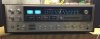
C2918E04-3D9C-4280-9A13-D6EEEB47FC40_1_201_a.jpeg
Everything appeared to work on first power up, first on DBT, then on mains power. Had the normal scratchy pots, but nothing unexpected. External was dirty but a good cleaning of the face/knobs would solve that. Reconditioning the wood case was also in order. Took off the cover. I expected some dirt, but this was a surprise:
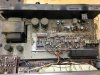
C97ED8F8-E109-458B-86C0-D8F7DDDEFB8F.jpeg
When I saw that, I was surprised there wasn't a dust fire when I turned it on! Fortunately, it cleaned well with an artist's brush and vacuum hose followed by wet washcloth for large areas and some electronics cleaner and q-tips for the small spots.
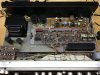
3AD4C203-AAAF-4277-ADB6-62359F5C664F.jpeg
Cleaned the tuner and did and alignment. Definitely needed it, as I was not getting any medium strength stations, and the dial pointer was off by about .5 MHz FM. Reception improved substantially with the alignment. Not a very sophisticated tuner, but it does the job as well as other Sansui receiver tuners I've had.

After a number of hours of testing, it became very apparent there was a background hiss on the rear channels that only appeared when using one of the modes that passed through the quad boards. There was no hiss on the 4 channel direct setting, so I knew this was not in the amplifier section. This receiver uses the same Vario-Matrix board as the non-A versions (F-2048), but for the second processing board it has and updated board (F-2084), hence the "A" designation. The only receivers that had this combination of quad boards are the QRX-7500A, 5500A, and 5001. After looking at the SM, these two boards have multiple 2SA726 and 2SC1312 transistors. :( Very likely one or more of these were the source of hiss. The F-2084 had three 2SC1312 transistors, whereas the F-2048 has 16 726/1312 transistors, so easiest path forward was to replace the transistors on F-2084 with KSC1845F.
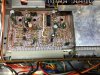
0C3B515A-3558-4A84-9388-F05E9D186C69.jpeg
One thing I have to say about the design of this receiver, everything is very accessible. The quad boards are plugin cards, and the bracket holding the cards can be removed with just three screws. Very nice! :thumbsup:

Popped the board back in, check on DBT, then full main. The hiss was greatly reduced to the point where it's equal to what I'm getting on the front channels, which isn't much. I suspect changing the transistors on F-2048 will take care of the rest of that.

Connected everything up and put some of my "test music" through. No noticeable hiss on the speakers between CD tracks. However, I got a pleasant surprise: the channel separation made a noticeable improvement - much closer, if not equal to what I get with the QRX-8001! :rockon:

I was hoping for a reduction in the hiss, but was not expecting any change or even improvement in separation. Very nice, indeed. Makes me wonder what replacing the transistors on the F-2048 will do? Wish I had a better understanding and there was more documentation of exactly what each board does, and which quad modes are processed through each circuit. At least there are good replacements for all of these old components, so we'll see what happens with further rehab. ;)
 
Last edited:
Register to hide this ad
Forgot to mention a couple of other initial surprises. I had the unit on for a while initially before I thought to check the voltage selector. The decal on the side of the case says 220V, so thought I'd better check. Good thing I did, it was set to 100V. :crazy: So, moved that to the 117V position.

Second, DC offset was pretty good, but the bias was about double what the SM calls for, which is 25±1 ma. I found the bias for all four channels set to about 52 ma. No idea why that was. Can't imagine the amp drifted that much over time, or is there a typo in the SM?

Screen Shot 2023-05-27 at 8.53.13 PM.png

An any rate, I set the bias to 25 ma on all channels. Trimmers worked well, so left the originals in at this point.
 
Got one years ago. but have never touched it. Might have to part company with it let some else enjoy the magic
 
Picked up a QRX-5500A from a nice seller on e-bay. I really enjoy Sansui quad and have the first and last variations: QR-6500 and 4500 (first Sansui Quad receivers) and QRX-8001 (last line of Sansui quad receivers). So, what I was missing was what happened in the middle as Sansui quad technology evolved. I've been keeping my eye out for something in the QRX-6500/5500 or 5500A line. The 5500A (and 7500A) were the last modification before the last iteration of quad processing that was used in the QRX-x001 line.

Anyrate, this one arrived safely, and looked promising with all knobs there, lights working, good case, etc. (but needing an external cleaning.)

View attachment 2897159
Everything appeared to work on first power up, first on DBT, then on mains power. Had the normal scratchy pots, but nothing unexpected. External was dirty but a good cleaning of the face/knobs would solve that. Reconditioning the wood case was also in order. Took off the cover. I expected some dirt, but this was a surprise:

View attachment 2897163
When I saw that, I was surprised there wasn't a dust fire when I turned it on! Fortunately, it cleaned well with an artist's brush and vacuum hose followed by wet washcloth for large areas and some electronics cleaner and q-tips for the small spots.

View attachment 2897164
Cleaned the tuner and did and alignment. Definitely needed it, as I was not getting any medium strength stations, and the dial pointer was off by about .5 MHz FM. Reception improved substantially with the alignment. Not a very sophisticated tuner, but it does the job as well as other Sansui receiver tuners I've had.

After a number of hours of testing, it became very apparent there was a background hiss on the rear channels that only appeared when using one of the modes that passed through the quad boards. There was no hiss on the 4 channel direct setting, so I knew this was not in the amplifier section. This receiver uses the same Vario-Matrix board as the non-A versions (F-2048), but for the second processing board it has and updated board (F-2084), hence the "A" designation. The only receivers that had this combination of quad boards are the QRX-7500A, 5500A, and 5001. After looking at the SM, these two boards have multiple 2SA726 and 2SC1312 transistors. :( Very likely one or more of these were the source of hiss. The F-2084 had three 2SC1312 transistors, whereas the F-2048 has 16 726/1312 transistors, so easiest path forward was to replace the transistors on F-2084 with KSC1845F.

View attachment 2897176
One thing I have to say about the design of this receiver, everything is very accessible. The quad boards are plugin cards, and the bracket holding the cards can be removed with just three screws. Very nice! :thumbsup:

Popped the board back in, check on DBT, then full main. The hiss was greatly reduced to the point where it's equal to what I'm getting on the front channels, which isn't much. I suspect changing the transistors on F-2048 will take care of the rest of that.

Connected everything up and put some of my "test music" through. No noticeable hiss on the speakers between CD tracks. However, I got a pleasant surprise: the channel separation made a noticeable improvement - much closer, if not equal to what I get with the QRX-8001! :rockon:

I was hoping for a reduction in the hiss, but was not expecting any change or even improvement in separation. Very nice, indeed. Makes me wonder what replacing the transistors on the F-2048 will do? Wish I had a better understanding and there was more documentation of exactly what each board does, and which quad modes are processed through each circuit. At least there are good replacements for all of these old components, so we'll see what happens with further rehab. ;)
Nice one!!
I have done restorations on two QRX7500, I always thought they were excellent units, well engineered and very well built.
Quite modular and easy to work on...
I remember being very impressed with it when the job was done.
I've got a 7500 parts unit that actually works, maybe I should sort it out and get it running!!

I've done the same, replacing transistors galore to get try and get rid of hiss, can't remember which ones specifically but sounded similar to what you were doing....
I remember having to replace a transistor in the VU meter drive circuit, they use an extremely high gain transistor to drive the meters hfe of about 800 from memory...
I like the meters on these units because they are actually proper VU meters and not just power output meters....
 
Nice one!!
I have done restorations on two QRX7500, I always thought they were excellent units, well engineered and very well built.
Quite modular and easy to work on...
I remember being very impressed with it when the job was done.
I've got a 7500 parts unit that actually works, maybe I should sort it out and get it running!!

I've done the same, replacing transistors galore to get try and get rid of hiss, can't remember which ones specifically but sounded similar to what you were doing....
I remember having to replace a transistor in the VU meter drive circuit, they use an extremely high gain transistor to drive the meters hfe of about 800 from memory...
I like the meters on these units because they are actually proper VU meters and not just power output meters....
Agree all around, Kev. The more I listen and work on it, the more impressed I am with it.

I did not realize until I got the unit that the Level Set knob does not just control the meter leves, it's actually a second "volume" knob. So, you set the "Level" first, then use the volume knob to set the output level.

Also agree I like the VU meters better than the power meters on the 8001/9001. The power meters are nice and look good, but unless you are playing the music loud, they barely move. I confess, I do like seeing those meters move! :)
 
Agree all around, Kev. The more I listen and work on it, the more impressed I am with it.

I did not realize until I got the unit that the Level Set knob does not just control the meter leves, it's actually a second "volume" knob. So, you set the "Level" first, then use the volume knob to set the output level.

Also agree I like the VU meters better than the power meters on the 8001/9001. The power meters are nice and look good, but unless you are playing the music loud, they barely move. I confess, I do like seeing those meters move! :)
I think they are some of Sansui's highest quality built units.
Get yourself a 7500A if you ever come across one, they are a beast!!
Yes, the pre-amp output level is a game changer, I really like that control. You can drive the pre-amp at its optimum signal to noise setting, then use the main volume after that....

Maybe check that to see if its set too low and you're turning up the noise floor....
 
I'm going to ask a pedantic question here. Is the only difference between the 5500/7500 and their respective A variants the one improved quad decoder board and the color of the dial scale/meters (green versus blue)? I ask because I kind of like the green/red color scheme of the 7500, and if I ever got one would be curious to know if upgrading it functionally to an A version is just a matter of swapping that one board. Or are there other differences that make that board swap inadvisable/impossible?
 
I think they are some of Sansui's highest quality built units.
Get yourself a 7500A if you ever come across one, they are a beast!!
Yes, the pre-amp output level is a game changer, I really like that control. You can drive the pre-amp at its optimum signal to noise setting, then use the main volume after that....

Maybe check that to see if its set too low and you're turning up the noise floor....

There are some interesting comparisons between the 5500A and 7500A (same comparison between 5500 and 7500). With the 7500 you get CD-4 capability (missing from the 5500), but you give up quite a bit of versatility built into the 5500:

1. For functions, the 5500 has 2 channel, QS Synthesizer Hall and Surround, QS Regular Matrix Hall and Surround, Phase Matrix (QS), and 4 channel discreet. In comparison, the 7500 leaves out the "Hall" effect completely.

2. On the 5500 you have a "Direction" selector, which allows you to rotate the sound field 90 degrees either way or 180 degrees. This feature is absent from the 7500.

3. On the tone controls, with the 5500 you can set L and R separately for each channel. On the 7500 there is no L or R individual control.

4. Last, the 5500 has two independent AUX inputs. On the 7500 there are two AUX inputs, but one is designated "High" (200 mV sensitivity) and one "Low" (100 mV sensitivity) and there is only one AUX setting on the Selector switch, so apparently, only one of the two sets of AUX inputs can be used.

Those differences are why I chose to go with a 5500 (A and non-A versions are the same for these features) rather than a 7500. I have no use for CD-4, and I like the added versatility of the 5500, even if I don't use all of the features.

I too like the Level set. I thought it was going to be just for the meters, but am thrilled it controls the overall volume level as an added feature.

Agree if you turn the level set down to about 9 O'clock, I don't get any background noise, but then little to no "bouncing" meters. :no: A setting between around 11 and 12 O'clock seems to fit most sources to use the range of the meters. As I mentioned, my background hiss is very low now - nearly inaudible, and none on either 2 channel or 4 channel discrete mode, so I'm sure the issue is old transistors on the F-2048 board.
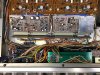
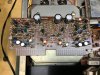
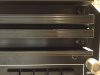
Quite frankly, I think the QRX-5500 is very underrated, and I'm surprised by how cheap they sell here in the U.S. I will do much more listening, but with the upgraded transistors on F-2084 the synthesized surround effect is very close or identical to what I get from the 80001.
 
I'm going to ask a pedantic question here. Is the only difference between the 5500/7500 and their respective A variants the one improved quad decoder board and the color of the dial scale/meters (green versus blue)? I ask because I kind of like the green/red color scheme of the 7500, and if I ever got one would be curious to know if upgrading it functionally to an A version is just a matter of swapping that one board. Or are there other differences that make that board swap inadvisable/impossible?

Quick look at the service manual for the 5500 and 5500A shows that the tuner board is different: F-1479 in the 5500 vs. F-1517 in the 5500A. However, other than that, the only difference I see is the F2047 quad board in the 5500 vs. the F-2084 board in the 5500A.

However, no idea if you could just swap those quad boards. It's not obvious to me at all that the pin-outs or power requirements are the same.
 
Ok, thanks fo giving that a look. It is a bit too much to assume a direct swap could be made of the F2047 for the F2084 board. I'd have to get service manuals for both models and compare them side by side. The fact the tuner is different is curious, I wonder what was upgraded/changed? These were decent enough tuners, but not high specification or performance, so not sure why Sansui would've spent the money to redo the tuner boards in the A variants.

I'm not really looking for another quad receiver (or any receiver really) at the moment, so it is kind of a moot point. But I will keep in mind the benefits of the 5500(A) compared to the 7500(A) you pointed out, just in case a good deal on one should find me.
 
There are some interesting comparisons between the 5500A and 7500A (same comparison between 5500 and 7500). With the 7500 you get CD-4 capability (missing from the 5500), but you give up quite a bit of versatility built into the 5500:

1. For functions, the 5500 has 2 channel, QS Synthesizer Hall and Surround, QS Regular Matrix Hall and Surround, Phase Matrix (QS), and 4 channel discreet. In comparison, the 7500 leaves out the "Hall" effect completely.

2. On the 5500 you have a "Direction" selector, which allows you to rotate the sound field 90 degrees either way or 180 degrees. This feature is absent from the 7500.

3. On the tone controls, with the 5500 you can set L and R separately for each channel. On the 7500 there is no L or R individual control.

4. Last, the 5500 has two independent AUX inputs. On the 7500 there are two AUX inputs, but one is designated "High" (200 mV sensitivity) and one "Low" (100 mV sensitivity) and there is only one AUX setting on the Selector switch, so apparently, only one of the two sets of AUX inputs can be used.

Those differences are why I chose to go with a 5500 (A and non-A versions are the same for these features) rather than a 7500. I have no use for CD-4, and I like the added versatility of the 5500, even if I don't use all of the features.

I too like the Level set. I thought it was going to be just for the meters, but am thrilled it controls the overall volume level as an added feature.

Agree if you turn the level set down to about 9 O'clock, I don't get any background noise, but then little to no "bouncing" meters. :no: A setting between around 11 and 12 O'clock seems to fit most sources to use the range of the meters. As I mentioned, my background hiss is very low now - nearly inaudible, and none on either 2 channel or 4 channel discrete mode, so I'm sure the issue is old transistors on the F-2048 board.
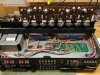
Quite frankly, I think the QRX-5500 is very underrated, and I'm surprised by how cheap they sell here in the U.S. I will do much more listening, but with the upgraded transistors on F-2084 the synthesized surround effect is very close or identical to what I get from the 80001.
Yes the 5500 is a well appointed unit, a sleeper in the lineup!!
The direction adjustment is a great feature, if you didn't need the extra power of the 5500, it has everything you need really...
I do remember now noting that the 7500A is a bit short of inputs, the extra AUX input is definitely needed!!

The FM tuner might be a more substantial unit in the 7500, I can't be sure though, they all do work quite well from memory...
 
To illustrated how easy this receiver is to work on, three screws hold the bracket for the pcb with the sockets for the quad boards. Once these screws are removed, the whole assembly slides back enough to clear the metal brackets holding the top of each board in place. Here' I'm showing the quad board assembly pulled out from the top brackets.

IMG_1676.jpg

Each board then can be removed from the plug-in connector individually.

IMG_1679.jpg

The driver board/OT/Heatsink are all one assembly that is easily removed. Five screws on the back of the heatsink hold the assembly in place. Here are two of the screws on one end of the heatsink.

IMG_1677.jpg

Then the entire assembly slides out as one unit giving full access to all components. Nice! :thumbsup:

IMG_1678.jpg
 
Heh. That's a long way from servicing an 8001/9001, no doubt. Sometimes I am suitably impressed at the design considerations Sansui made in terms of access/service. At others, I have to wonder what the hell they were thinking.
 
Heh. That's a long way from servicing an 8001/9001, no doubt. Sometimes I am suitably impressed at the design considerations Sansui made in terms of access/service. At others, I have to wonder what the hell they were thinking.
Agree. I can only assume they never thought anyone would need to service the double sided board with all those pass throughs on the 9001/8001. Pulling the driver board assembly on the 5500/7500 also gives you direct access to the foil side of the PS board (showing in the picture).

However, in my limited experience with Pioneer and Kenwood from the same era, Sansui was miles ahead of what those manufactures were doing in terms of how their amplifiers/receivers were built. I had several Pioneers when I first started in this hobby, and they were all nightmares to service. No plugin boards in any of the units I had, and all those wirewrap connectors! Many feel the SX-x50 series of receivers was the best of Pioneer offerings in the 70's. But when you look at how they were built, the only receiver with plug in cards is the SX-1250. All the rest don't have a single plugin card, and most of the boards are held in place with plastic clips rather than screwed to the chassis.
 
Replaced all transistors on F-2048 quad board and lost front left channel sound in all of the "processed" quad settings :eek: (normal sound in 2 channel and 4 channel discreet settings - in those settings the signal does not pass through the quad boards). After a few hours trouble shooting narrowing down where the signal was getting lost, I came upon this thread that documents the board printing is incorrect for TR05 and TR08: E and C are swapped from what is printed on the board! :crazy: After swapping legs on those two transistors, all back to normal! After listening tests to ensure all was good, I continued on with a recap of the board. It must also be noted that the board marking for C09 is also backward:
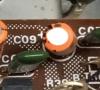
Screen Shot 2023-06-08 at 6.13.43 AM.png

Paying attention to those board printing errors will save a lot of grief if you refurb an F-2048 board! :thumbsup:
 
Long term impressions.

After rehabbing the two quad boards, I decided to place the QRX-5500A in my main quad system and remove my QRX-8001 for some more re-capping in the power supply as preventive maintenance. The 5500A has been in use ever since. Background noise is dead silent. The clarity is wonderful without being harsh. There is something about the sound of this unit that I can't quite describe, but it is there. It is so pleasing that I may not put my QRX-8001 back in the main quad system! When I couple the sound with the versatility built into this receiver, I'm hard pressed to come up with a reason to rotate in any other Sansui quad unit.

In listening tests, the main difference I could hear in synthesized quad between the 5500A and 8001, is in the Hall setting. I think there is a bit more effect with the 8001, but honestly it's very subtle, and the 5500A Hall setting is in no way unpleasant, maybe just a bit different. I can't say I heard anything different in the Surround setting between the 8001 and 5500A. I also did some listening with SQ material, and I think the 5500A is a bit better. No idea why that should be, but I was noticing more channel specific sounds in the 5500A. Maybe this is because I rehabbed the quad processing boards in the 5500A and have not touched the quad boards in the 8001.

All the rest works wonderfully on the 5500A. I've become very used to the "Level Set" adjustment, and can really dial in the optimal combination of level and the overall volume with the volume knob. And of course, you can also optimize the VU meters! I've got loads of inputs on the 5500A, and the option to rotate the sound is very handy at times. With the two AUX inputs I'm able to connect a 4 channel SACD player and a regular CD player. Three tape in/out and two phono inputs means I won't be running out of options any time soon. Again, i just can't come up with a reason to put the 8001 back in the main quad system. I may have found nirvana!
 
Starting the restoration of this receiver. Just re-capped the driver board, replaced differential pair transistors 2SA726 -> KSA992F. All went well. Don't have the right replacement trimmers on hand, so will need to order those.

Looking at the filter caps (C705, 706), they are 10,000 µF 35V. I've found Kemet replacements of the right diameter (40 mm), but wondering if I should be thinking about upping the capacitance here?
 
Love this thread. Still have one on my bucket list. Less common than the QRX-5500 in my part of the world.
 
Last edited:
Starting the restoration of this receiver. Just re-capped the driver board, replaced differential pair transistors 2SA726 -> KSA992F. All went well. Don't have the right replacement trimmers on hand, so will need to order those.

Looking at the filter caps (C705, 706), they are 10,000 µF 35V. I've found Kemet replacements of the right diameter (40 mm), but wondering if I should be thinking about upping the capacitance here?
I don't think it really matters, or that you will be able to hear it. The cap brand you choose might have more influence with its "house sound".
 
I don't think it really matters, or that you will be able to hear it. The cap brand you choose might have more influence with its "house sound".
Thanks, selection is pretty limited for cap brand if I want caps that fit the metal holders. Kemet is about the only option for 10,000 µF caps. Might be more possibilities if I go up in capacitance...
 
Back
Top Bottom